

It’s tempting to think of a new season as a blank slate. But each new season is intrinsically a coda to the one just past. This is especially true of the 2026 Padres who are navigating the ripples from a 2025 offseason which saw high-visibility departures of on-field talent, prominent coaching turnover, and end-of-season financial revelations that cast the Padres, and indeed all of MLB, in the long shadow of the spending juggernaut Los Angeles Dodgers. But there is one way in which the 2026 season is truly a blank slate: it will see the launch of the long awaited ABS (Automated Ball-Strike) challenge system. To understand what that means, it’s useful to compare case studies from the end of the 2025 postseason with the team’s first week of Spring Training.
Last Call?
In the final game of the Padres 2025 postseason, they entered the 9th inning down by three runs against the Cubs. Although Cubs reliever Brad Keller had labored through a 20 pitch 8th inning, their bullpen had already burned five arms earlier in the game, and Keller was asked to stretch for another inning to close out the series.
Jackson Merrill led off, and with the count 1-1, catcher Carson Kelly called for a changeup low and away:
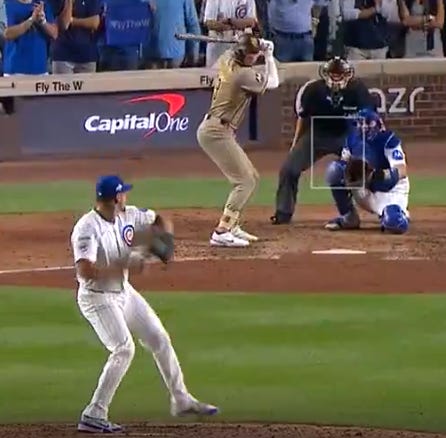
But Keller, running on fumes, missed catastrophically with location, leaving the changeup over the inner half of the plate:
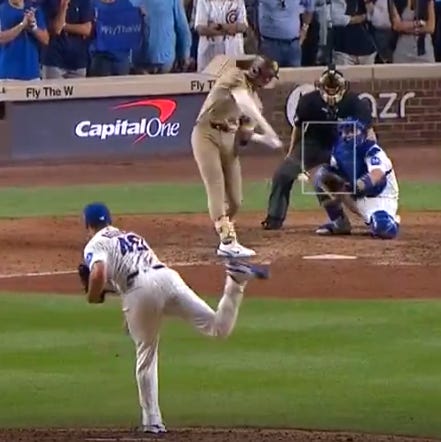
Merrill didn’t miss:
A bullpen with options might have treated this as a sentinel event and pulled Keller before further calamity ensued. But every arm the Cubs had was overtaxed, and Keller was asked to soldier on.
Xander Bogaerts was up next with no outs and the tying run on deck. Keller ran the count full, throwing three uncompetitive pitches with two strikes just catching the edge of the plate:
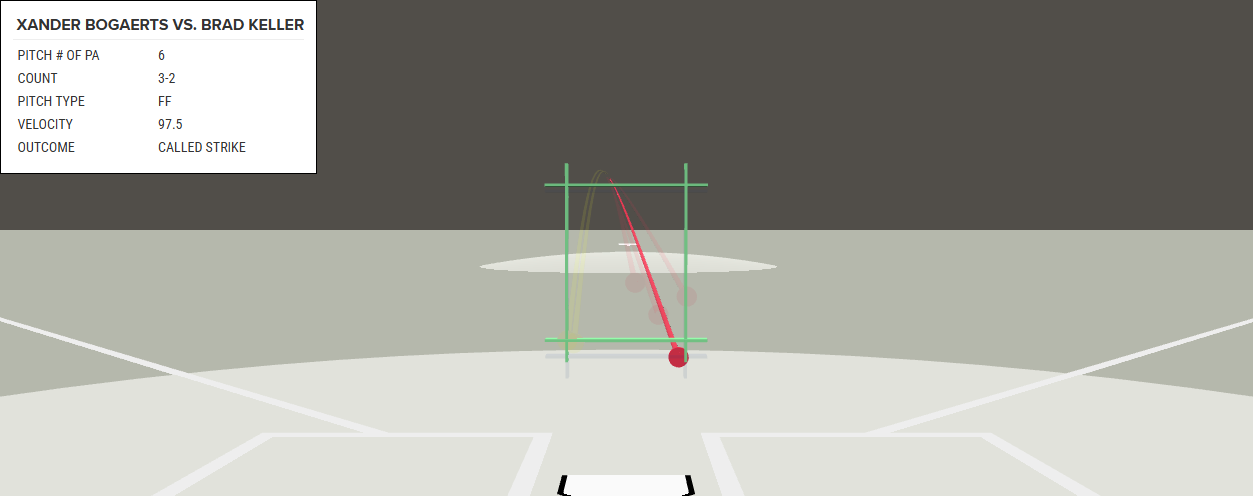
The sliding doors moment came on 3-2, with Keller still struggling badly with control, a pitch roughly a baseball’s width below the zone was called strike three. Perhaps the last call to ever so meaningfully impact a 9th inning at bat in an elimination game without the possibility of a challenge:
This at-bat was dissected immediately through the lens of the forthcoming ABS system. Some suggested the broadcast strike zone box was misleading. But a definitive evaluation showed that indeed the 2026 ABS system would have overturned this call:
Instead of a runner on first with no outs, the Padres had one out and the bases empty. Keller then fully unraveled, hitting Ryan O’Hearn and Bryce Johnson after very uncompetitive pitches out of the zone:
Keller’s meltdown forced the Cubs’ hand and they brought in a gassed Andrew Kittredge who had just enough left to induce a grounder from Jake Cronenworth, out by inches at first, and a hard-hit fly ball from Freddy Fermin that died in the windy Chicago night to end the Padres season.
Sage observers will correctly note that the missed call to Bogaerts can’t be presumed to have made the difference in the game. A correctly called ball does not guarantee two HBPs and a bases-loaded, no outs situation for Cronenworth. That’s a timeline we’ll never see. But we don’t have to know how these particular events would have unfolded to estimate the impact such a call has on win probability generally.
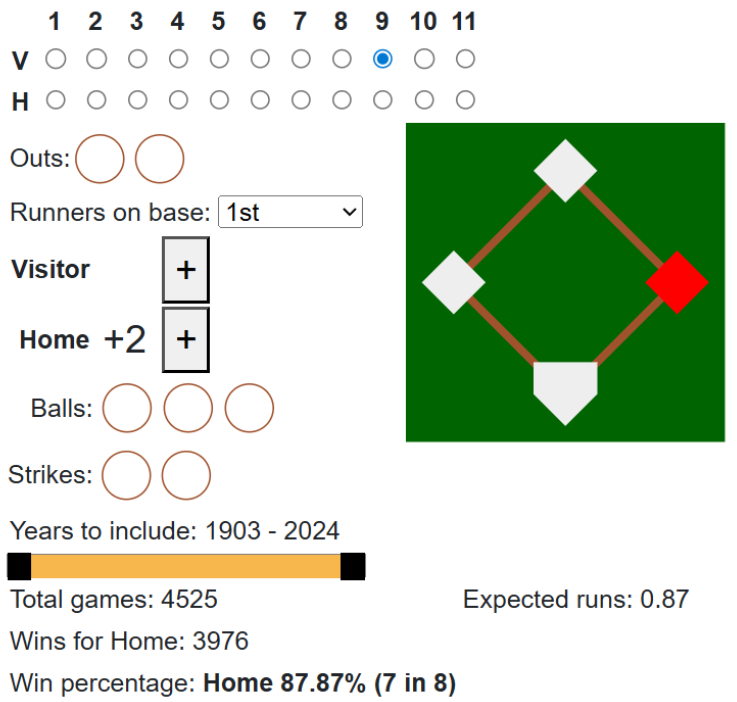
Bogaerts’ called strike created a base/out state of one out and bases empty. In the 9th inning, down by two runs, teams only have a win probability of 2.5% and a run expectancy for the inning of 0.26 runs.
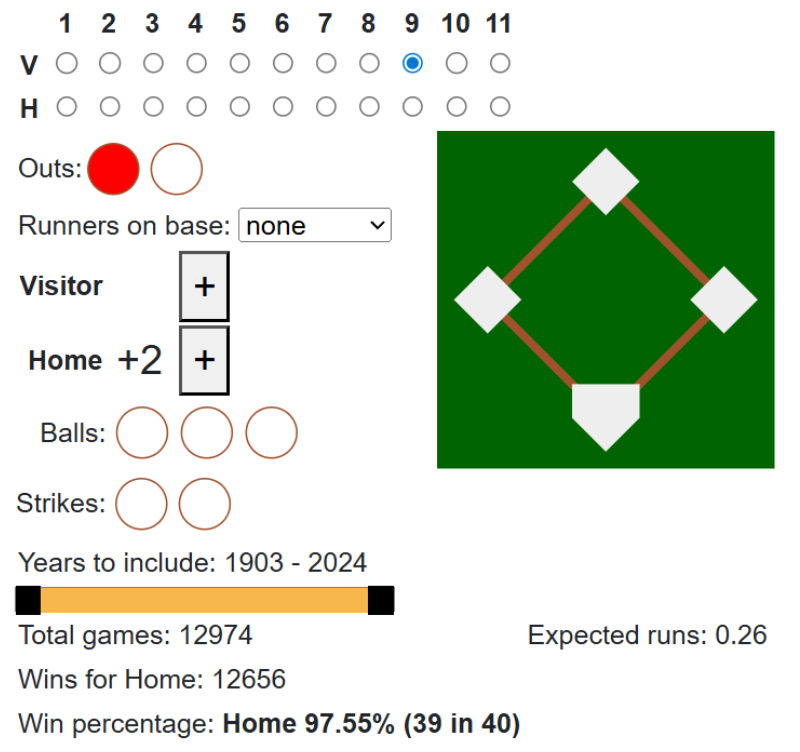
But a correct call would have left a runner on first with no outs, a base/out state that increases the trailing team’s chance to come back to win to 12.1% with a run expectancy of 0.87 runs:
The point here isn’t to air a grievance. The Padres’ season didn’t come down to a bad call (or at least we can’t know that it did). The point is how profoundly impactful a single missed call can be. Here is the net result of the strike call made in the 2025 true timeline, and that of the 2026 hypothetical in which ABS correctly overturns the missed call:
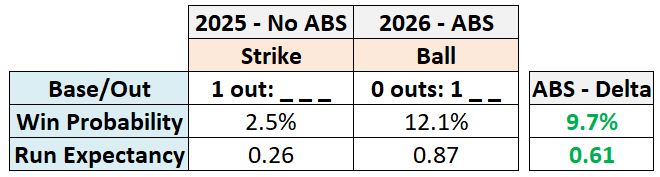
The single missed call subtracted nearly 10% win probability. Projected across 162 games, that is a difference of 16 wins. It changed the run expectancy by 0.61 runs. That’s almost 100 runs across an entire season.
Of course, Bogaerts’ at-bat came in particularly high leverage, and not every game will have a pivotal moment like that.
But some will.
And in 2026 teams will get two of these challenges per game. Plus they retain each challenge that is successful…
The ABS challenge system isn’t just a measure to improve the integrity of ball/strike calls, it’s a strategic asset teams need to be thinking about very seriously. It’s impactful enough that it will swing a few games a year for every team. The best organizations will covet these challenges as a source of competitive differentiation. And they will identify that the addition of ABS has added a new skill to evaluate.
Skill Trees
Statcast has an ABS dashboard, and interestingly the El Paso Chihuahuas’ hitters led the minors in 2025 in successful ABS challenges, avoiding 21 strikeouts and earning 16 walks for their efforts across 185 challenges. It’s hard to know if this implies an organizational emphasis. But it’s unquestionably a new skill for the modern major leaguer.
There are two skill trees teams must consider:
Strike-zone acuity: The skill of the batter/catcher/pitcher1 in estimating if a pitch caught the strike zone, and
Situational leverage awareness: Understanding when the expected value of a challenge justifies the attempt
The first point is intuitive, the league will learn which players demonstrate true strike-zone acuity. The second point is less intuitive, but likely more impactful. The first week of spring training provided a very good look at what the Padres brass should be focused on.
Close Calls
Luis Campusano made the first ABS challenge for the 2026 Padres on the first day of Spring Training:
This was a strike by perhaps a millimeter:
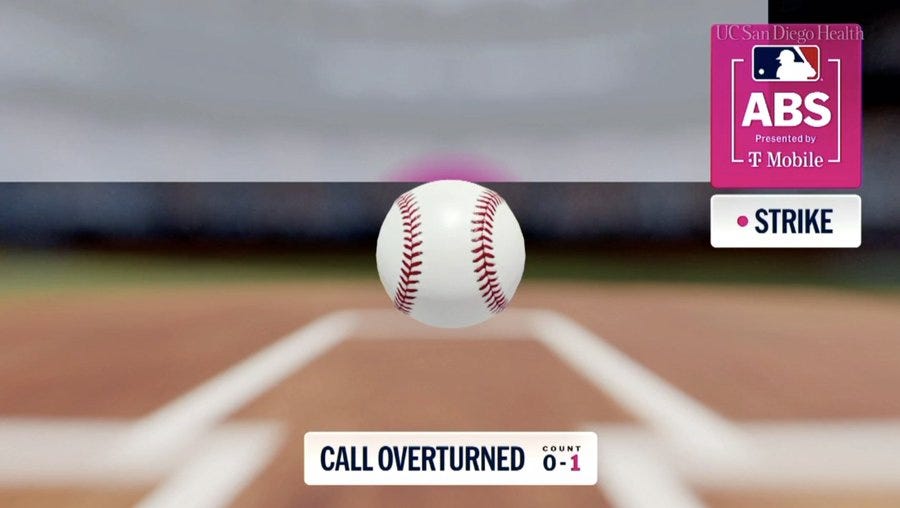
It’s hard to believe that this was an extremely high confidence challenge. Maybe it was. More importantly, though, even if Campusano believed strongly in the challenge, it was clearly a far less impactful challenge than the hypothetical Xander Bogaerts example.
Campusano’s challenge came in the bottom of the 2nd in a 0-0 game with two outs and a runner on first, with the count 1-0 after the missed call. Campusano’s successful challenge shifted the count to 0-1 with no change in the base/out state. Here is the impact this challenge had on the Padres win probability and run expectancy allowed:
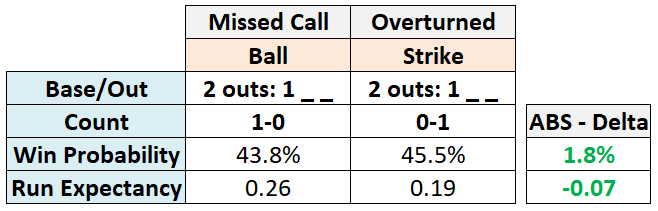
Regardless of Campusano’s confidence in his challenge, the maximum impact it would have on the team’s win probability is only 1.8%, and less than a tenth of a run saved. This is an important strategic implication. The expected value of a challenge changes drastically depending on game context. This isn’t to say Campusano’s challenge was a bad one; it’s Spring Training, the stakes are low and experiential knowledge is valuable. But was it a game theory optimal use of an ABS challenge? We can approach that question using expected value.
High Confidence, Low Value
There’s gory math in the footnotes2 for the sickos, but we’ll use a very simple expected value calculation for Campusano’s decision to challenge that illustrates the high confidence strategy. Say Campusano had a 75% confidence that the umpire had missed the call despite how close it was. Correctly overturning the missed call would yield the 1.8% increase in win probability to the Padres. The expected value of Campusano’s decision to challenge would be:
EV = (75%) * 1.8% = 1.35%
Before the ABS verdict is rendered Campusano should expect that his decision to challenge will increase the Padres win probability by 1.35%. That’s good. A nightly increase in win probability of 1.35% can accrue two extra wins across a season. But we can really start to learn the game theory optimal (GTO) ABS strategy by comparing Campusano’s decision to a nearly identical pitch challenge that arose later in the week.
Low Confidence, High Value
A challenge by Ty France during Wednesday’s Spring Training matchup against the Angels showed another angle of the GTO ABS strategy: There will be instances when it is strategically superior to challenge a call with low confidence in an overturn when there is high leverage on a close outcome.
With two outs in the bottom of the 6th the Padres were up 2-1 with the bases loaded, and France took a 1-2 pitch for a called strike three, ending the inning. But the pitch was close and France challenged:
This was another incredibly close challenge. It was ruled a ball by less than 0.1 inches:
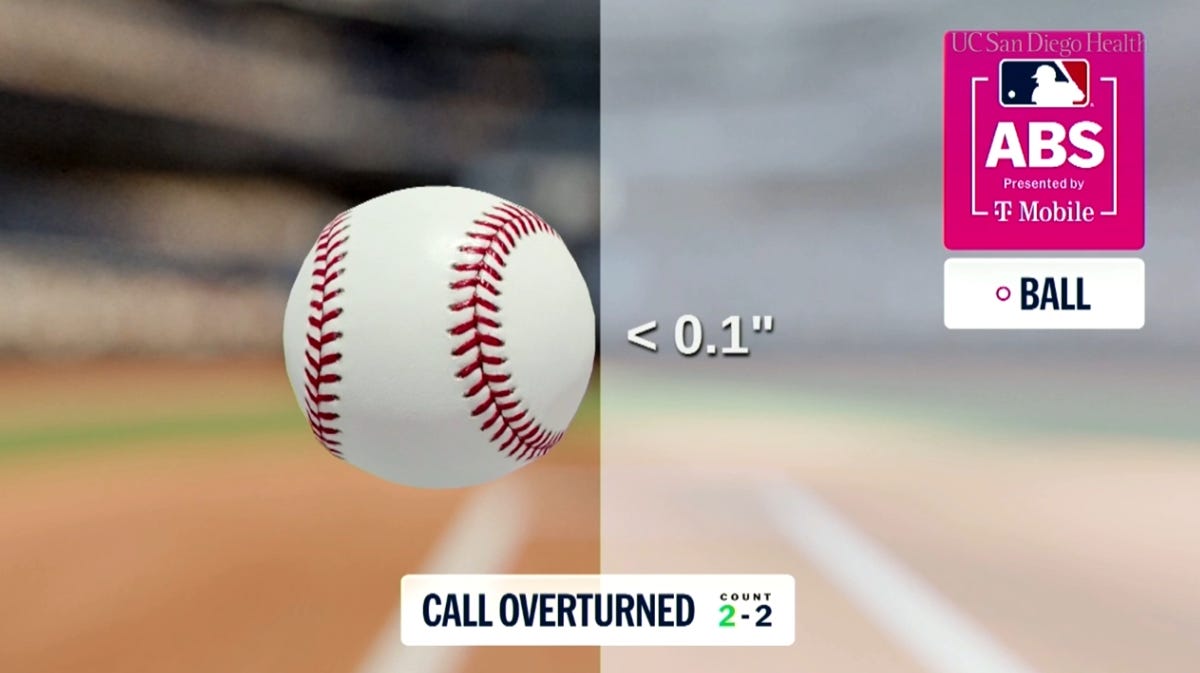
Again, it’s hard to believe this was a high confidence challenge by France, the call was overturned by a sliver of daylight similar to Campusano’s challenge. But a key difference is that there was massive leverage on this call. In this instance the overturned call meant that instead of a rally killing, inning ending strikeout with zero runs scored, France got to see another pitch with the bases loaded. Here is the impact France’s challenge had on the Padres win probability and run expectancy:
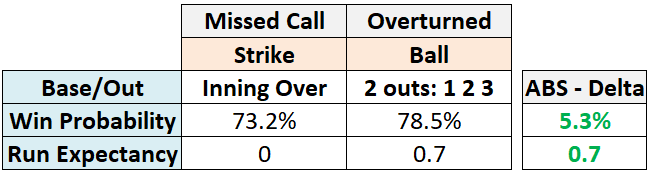
The impact of the potential overturn in France’s at bat carried almost three times the swing in win probability (5.3% vs 1.8%), and ten times the swing in run expectancy (0.7 vs 0.07) as the potential overturn in Campusano’s challenge. On very similar close strike calls.
The implication here is that France could have far less confidence in an overturn, and still have higher expected value from his decision than Campusano. If France had been only 30% confident that the umpire had missed the call, but recognized the higher leverage of the situation, he could have intuited that he should still challenge:
EV = (30%) * 5.3% = 1.59%
For Campusano’s challenge to yield the same 1.59% expected value he would need to have 88% confidence in an overturn on an identically close pitch. It’s hard to imagine that the skill gap in strike-zone acuity between players will be this wide. More importantly, players’ true talent level at discerning missed ball/strike calls won’t be known for some time. And until it is more clearly understood, it’s highest yield for teams to focus on instilling situational heuristics. Campusano’s decision to challenge was acceptable if he had high confidence in the call being overturned, but France’s decision was close to a no-brainer, even low confidence in an overturn still carried similar expected value.
As it turned out, the Padres capitalized on France’s successful challenge and reaped a huge swing in win probability.
They ended the inning up 4-1 instead of 2-1, their win probability stretched to 91.7%, an 18.5% swing. But if you’ve followed so far you can understand why France’s decision was a good one even before it worked out so splendidly.
Skill Building
There is certainly skill building players can be doing right now. ABS will be customized to a player’s dimensions, and every hitter should be memorizing their height-based vertical bands. But it’s simply going to take time for repetitions to accrue and players’ true strike-zone acuity talent levels to emerge. No such time is required for the game theory to be analyzed. While it’s unrealistic to expect players to be doing Bayesian mathematics during a game, they don’t have to. Much like the NFL instills heuristics into its players on use of timeouts, when to automatically attempt a play on fourth down etc. Teams can be instilling ABS heuristics right now. Certain situations already can be inferred to be very low threshold for challenge (late in game, two strikes, two outs, bases loaded), and very high threshold to challenge (early in game, bases empty etc.). Getting very good at utilizing ABS challenges, very quickly, should be an imperative for a team whose hopes of competing rely heavily on the marginal decisions they make. Decisions they control.
Only the batter, catcher, or pitcher, may call for an ABS challenge immediately after the call; No help from the dugout or other players on the field is allowed.
Calculating the game theory optimal decision for a given situation using the expected value of an overturned call and the expected cost of attempting a challenge would look something like this:
Expected value = p(missed call) * ΔV
p(missed call): posterior probability the umpire call is wrong (based on player strike zone acuity/pitch location etc.)
ΔV: the value swing from “call stands” to “call overturned,” (measured in win probability or run expectancy etc.) for the current base/out/count state. The situational leverage.
Expected cost = (1−p(missed call)) * λ (c, t)
λ(c, t) is the shadow value (expected marginal win probability), of having remaining challenges, given state c (how many challenges left: 2 vs 1 vs 0) and t (how much future game is left + leverage environment ). Think of it as the potential win probability preserved by keeping a challenge for future use, but the marginal value increases the fewer challenges remain due to the change in optionality. So λ (1, t) > λ (2, t), and λ (0, t) would only occur if it were effectively a challenge on what would otherwise be the final pitch of the game. None of this is worth actually calculating in our opinion, but feel free to impress us in the comments.
GTO policy is to challenge when: p(missed call) * ΔV > (1−p(missed call)) * λ(c, t)
Another Masterclass. I feel guilty for not paying for this. Please put up a paywall or something that we can use to support your work
Welcome back, and thanks for getting into the weeds on a topic I've been thinking about quite a bit.