
Timing Is Everything
On Manny Machado, swing timing, and the difference between absolution and understanding.

“Just say I suck… You don’t need to say, ‘Oh, this, this and this.’ No, it’s that my numbers suck.”
-Manny Machado
Manny Machado spoke candidly with Kevin Acee about his miserable season last week, and he offered some tangible insight into the struggles he’s had on the field. And he made no excuses. It’s easy to conflate explanations with excuses, but they are fundamentally different. An explanation tells you why something happened. An excuse tells you why someone should not be blamed for it. Machado is not asking for absolution; he’s not blaming anyone else. He’s searching for the causes of an unrecognizably poor performance at the plate this season. And we think there are, in fact, explanations that go beyond the simplistic, and anxiety-provoking, diagnosis that Manny Machado is becoming Manny Washado.
Trapdoor Season
Machado’s 2026 line is not merely below his career standard. After an 0-3 day on Tuesday Machado has a slash line of .175/.255/.354, good for a .609 OPS and an unthinkable 72 wRC+. This is a result unmoored from his prior production. He’s only a season removed from posting a 123 wRC+, and he’s never come in lower than a 102 wRC+ in a full season. His previous low water mark came in his rookie year with a 97 wRC+. This isn’t the incremental drop in production that might be seen when a star player is aging out. This is a trapdoor season. The bottom fell out. And it’s fair to ask, why?
In Acee’s piece, the substance of what Machado revealed was significant: he made swing changes in the offseason, including work with Richard Schenck, known in hitting circles as “Teacherman.” Acee described Schenck’s general philosophy as emphasizing:
staying on the back leg, coiling up the body, letting the ball go as deep as possible and then unleashing a swing as fast as possible.
A swing philosophy can be a perfect fit for certain hitters, and a poor fit for others. It may simply be more difficult for some hitters to incorporate the mechanics at major-league game-speed. Schenck is most famous for working extensively with Aaron Judge, and those results speak for themselves. It’s likely he’s a wonderful hitting coach. Machado’s offseason work with Schenck is relevant, but not because this article needs to litigate the Teacherman hitting philosophy. The takeaway is that Machado tried to incorporate mechanical changes seeking improvement, but it simply hasn’t worked. Instead he’s struggled, and Machado has linked his offseason mechanical changes to his struggles in 2026, and is actively working to find his previous form.
Machado noted other factors including an abbreviated Spring Training may have played a role. Acee summarized thusly:
So, in short, his timing got messed up by the changes he made. Then he missed half of spring training while playing in the WBC.
By all accounts, he has worked feverishly since March to get back to his usual mechanics.
Nothing in Acee’s account reads as excuse making. The article displayed Machado genuinely looking for explanations, and emphatically denying that any explanation would excuse his on field performance. And coincidentally, the same week Acee’s article was published, Baseball Savant made public a set of swing timing metrics that for the first time ever allow us a granular way to evaluate how a hitter’s swing is meeting the baseball in time and space. And here we can test Machado’s intuitions about what may be wrong.
The Timing Microscope
Baseball Savant’s swing timing metrics provide an unprecedented look at the degree to which hitters are “On Time” with their swings, as well as several other measures describing the hitter’s quality of contact. A quick look at Machado’s swing timing on fastballs in 2026 shows some interesting findings.

Machado’s flawed swing percentage on fastballs has been 9%, a significant increase from a season ago. A flawed swing is one which is neither on time, lined up, or centered:

A spike in flawed swings screams mechanical issue. But interestingly, the data showed no change in overall On Time swing percentage with a stable 68% on time swing rate year-over-year. And this is where it’s helpful to visualize the swing data, because this metric can be a little misleading.
“On time” sounds binary, but it is not. Baseball Savant defines “On Time” as a 16-millisecond window encapsulating the eight milliseconds before, and eight milliseconds after perfectly timed contact. At major-league fastball velocity, that is not a trivial span. A swing near the early edge of that window and a swing near the late edge of that window both count as “on time.” But they are not the same swing, and they do not produce the same batted-ball geometry. Here is the density plot for Machado’s swings on fastballs (four-seam and sinker) in 2026 (teal) and in 2025 (orange):
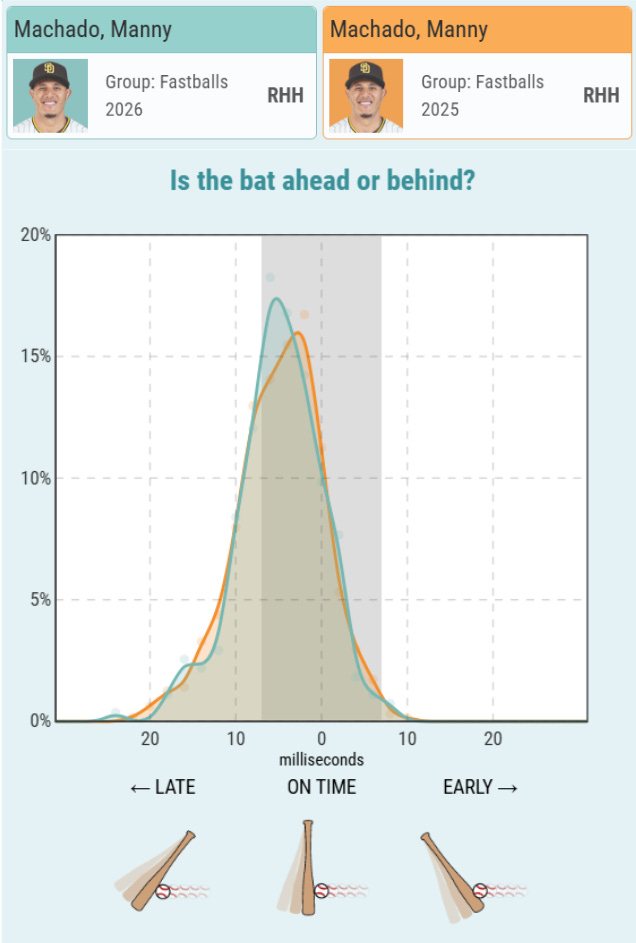
The density plot format isn’t the most intuitive. It becomes more intuitive when you parse the data down to the outcome of interest; what has happened at the point of contact when Machado has been ‘On Time’ against fastballs in 2026?
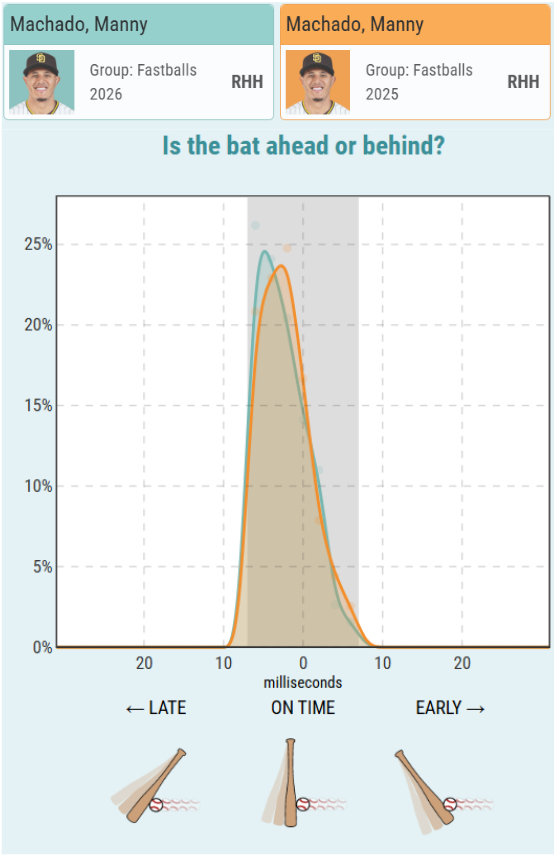
Here it stands out more plainly. Even when he’s been on time with swings against the fastball in 2026, the point of contact has skewed to the late side of the 16 millisecond window considered “On Time”. This doesn’t look like much. The skew here is no more than a few milliseconds to the ‘late’ side of the on time window. But as we wrote when discussing Tatis’ similar struggles with swing timing, at 95 mph, a baseball travels roughly 1.67 inches per millisecond. Just a few milliseconds of swing timing can have profound impact on the contact geometry. The interesting thing is not merely whether Machado is technically “on time” more or less often than he was last year. The interesting thing is where inside the on-time window those swings are clustering. If his on-time swings against fastballs are disproportionately living on the later side of that band, he is not necessarily embarrassingly late. But he may be late enough to lose the perfect point of contact that turns a hard swing into the most desirable batted-ball outcomes.
Subtle timing changes like this can help explain why a season can go wrong without the hitter looking broken in the obvious ways. The swing-path framework explains why. Attack angle (the vertical direction of the sweet spot at impact) and attack direction (the horizontal pull/opposite-field direction of the sweet spot at impact) are tied to swing timing: earlier swings tend to produce more pull-side attack direction and higher attack angle, while later swings tend to move the other way. A deeper point of contact can move the attack direction toward the opposite field. It can reduce the launch conditions that create pull-side loft. It can turn a hard swing into contact that is much easier for the park and the defense to swallow.
So if Machado has identified that offseason mechanical changes may have inadvertently led to his swing timing going awry, why doesn’t he just decide to go back to his old mechanics?
Training Decisions
At the level of major league baseball, ‘swing decisions’ are not really decisions in the ordinary conscious sense. They are trained motor programs being accessed under severe time pressure. The motor-control literature on hitting in baseball has long treated the swing as a severely time-constrained action involving pre-programmed movement:
(H)itting involves using an open-loop, pre-programmed movement that is parameterized based on situational probabilities, advance cues from the pitcher’s delivery, and information early in the ball flight, which are used by an internal model to predict the future location of the ball
What we call a ‘swing decision’ is really a hitter accessing trained reflexes. That is why ‘just stop doing it’ is not a serious prescription for a hitter whose swing mechanics are out of sync. If Machado spent the offseason conditioning his body to get to the ball a certain way, he cannot simply choose different mechanics. His body is accessing what it has trained itself to do. And it’s not trivial to retrain that in season. It is not impossible. But it never happens overnight.
There’s at least one further variable with explanatory power: the pitching environment.
Speed Kills
The modern game has compressed the hitter’s decision window to a degree that makes small timing deviations catastrophic, because average pitch velocities have never been higher.
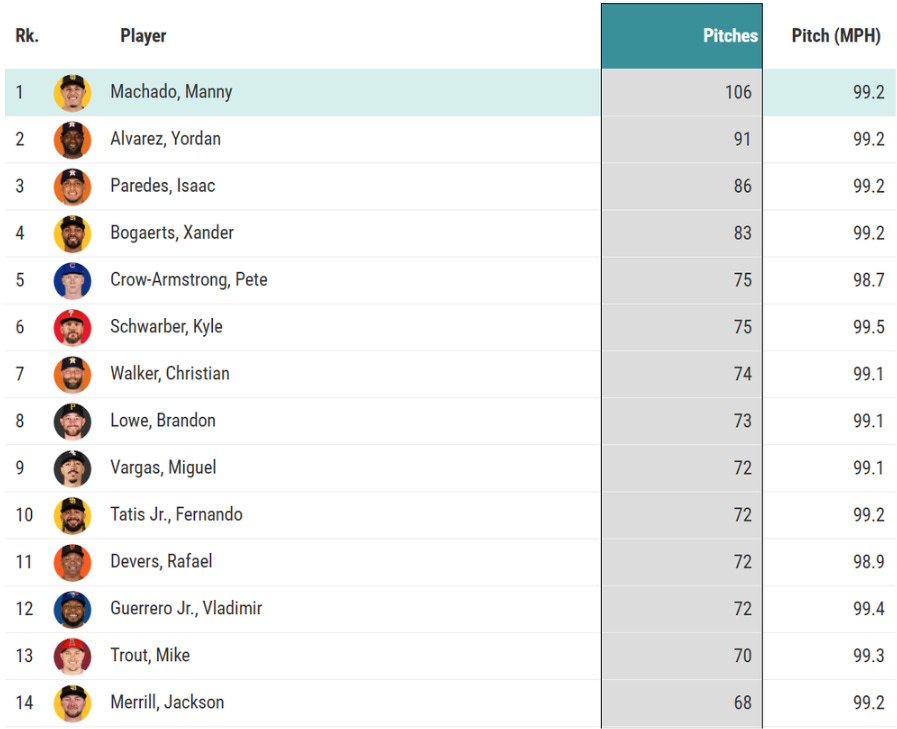
Tom Verducci recently framed Machado’s plight aptly. In Machado’s 2013 season, the average fastball he saw was 92.1 MPH. In 2026 it has been 95.5 MPH. Even more striking, Machado saw only 27 pitches at 98 MPH or harder in 2013, while in 2026 he’s already seen 106 such pitches (a 238 pitch pace).
Machado in fact leads MLB in total pitches seen at 98+ MPH (and there are some familiar faces on the leaderboard with him):
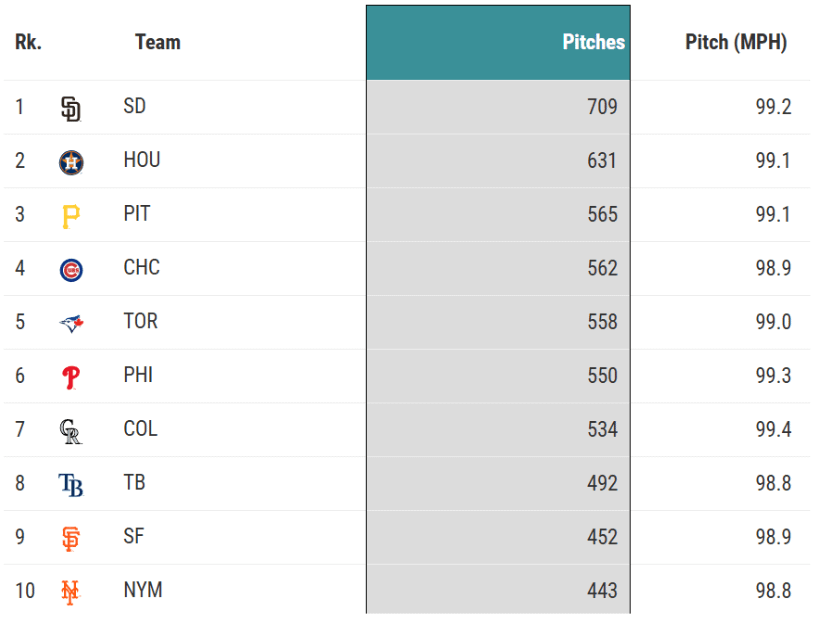
The Padres as a team have faced the most extreme fastball velocity in the league, seeing 709 pitches of 98 MPH+, almost 500 more than the lowest team in the league (Tigers have seen only 212):
That is the context in which Machado’s mechanical timing issue has to be understood. Velocity faced might not be the primary cause of a slump, but it can be a major amplifier of one. It narrows the margin for mechanical experimentation. It can be the difference between being technically “on time” and being perfectly squared up.
The pitching environment is likely to normalize with the outsized share of high velocity the Padres have faced being replaced by more typical opponent velocities as the season goes by. But it’s fair to question exactly how much this might improve Machado’s prospects unless the root mechanical cause is first addressed.
There’s a final factor, one that Machado did not invoke, but likely adds incremental explanatory power to Machado’s mystifying season: Petco Park
Park Factor
This is where the analysis veers dangerously close to excuse territory, because there is literally nothing a player can do about playing in their home park. But we raise this not to find excuses for Machado, but simply to help better understand the 2026 season generally.
The distinction between actual and expected contact outcomes is important when looking at park-factor. Petco has produced an above league average expected wOBA on contact which is calculated based on the exit velocity and launch angle of a ball in play. But Petco has produced disproportionately poor actual wOBA on contact. There are several reasons why otherwise favorable exit velocity and launch angles might not turn into the expected production in Petco, primarily deep power-alley dimensions, and atmospherics. Some combination of these factors has led to Petco Park being the most suppressive park in baseball when balls are hit into play, allowing a wOBA on contact park-factor of 88:
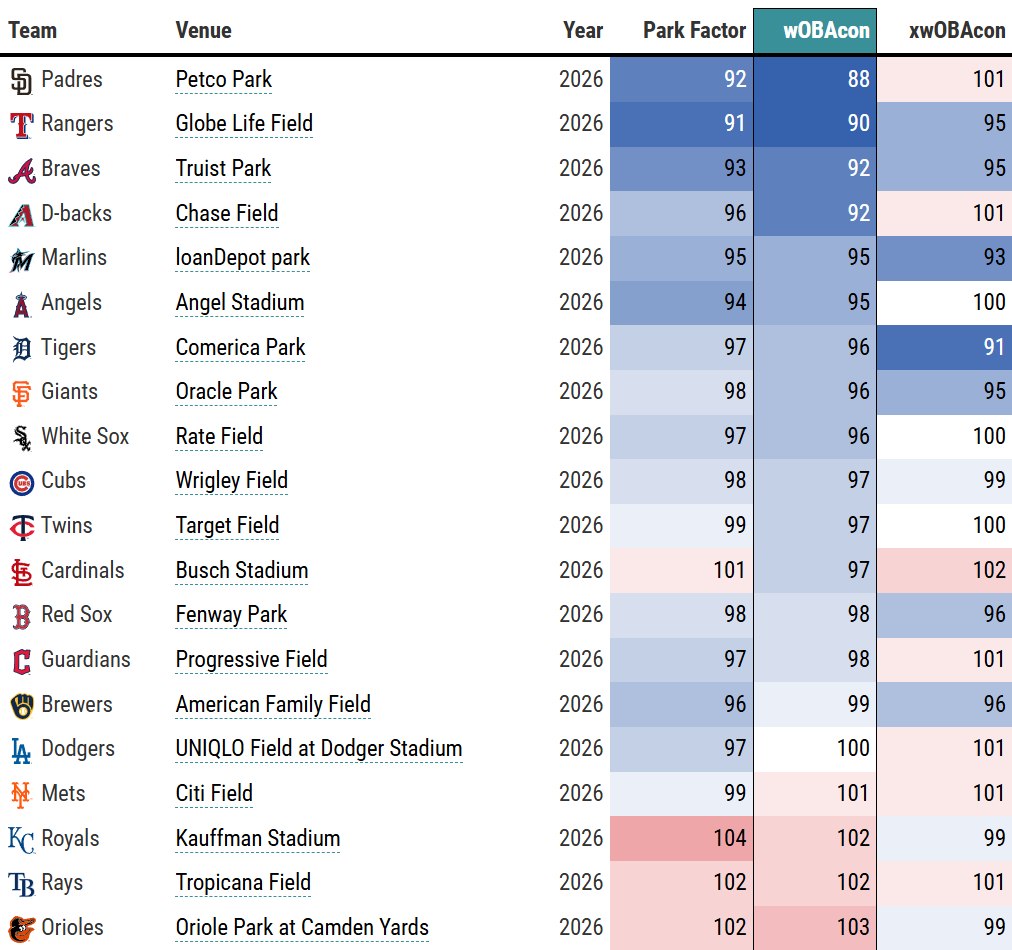
For reference, no park in MLB has had a wOBA on contact park-factor of less than 92 across the past three seasons (Globe Life Field).
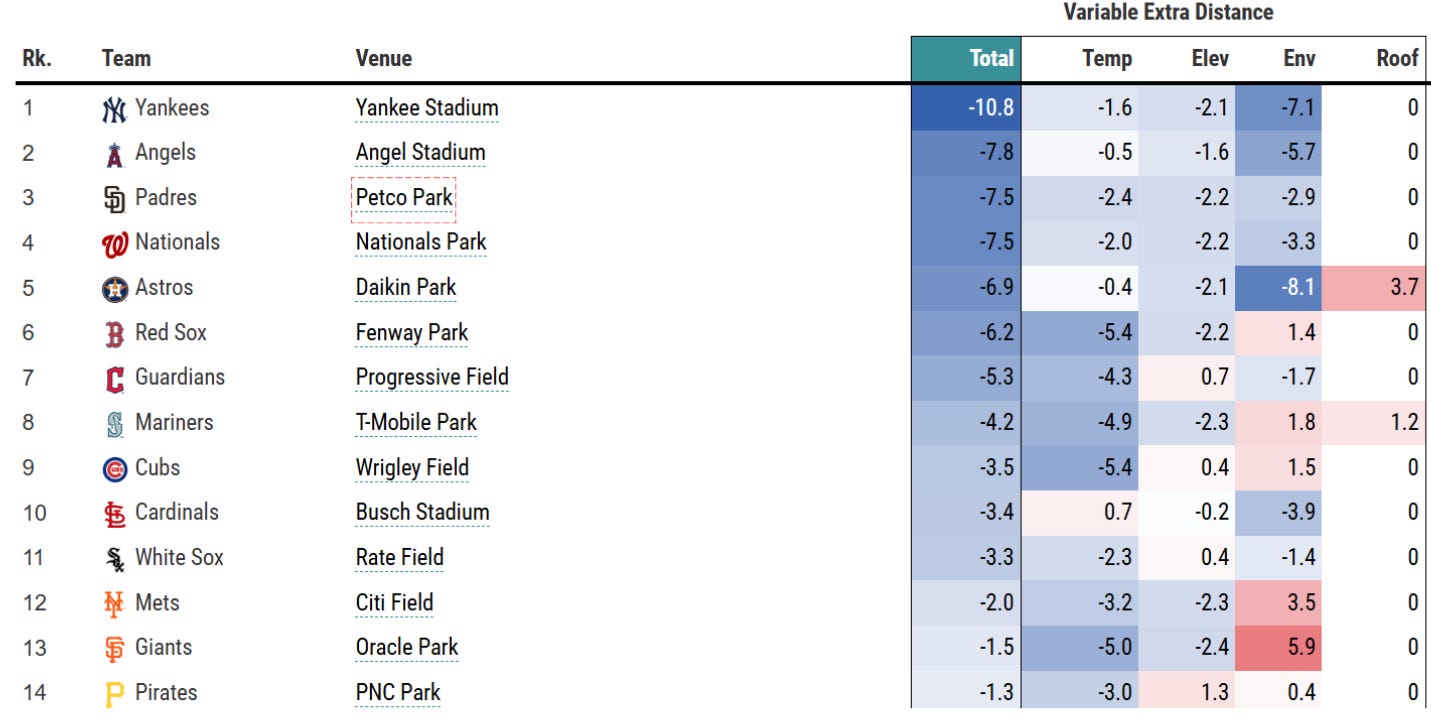
The suppression of wOBA on contact in Petco this season is almost certainly due to the profound fly ball distance suppression, which has averaged -7.5 feet in 2026:
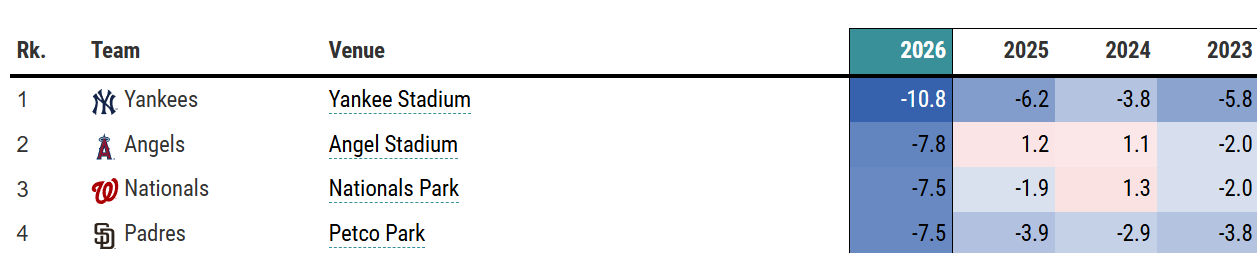
This is extreme flyball suppression even for Petco which hasn’t played worse than -3.9 feet of variable extra distance the past three seasons:
Park-factor does not explain why Machado’s swing has been off. It helps explain why the consequences have been so severe.
We can never say which specific hits might have been suppressed by the lost fly ball distance, but we can identify some good candidates. Here is a flyout to center field that Machado hit 104.3 MPH with a 31 degree launch angle:
Here’s a hit by Ben Rice to the same part of the outfield with nearly identical launch ballistics, but in Tropicana Field which has a variable added distance park-factor of +2.6 feet:
This ball travelled ~13 feet further than Machado’s flyout, a span roughly equal to the difference in the variable added distance on fly balls in Petco versus Tropicana Field (net +10.1 feet in Tropicana Field).
The difference between “badly underperforming” and “falling off a cliff” can be a handful of balls dying at the track, becoming near-miss contact instead of damage. And that’s all we’re talking about here. Petco’s role here is likely only marginal, helping to explain why Machado’s falloff has appeared so extreme. The bulk of the explanatory power is more likely within mechanical asynchrony and pitching environment. But it all adds up.
Time Is Undefeated
There is a haunting line in Moneyball about David Justice near the end of his career:
After he would hit a long fly ball, Justice would return to the A’s dugout and say, matter-of-factly, “That used to be out.”
Manny Machado is at a stage in his career where any prolonged slump is naturally going to raise concerns about whether his struggles are due to simply aging out. That time will come. Time is undefeated. There’s no way to prove it hasn’t already taken another victim. But it doesn’t seem likely that Manny Machado woke up at 33 and simply stopped being Manny Machado. Aging usually announces itself as erosion, a steadily downward slope. This season has not looked like a slope. It has looked like a cliff. And cliffs often imply a discrete change has been made.
The Baseball Savant swing timing tools allow a quantifiable confirmation that Machado’s intuition, that his swing timing has gone awry, is at least part of the explanation. Add an extreme velocity pitching environment that further constrains the flawed mechanical timing window and the slump gets worse. Layer on top of that the difficulty of retraining a swing in season, when the “decision” to swing is really the accessing of conditioned reflex, and the slump recovery is prolonged. Play half the games in a ballpark that has punished actual contact outcomes on a historical pace this season and the slump tips that final increment from underperformance into cratering. Put all these factors together and the shape of Machado’s season seems less mysterious. It doesn’t excuse anything. And it probably doesn’t explain everything. But it explains more than the lazy alternative:

That does not mean age is irrelevant. It means age is not the most satisfying explanation for this particular failure pattern. From what we can see, Machado’s struggles appear far more likely to be explained by the confluence of factors above. Timing is everything. And his swing timing has, demonstrably, been out of sync. It’s the first identification of something that can actually be improved on. And we’d wager that before the season is over, Machado’s wRC+ will again resemble that of a major-league third baseman. That’s not a terribly high bar, but with nearly half the season banked it’s exceedingly unlikely a typical Machado wRC+ is in reach. This will be Machado’s worst offensive season even if/when he returns to form.
The Question
The question looming over Machado’s season is not merely whether he can regain effective swing timing. The superseding question is whether he can find it soon enough that there is still a season to play for when he gets right. That’s something no one can know. And it depends on far more than Manny Machado alone. But time will tell. Until then all we can do is keep watching. And keep the faith.
I hope you are right but a few things give me pause. The start of this swooning seemed to start last year. His wRC+ in August was 70, then 85 for September. Maybe noise after a great first half, but troubling. He had an okay April at 104, then 46 for May, and 54 thus far in June.
Another is his bat speed percentile. Unhelpfully this has only been tracked since 2023, but in 2023 he 96th percentile, then 90th percentile in 2024, 84th in 2025 and 76th this year. 76th gets a light red color on Statcast, so thinking "not too bad" but assuming 2023 was representative of his earlier career, his hitting approach for his career had to be influenced by having elite bat speed. Can he adjust his hitting to be a useful hitter with less power/fast swing? Not sure. Also nagging is that maybe he tried to alter his swing to compensate for his declining bat speed/power. Going to Judge's coach makes sense. However, I imagine re-working a swing after having used a different approach successfully for his career has to be hard but the fact he was willing to try suggests he is concerned. And it didn't take.
If he could emulate Judge's bat speed, that would be incredible. Judge's 33 yo season he was still at 99%; this year it dropped to "only" 93% but this is the first decline seen in the data. His wRC+ is 148, pretty darn good, but given the range of the prior four seasons was 173-220, with 3 of those years over 200, 148 might be mildly concerning.
Maybe a pessimist on this because when we re-signed him, I remember seeing all those expensive mid to late 30s seasons with dread. Same with Bogaerts. AJ/Seidler built the team to win it all at some point between 2021-2025 but, despite having good teams, that did not happen.
If Machado stays on this decline and we similar, if slower, decline in Bogaerts, it is hard to see us being a legitimate contender, especially with the patchwork starting we have had to contend with. If Pivetta and Musgrove can come back to elite form, maybe but we are going to be shouldering a lot of essentially dead money without much support coming from the minors. Unclear if the new owners are ready to pay the needed money support a fractured rosters.
"This isn’t the incremental drop in production that might be seen when a star player is aging out. This is a trapdoor season. The bottom fell out. And it’s fair to ask, why?"
Faulty premise, and the answer is as simple as 07/06/1992.
Decline is seldom linear, and the cliff approaches ominously for every hitter. Take a look at Manny's ten most similar hitters through age 32 and you'll see a couple of contemporaries whose decline has yet to happen (don't hold your breath, Phillie and Indian fans), the legendarily ageless Beltre, and a bunch of Hall of Famers or near- HOFers who were pretty much never worth a shit at the plate after age 32. Life is cruel and unfair, but it's easier to suffer the slings and arrows when you're about to enter the $39mm AAV portion of your contract. He'll work his tail off to be the Manny of old, but it will be to no avail.