

The runup to the trade deadline had been somewhat subdued compared to years past, but in the early morning on July 31st it finally detonated. The first of several shocking trades orchestrated by AJ Preller ignited what would become the most chaotic trade deadline in MLB history. Now the dust is settling and a very clear picture of the Padres strategy has emerged.
Sammy Levitt summarized the day’s dealings:
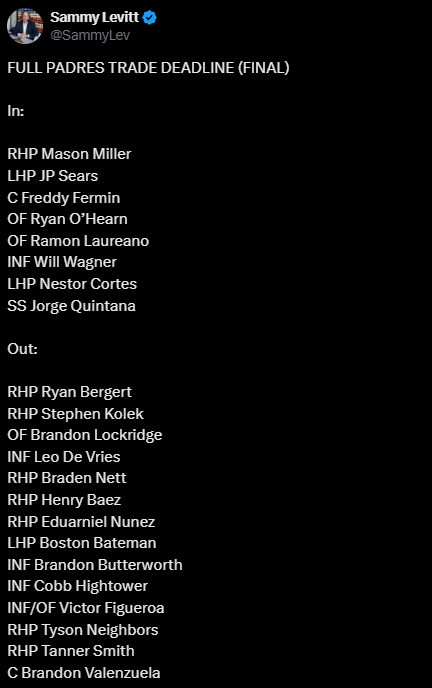
There is no shortage of coverage of, and reaction to, the individual trades. The outflow of future value is undeniably immense. But so too is the influx of major league talent. Here we’ll only consider how the headline players fit with the roster. And it’s remarkable how clean the fit is.
Mason Miller
Miller’s acquisition sparked speculation that Preller may be willing to move another reliever, but he made clear afterward that his intention was to have Miller join the Padres already dominant bullpen. Mason Miller is the preeminent flamethrowing closer in baseball. His season ERA of 3.76 belies his dominance. He hasn’t given up an earned run since June 19th. He’s struck out 58 batters in 38.1 innings pitched. And he does it with the best fastball in the league. His four-seamer regularly reaches 103 MPH, and it has an unusually large amount of horizontal break averaging 8.6 inches to the arm side. The velocity and movement is on display in this offering to Trea Turner:
He pairs the four-seamer with a hard slider that also has well above average 8.9 inches of horizontal break to the glove side and separates from the fastball by 17 inches on the vertical plane. This combination creates the need for hitters to cover the entire plate. Miller’s numbers against lefties have been slightly worse in 2025 owing to some early season outings, but in 2024 he was actually more effective against lefties. You can see the dilemma lefties face in a pair of at bats by Brandon Marsh. In this matchup Miller got the strikeout with a high four-seamer that Marsh was hopelessly late on:
Here, in the same count, Miller goes to the slider with the same tunneling as the four-seamer:
Marsh just didn’t have time to recognize the spin, and the two-plane separation makes a defensive swing impossible to execute.
Miller is a truly elite pitcher who can shut down the very best lineups in baseball. He made 11 appearances in 2024 in which he recorded five outs or more. His addition to the Padres bullpen shortens games by an additional inning. Any inning the Padres choose. Miller’s addition gives the Padres an unrivaled ability to lock down games in which they reach an early lead. Even if that lead is 1-0, the combination of Miller, Jeremiah Estrada, Adrian Morejon, Jason Adam, and Robert Suarez can plausibly shut down the opposition after the starting pitcher gets through three innings. That won’t be a game plan the Padres go to often in the regular season. But it is absolutely something they will go to if the need arises in the post-season.
JP Sears
The Athletics also sent JP Sears, a lefty starter with a six-pitch mix and a track record of durability. It’s likely that Sears will be used to pick up rotation starts during the regular season. Something that will be interesting to watch is the effect of changing home ballparks. Sears is a very flyball heavy pitcher who has been playing in the scorching hot minor league confines in Sacramento which has been second only to Coors Field in the variable extra distance added to fly balls:
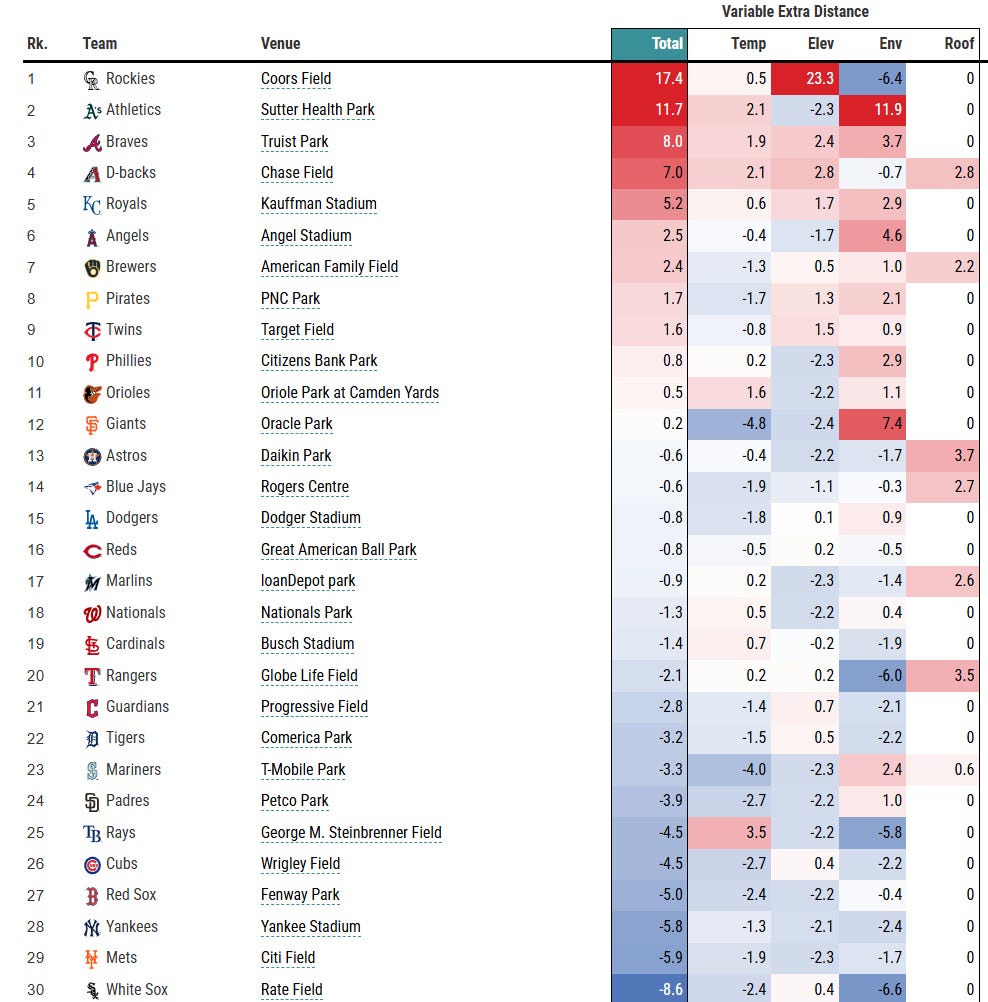
Coming to Petco with its notorious flyball suppression, and a strong outfield defense is likely to add to his effectiveness. Sears has been excellent against opposing lineups the first time through the order, but like most starters his effectiveness has waned through successive trips through the order:

It’s very interesting to consider the optionality Sears gives the Padres as an opener, especially because of a trade that didn’t happen.
The Trade That Didn’t Happen
Dylan Cease generated a lot of interest at the trade deadline but is staying with the Padres. Despite his down year, he has maintained a dominant performance the first time through the order:
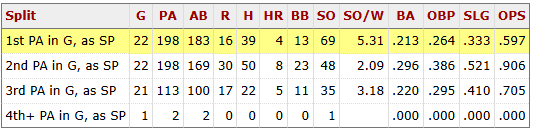
From a game theory perspective pairing two pitchers with effective first time through performance, throwing from opposite sides, creates a game-planning nightmare for opposing managers, and makes it that much more likely that the game can be bridged to the dominant bullpen. Cease will have ~10 starts left in the regular season to showcase whether he can maintain effectiveness further into games than he has so far. Sears provides some insurance against a worst case scenario that sees Cease remaining a one-time through pitcher. But there’s reason to think that Cease can find better form in the second half.
We wrote about how amidst a disappointing first half of the season, Dylan Cease had nearly become a two-pitch pitcher, using his four-seam fastball and slider a combined 88.2% of the time, hardly throwing any of his secondary pitches:

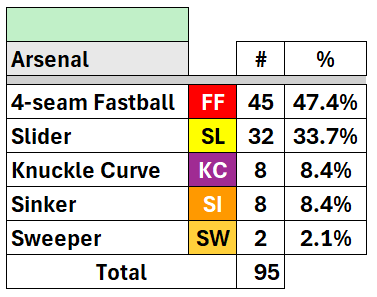
There’s evidence that starting pitchers that fall into this two-pitch pattern suffer inordinate penalties each successive time through the order (TTO), and that the cause seems to be hitter familiarity with the pitcher’s offerings. And that’s why it has been interesting to see how different an approach he’s taken in the three post-all star break starts he’s made. Here was the pitch mix in his first start against the Nationals on July 18th:
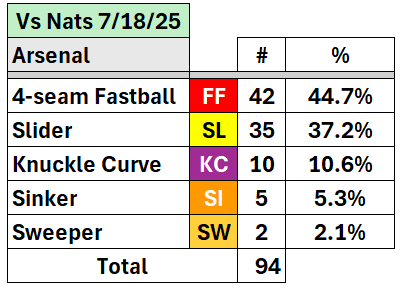
It doesn’t look like a drastic change at first, but here’s a chart of how he approached every hitter in the game:
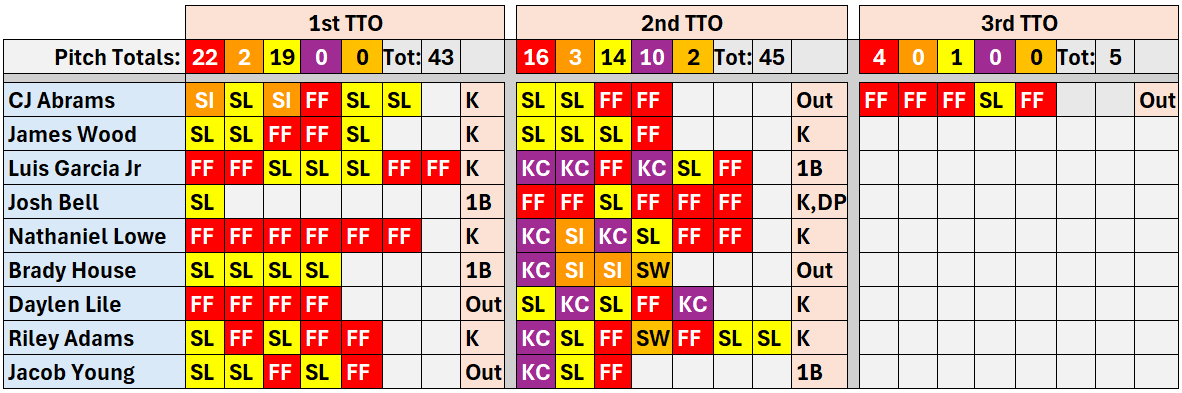
CJ Abrams saw two sinkers in his first at bat, a pitch Cease had only thrown 2.2% of the time in the first half of the season. Every Knuckle Curve he threw came during the second time through the order, and only one hitter saw the same first pitch as the previous at bat. This is not a fluky change in pitch mix. It is 100% deliberate, and an attempt to counter the problem of being too predictable and familiar to hitters successive times through the order. And it certainly seemed to help. Cease was dominant striking out 10 hitters and giving up no runs across 5.1 innings. Importantly, his knuckle curve was very sharp. In fact the final pitch of this at bat against Daylen Lile may have been the best he threw all game:
In his next start against the Marlins he again had a more varied pitch mix:
He approached hitters quite differently successive times through the order, with the vast majority of the sinker and knuckle curve offerings coming the second and third time through:
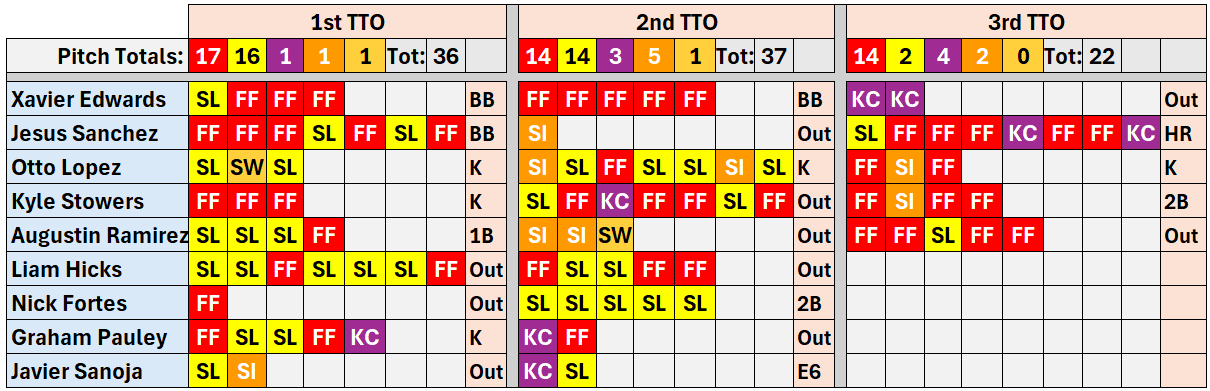
This was a less effective outing due to the damage from a two-run home run after Javier Sanoja reached on a throwing error, and Jesus Sanchez hit a home run in his third at bat against Cease:
The mistake here is clearly execution. The knuckle curve was the 16th pitch Sanchez had seen from Cease that game, and Cease missed badly with location leaving it out over the middle of the plate. Cease finished 5 innings giving up 2 earned runs in a game the Padres would eventually lose 3-2.
In Cease’s most recent outing he showed the most varied pitch mix to date:
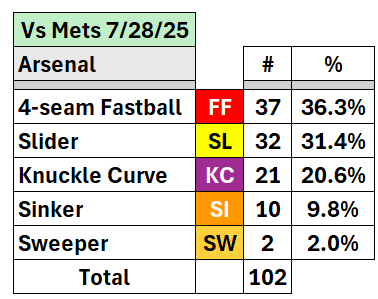
And what stands out is how early he went to his pitch mix:
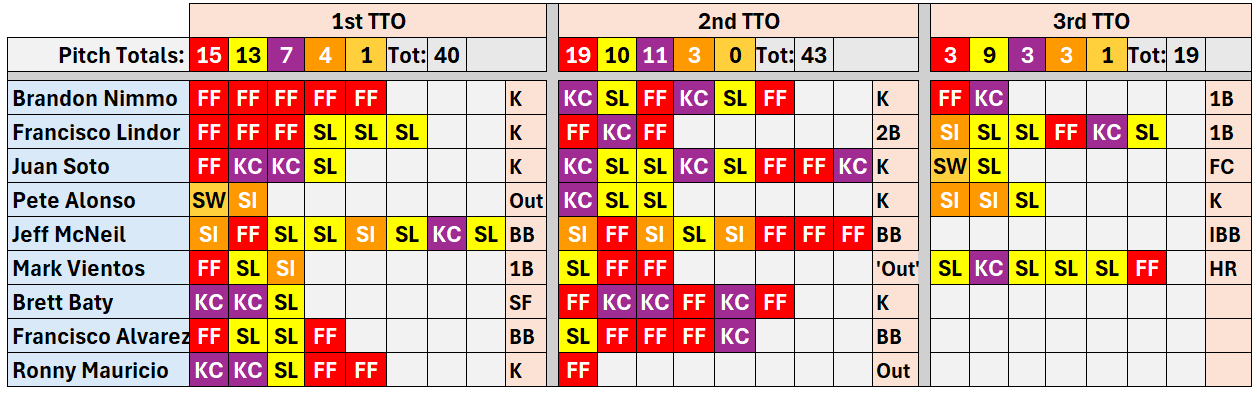
He diced Brandon Nimmo and Francisco Lindor with his four-seamer/slider combo, but mixed in his knuckle curve, sinker, and sweeper the first time through the order, and continued to vary pitches the second time through. And Cease was very effective. But the third time through trouble found him. He gave up back to back singles to Brandon Nimmo and Francisco Lindor, the latter reaching on an infield hit. After a fielder’s choice to retire Juan Soto and a three pitch strikeout of Pete Alonso (who didn’t see a single four-seamer all game), the Padres elected to intentionally walk Jeff McNeil who had seen 16 pitches in his first two at bats against Cease. This brought up Mark Vientos, who had driven a four-seamer over the wall in right the previous at bat (saved from being a home run by Tatis’ heroics). Vientos third at bat against Cease ended with a four seam fastball in a nearly identical location to the pitch he’d nearly homered on his previous at bat, and this time he did. Cease’s final line was 4.2 innings pitched, 9 strikeouts, and 5 earned runs, four of which came from the third time through the order.
We’re used to keeping track of a pitcher’s outing by innings, but we should really pay more attention to the time through the order and expect trouble if the starter has a high pitch count by the second time through, irrespective of what inning that might be.
Cease’s numbers in the second half thus far are not much different from the first half. But he has been an entirely different pitcher from an approach standpoint. He has remained dominant the first time through the order, including a ludicrous 40.7% strikeout rate. He’s been pitching more like a true starter with a four-pitch mix with a couple sweepers sprinkled in for good measure. And he’s had results more typical of a true starter, with damage starting to get to him the third time through the order. This may not seem like much, but it’s not nothing. And it’s not an accident. He’s making adjustments. It is far too early to write Dylan Cease’s obituary as a multiple-times through the order starter.
Freddy Fermin
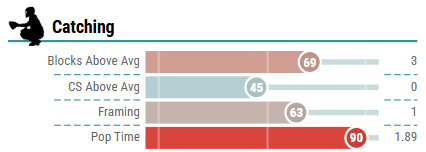
The Padres traded for Royals Catcher Freddy Fermin. Fermin has a sterling reputation around the league, and it will be up to Fermin to continue to develop game plans to vary Cease’s pitch mix now that Martin Maldonado has been DFA’d. Fermin has outstanding pop-times, a good enough arm to impact the run game, and is an adequate pitch framer:
Fermin is undoubtedly a better hitter at this stage than Maldonado as well. He’s a very aggressive hitter who rarely strikes out or walks. Early in his career he projected to be a plus offensive player hitting 15 home runs with a .845 OPS in a little over half a season his final year in AAA. That hasn’t translated to the major league level, but he’s capable of hitting a few home runs, especially on pitches down-and-in where he tends to have steep swing path tilt and elevate pulled fly balls:
He’s primarily going to be a contact heavy hitter who hits it to all fields, as he did against the Padres earlier this year in high leverage:
He also has a bag of tricks. He’s known to be a very good bunter, which might sound like the last thing the Padres need more of. But Fermin differs from the current Padres bunt enthusiasts in the way he deploys the bunt. He’s bunted five times in 2025, twice to sacrifice runners over, but three times for base-hits. He’s reached base on all three attempts to bunt for a hit. And there’s a clear reason why. He’s picked up on one of the biggest inefficiencies in baseball:
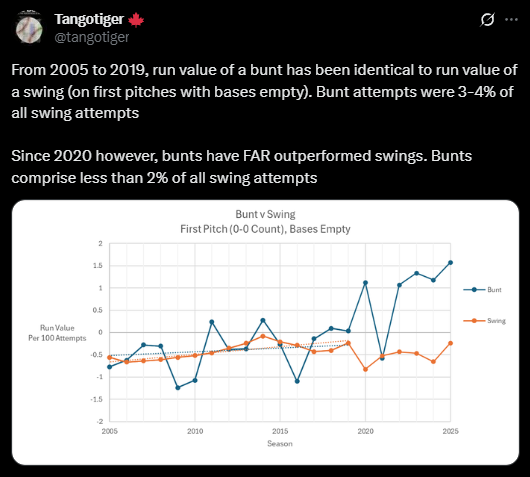
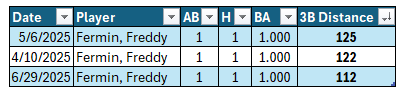
This was research from Tom Tango, the original creator of WAR which dominates the current baseball orthodoxy. Bunting was absolutely over utilized until the 1990’s and has been in a steep decline since. It is now so rarely used it is possible to catch defenses flat footed. This is exactly what Fermin does. His three bunt attempts for hits this year have come when he was leading off an inning and the third baseman was playing at least 110 feet back:
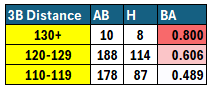
Fermin is not just a good bunter, he is a smart bunter. Here are the results of right-handed hitters bunting with the bases empty (bunting for a base hit) at varying starting 3B distances from home plate since 2020:
Here’s what it looks like:
Miguel Vargas was playing 125 feet back at third base, Fermin recognized that, and the situation (bases empty, no outs in a tied game), and dropped a bunt that has an expected batting average of .606.
Here he is leading off the 5th in a tied game with the third baseman 122 feet back at the start of the at bat:
And here again leading off the 5th in a close game with the third baseman playing deep and a lefty on the mound:
Dropping bunts like this confers a high likelihood of reaching base, but also forces the third baseman to play closer in subsequent at bats. This can be beneficial to a hitter who then has a higher likelihood of a line drive or ground ball to the pull side getting past the drawn in third baseman.
It’s fair to wonder if this skill might help with a particular struggle afflicting one of Fermin’s new teammates.
Xander Bogaerts has had notorious ‘bad luck’ hitting with runners in scoring position despite often hitting the ball hard, and has grounded into an unfortunate number of double plays. Part of this is that opposing third basemen tend to play incredibly deep when he is up to bat, precisely because he is apt to hit the ball hard to the pull side:
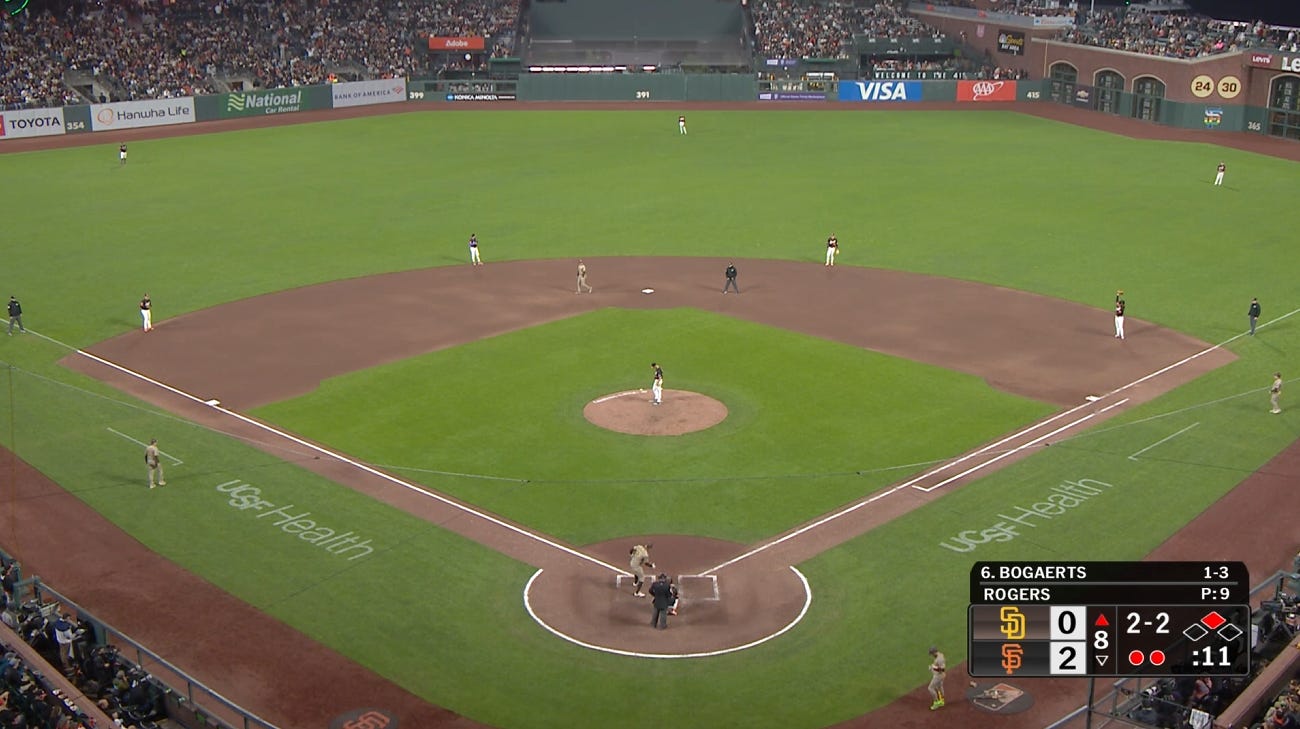
Hard hit ground balls/low line drives with high xBA’s don’t tend to realize their expected outcomes when defenses are perfectly aligned to prevent them from getting through the infield:
While it’s true Bogaerts is not being paid to bunt, it’s not unreasonable to mix in a strategic bunt from time to time to keep a defense honest, especially when it comes with such a high success rate. This season Bogaerts GIDP’s have come with the third baseman playing an average of 120 feet back. And there are opportunities to drive in runs this way:
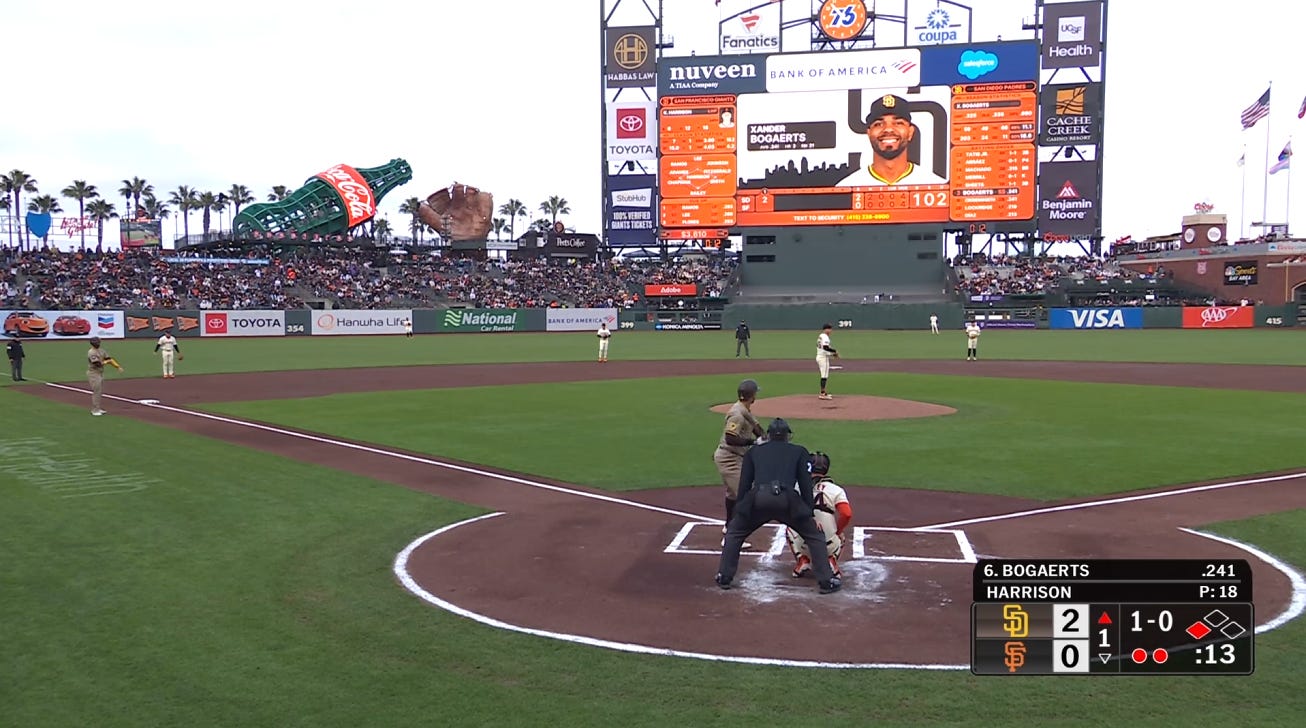
Again, this isn’t something that can be executed at will, the circumstances have to be right. But for his three seasons in San Diego opposing pitchers have been busting him inside with RISP and he’s hit into an inordinate number of ‘unlucky’ hard hit outs to the pull side of the infield.
The Padres are a team badly in need of bunt sobriety. We can hope for some cross-pollination with one of the smartest bunters in the league. At the very least the Padres will have a hitter in the bottom of the order who has reached safely in 11 of 15 bunt attempts for a hit in his career and has never laid down a sacrifice bunt in the 1st inning (or 2nd, or 3rd).
Ramon Laureano
Ramon Laureano is a right-handed hitting outfielder who can play a good left field. And he hits nukes:
He’s been better versus left-handers in his career, though this season his OPS is higher against RHP:

His track record suggests hitting left-handers will continue to be a strength:
He also has special arm talent in the outfield, including this legendary throw from his rookie season:
Joining a trio with Jackson Merrill and Fernando Tatis Jr might give the Padres the most arm talent of any outfield in baseball. Laureano is likely to split time between left field and pinch hitting duty when a tough right-handed starter is on the mound.
Laureano is enjoying his best season at the plate, and there’s reason to think that his swing decisions are the key input that has changed year-over-year. His chase rate is the lowest of his career (22.9%) and his overall swing percentage is the lowest in the past five seasons. The physical tools have always been there and in 2025 he’s been pairing that with better pitch selection. He will take the at bats that were going to Bryce Johnson, Brandon Lockridge, Tirso Ornelas, Connor Joe, and Oscar Gonzalez earlier in the season.
Ryan O’Hearn
Ryan O’Hearn is a left-handed hitting first baseman/corner outfielder who provides plus defense when at first base. He was a 2025 All-Star thanks to a stellar first half. O’Hearn has very quick hands and makes good swing decisions. He puts up good walk rates and doesn’t strike out much. He’s a very tough out and has bat speed:
Like many left-handed hitters he struggles to get to his power against lefty pitching:

He’s likely to get most starts at first base against right-handed pitching. He will take the at bats that were going to Trenton Brooks, Jason Heyward, and Tyler Wade earlier this season.
Nestor Cortes
Nestor Cortes is a left-handed pitcher that was a last minute addition. He’s missed nearly the entire season after an elbow injury, but has been completing rehab starts. Cortes was previously very successful as a starter in New York. It will be interesting how the team determines his effectiveness as he makes his way back from injury. He’s unlikely to take any high leverage duty even if healthy, but he can create matchup problems from the left side and that alone can provide situational value.
Interestingly Cortes came to the Padres with cash and switch hitting shortstop prospect Jorge Quintana. Quintana is only 18 years old and has put up a 12% walk rate in rookie ball for the Brewers a year after receiving a $1.7 million signing bonus in 2024. This trade was the strangest of all.
Will Wagner
Will Wagner is a left-handed hitting utility infielder who hit well in the minors and in a short stint across the past two seasons in the majors. He is optioned to AAA and provides multi-positional depth beyond the 26 man roster. He’s likely to be with the team when rosters expand in September. He is a floor raiser in the event of missed time from injury.
The Way Home
The Padres season has been defined by overcoming the shortcomings of an incomplete roster. No longer. They have the deepest bullpen in baseball. They will have a power bat every day in left field, DH, and off the bench. They have a starting catcher capable of giving high quality defense and at bats every night. The long missing Michael King appears to be healthy. Yu Darvish as well. And they have the right pieces to unlock new win formulas. They are good enough to beat any team. But baseball is a sport where that description will always apply to more than one team. The National League is a powerhouse. And every contender bettered itself at the deadline. There are 53 games left in the regular season to bank enough wins to survive. The Padres have the firepower. Now it’s a dogfight all the way home.
Excellent work... again.
This is the most complete Padre team ever with the highest ceiling.
Only recent rival is 2024. But I’d take 2025…with good health (esp for Darvish and King).
2024- players that we don’t have this year: Profar, Higgy, Solano, Peralta, T Scott, HA Kim (injured in mid Aug), Joe Musgrove (ucl about to bust, pitches - few innings in one playoff game)
If playoffs started today, 2025 vs 2024:
- healthy Arraez >= injured Arraez
- Fermin + Diaz >= Higgy+ Campy
- Laureano / O’Hearn / Sheets in LF vs Profar- tough one but the ceiling is as high or higher and floor seems higher too
- healthy Tatis vs recovering from a Fractured leg Tatis
- Sheets / O’Hearn / Laureano roughly equal to Peralta / Solano as bench bats
- fully healthy Manny vs still recovering Manny
- Pivetta / King / Darvish / Cease / Vasquez + Sears + Cortes > King / Darvish / Joe M on his way to TJ / etc.
Cease 2025 < 2024 but potential to reach 2024 is clear and semi-reasonable to expect
2025 bullpen > 2024 bullpen overall. Miller replaces Scott. At least even. (Though Scott was a great weapon vs LHH like Ohtani.) Morejon, Peralta better in 2025. Adam and Estrada are too arguably. Suarez no worse than 2024. Morgan added in 2025. Reynolds, Hoeing, Marinaccio as depth pieces. Matsui arguably worse but still capable.
Lineup has all the pieces. Power, speed, contact, optionality.
Defense has improved vs 2024 if they play O’Hearn at 1B.
Better depth: Sheets, Iglesias, Wade, Johnson, Wagner, and Diaz vs Solano, Peralta, Diaz, Wade, Lockridge, Nick Ahmed
Starting Pitching: more upside overall (assuming healthy Yu and King) with Pivetta as the 4 and Vasquez pitching better and depth options with Cortes and Sears. Plus more LHP to provide optionality to play matchups, openers, etc.
Bullpen: more impact arms and reliable depth.
This team is LOADED.