
All The Small Things
The ABS Challenge

On Sunday the Padres finished back-to-back series against the two best teams in the National League. They swept the Braves, then took one of three from the Dodgers. A 4-2 homestand against that caliber of opponent is objectively good. Better, probably, than many people expected. But looming problems with the increasingly patchwork starting rotation, and an only-just-unthawing offense may be putting a damper on the unqualified optimism that typically follows such a homestand. Those are big problems, and big problems rarely have easy solutions. But there are also smaller edges available to a team right now. Win probability that can be added free of charge or transaction: simply by making better decisions around the margins.
Two pitches from the homestand illustrated one of those margins perfectly.
No Cost
The Padres won the first game of the homestand 1-0, beating the Braves on Manny Machado’s 14th home run of the season. But the final pitch of the game deserves its own analysis.
With runners on first and second, Mike Yastrzemski faced Mason Miller in an 0-2 count. Miller closed the door with a slider on the outer half of the plate for a clear strike three. But Yastrzemski challenged:
Yaztremski is not sitting in suspense here. He knows with near certainty that this was a strike. But he understood the leverage of the situation and the opportunity cost of challenging: the leverage was very high because strike three ended the game, and the opportunity cost was zero because to not challenge meant there was no game left to deploy the saved challenge. That is the easiest ABS decision in baseball. But it’s interesting to look at its component parts.
This was not a pitch Yastrzemski would likely challenge in a normal situation. The pitch was 3.72 inches from the edge of the strike zone. Pitches that far over the plate have accounted for only about 1% of batter challenges (51 out of 5,192 total challenges). But in that specific game state, it’s mathematically correct to challenge this pitch 100% of the time because of the leverage and opportunity cost tradeoffs.
In fact it was the third time already that the Padres had ended a game on a called third strike that yielded a desperate challenge on equally obvious strikes:
Yaz, Cole Young, and Brandon Nimmo are not alone. So far in the ABS era, when the batter has had a challenge remaining, every called third strike that would otherwise end the game has been challenged. In that one narrow scenario, the league has been perfectly efficient. Everyone understands that when the alternative is immediate defeat, even a nearly hopeless challenge is correct.
The problem is that the same kind of thinking has not carried over to other high-leverage states.
Sunday’s loss to the Dodgers provided the inverse case study.
Opportunity Cost
In the final game of the Dodgers series, the score was tied 1-1 in the top of the fifth. The Dodgers had the bases loaded with one out. Michael King faced Freddie Freeman in a 3-2 count.
King threw a pitch that was called ball four.
The walk forced in a run, gave the Dodgers a 2-1 lead, kept the bases loaded and one out in the inning. King and catcher Rodolfo Duran did not challenge.
It is easy to understand why Yastrzemski challenged a pitch that was almost certain to be confirmed. The game-ending leverage was intuitive. There was no future to save the challenge for.
But the Freeman pitch was actually the more strategically compelling challenge opportunity. The leverage was much higher on the pitch to Freeman, even though the game was literally on the line in Yastrzemski’s at bat. That’s not intuitive, and perhaps that’s why the Padres tandem let the moment slip by. But it’s easy to understand when breaking down the resulting game states.
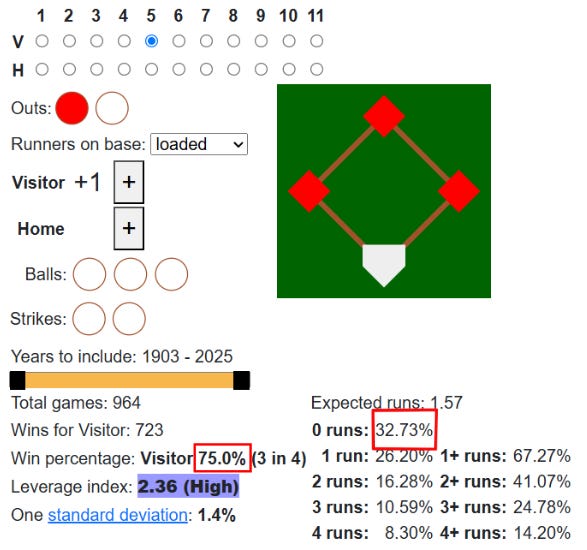
If the ball four call stood, the Dodgers would score a run to take the lead, they would still have the bases loaded, and still had only one out. Their win probability would jump to roughly 75%, and the chance of the Padres escaping the inning without further runs scoring would fall to about 33%:
A successful challenge would have turned ball four into strike three. The game would have remained tied, there would have been two outs, and the Padres’ chance of escaping the inning without another run scoring would have been roughly doubled to ~67%:
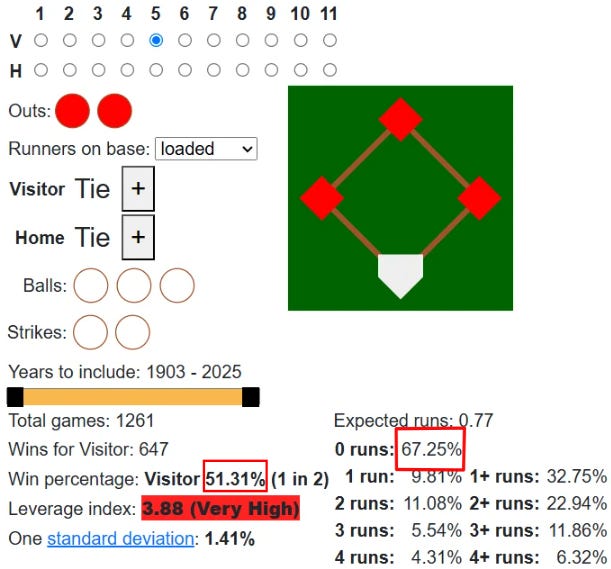
The run swing between the two outcomes was ~1.8 expected runs. The win-probability swing was ~23.69 percentage points.
The point is, this was not a normal ball/strike call. This was a single taken pitch carrying more than one-fifth of a game in win probability. That’s much larger than most entire at bats. And it’s larger than the win probability swing of ~8% on the pitch that Mike Yazstremski, correctly, challenged without hesitation.
Game Theory Optimal
On a normal pitch, a player should usually challenge only when he is confident the umpire missed the call. But in this situation, high confidence is not the correct threshold. The correct question is not, “Am I sure this was a strike?” The correct question is, “Is there any real chance this pitch clipped the zone?”
The answer was yes.
As it turns out, the pitch to Freeman was a strike, which the Dodgers broadcast noted, incredulous that it wasn’t challenged:
But the process point matters more than the result. Because King and Duran could not be certain it was a strike or else they would have challenged. The process point that leads to the game theory optimal decision is recognizing that they should have challenged even if they believed the umpire was probably right. When the payoff is that large, a low-probability challenge can still be the correct play.
The friction in any ABS challenge is the opportunity cost: If the challenge fails, the team loses future challenge capacity. A player who is not confident in his view of the pitch has to weigh the chance of an immediate overturn against the possibility that the team may need that challenge later. Most of the time, that is a reasonable hesitation. But not always, and certainly not on Sunday.
To illustrate, let’s use the win-probability gain from a successful challenge Sunday of 23.69 percentage points, and make the cost of a failed challenge be the future value of the challenge the team might lose. In 2026 the average win probability added by an ABS challenge is 0.83% (43.18 net WPA across 5192 ABS challenges). The break-even point for this tradeoff is shockingly low:
(Breakeven %) * 23.69% = 0.83%
Breakeven % = 3.5%
A 3.5% chance of getting the call to Freeman overturned would yield roughly the same win probability added as the average ABS challenge in 2026. Even tripling that would mean a ~12% confidence would be expected to break even
This calculation is very back-of-the envelope. It will be a bit different if an alternate win probability framework were used, and can be more complex if more variables are accounted for. For example TapToChallenge.com uses a slightly different win probability database and estimates the swing in win probability on Freeman’s walk was closer to 21.2%. They also estimate opportunity cost based on the game state and remaining challenges, so in Sunday’s scenario the opportunity cost of the 5th inning challenge with two challenges remaining is estimated to be only 0.2% win probability. This leads to their estimate that the minimum probability of an overturn needed to breakeven is only 1.4%.
Put another way, if King and Duran felt there was at least a 1.4% chance that pitch would be overturned on ABS challenge, they should immediately challenge. King and Duran did not need to think the pitch was probably a strike. They only needed to think there was a plausible chance it was a strike.
This will never be intuitive, and there will never be enough time to do any of these calculations in the heat of the moment. On the final strike call of a game, intuition aligns perfectly with calculation, and players have internalized the appropriateness of spending a challenge on an unlikely overturn. But the teams that learn to do this in-game, when leverage reaches a threshold where it’s no longer necessary to have high confidence to initiate a challenge, will separate themselves from the pack. At least for awhile. So how can they do this?
The New ABS Skill Trees
When we wrote about ABS before the season started we noted that new skill trees were entering the game:
There are two skill trees teams must consider:
Strike-zone acuity: The skill of the batter/catcher/pitcher in estimating if a pitch caught the strike zone, and
Situational leverage awareness: Understanding when the expected value of a challenge justifies the attempt
Those are related skills, but they are not the same skill.
A player can be good at reading the zone but poor at identifying when a low-confidence challenge is still correct. A player can also be mediocre at reading the zone but still make good challenge decisions if he understands which game states demand aggression.
The Freeman pitch was a failure of the second skill more than the first.
King gave an excellent post-game interview in which he carefully walked through an impeccable analysis of the missed opportunity:
It went through my head to challenge it, but I wasn’t fully committed to it… and then I thought about it well later… even if I’m wrong the team’s probably not mad at me for challenging that one.
It’s likely that almost every player, in the same situation, is going to have the same untrained reaction in the moment: a sense that a challenge may be warranted, but friction to pulling the trigger because it’s a low confidence challenge, and that runs counter to the typical ABS challenge rubric. And they won’t have time to think it through. A player is given roughly two seconds to challenge a pitch, and this interval can fly by even on very obvious missed calls:
No one is doing expected-value math in that window. If there’s any extra cognitive strain due to a player being caught between minds, the moment will pass and the opportunity missed. This happened to King on Sunday. And that’s not a failing of the player. This is how the human mind works. Weighing tradeoffs, even in a shorthand sense, takes time. In order to make a low confidence challenge, you must be prepared to do so before the opportunity arises. But the answer cannot be a complicated algorithm.
The answer has to be a preloaded heuristic. Which has to come through training, and strategic game management.
Mode Switching
ABS strategy needs two modes. In normal spots, require conviction to challenge. The player needs to rely on his strike zone acuity and recognize when there is a high-confidence for overturn and act decisively. This will be the default mode for the vast majority of at bats.
But once in awhile there will be a moment where the leverage changes the calculus, and the optimal strategy is to take on more risk, challenge with lower confidence, because a jackpot is available. In these spots the player should challenge if an overturn is merely plausible. A game state where the difference between ball and strike dramatically changes the scoreboard, the inning, or the game’s win probability is worth gambling more for. Full count with the bases loaded is the cleanest example, because the pitch is not merely changing the count leverage, it is deciding between a walk that forces in a run, and a strikeout that records an out.
The Padres do not need every player memorizing a probability table. They need players to recognize a short list of automatic or near-automatic challenge states, for example:
For hitters: End-of-game called strike three, challenge remaining, always carries enough leverage to justify a low confidence challenge, even if it looked like an obvious strike.
For pitchers/catchers: Full count, bases loaded, close score, any close pitch carries enough leverage to justify a low confidence challenge.
Those are not difficult rules to install. They are the baseball equivalent of pre-snap or late-clock rules in other sports. A quarterback normally should not throw the ball into the ground, except when spiking it to stop the clock is correct. A basketball defender normally should not foul intentionally, except when the game situation demands an immediate foul. These situations demand awareness of the need to mode switch beforehand. And these strategies are built into the players’ strategic understanding of the game.
ABS challenges need the same kind of situational programming. But Baseball is more complicated. There are 288 base/out/count states before you start adding inning and score. That list isn’t going to fit on an arm band. But baseball is also a set piece game. There is time for communication and situational awareness before every pitch. While the dugout is banned from assisting with ABS challenge decisions in real time, there’s nothing stopping a team from relaying to the players on the field before a pitch that the game state has crossed the leverage threshold to switch to aggressive low-confidence challenge mode.
Michael King ultimately derived the correct solution to the missed challenge opportunity after the fact. This is unsurprising as he has a great intellect and a great baseball mind. But intellect is neutralized when a decision must be instantaneous. Well understood heuristics compress the work product of intellect into trained reflexes that can be deployed instantaneously.
Not Alone
It shouldn’t be surprising, if you’ve followed the leverage discussion, that the 13.77 leverage-index of the missed ABS opportunity on Sunday was the highest ever recorded:
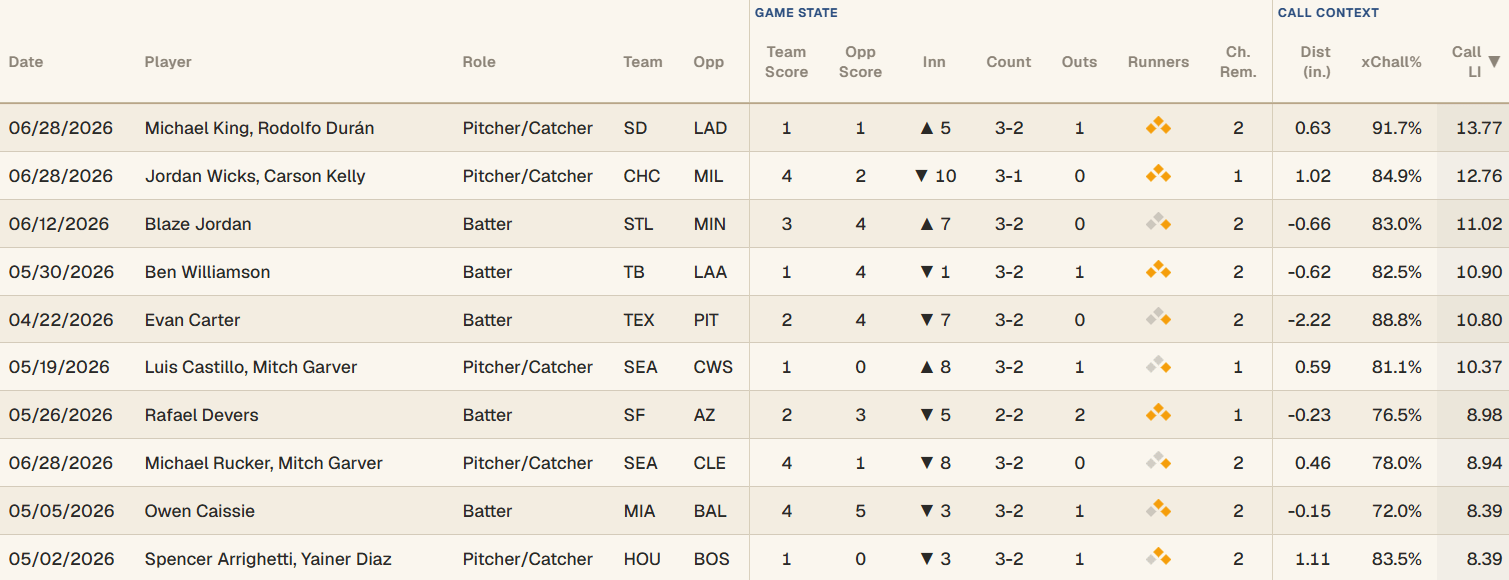
There are few ABS game states that can exceed the leverage of a tied game with the bases loaded and a 3-2 count. Coincidentally the second highest leverage index non-challenge also occurred Sunday when the Cubs battery of Jordan Wicks and Carson Kelly left their ABS challenge unspent in an incredibly tense game state:
It’s nearly certain that if given enough time to consider their decision, Wicks and Kelly would arrive at the conclusion they should have instantly challenged even with low-confidence, similar to King. But the moment passed. Whether they forgot about the challenge, or didn’t realize that a low confidence challenge was worth the risk, they left win probability on the table with a decision they controlled.
CRY About It
We have metrics for almost everything in baseball, but we don't have a good way to quantify one simple question:
How much should a team regret not challenging a pitch?
There isn't a yardstick for missed challenge opportunities, but the intuition is straightforward: regret should be greatest when a challenge was both highly expected and highly consequential.
We can estimate that by multiplying a pitch's expected challenge probability (xChallenge%) by its Leverage Index.
Challenge Regret Yardstick (CRY) = xChallenge % * Leverage Index
When we calculate the CRY Index for the largest missed opportunities for ABS challenge we a see a reordering, but with a consistent presence on top:
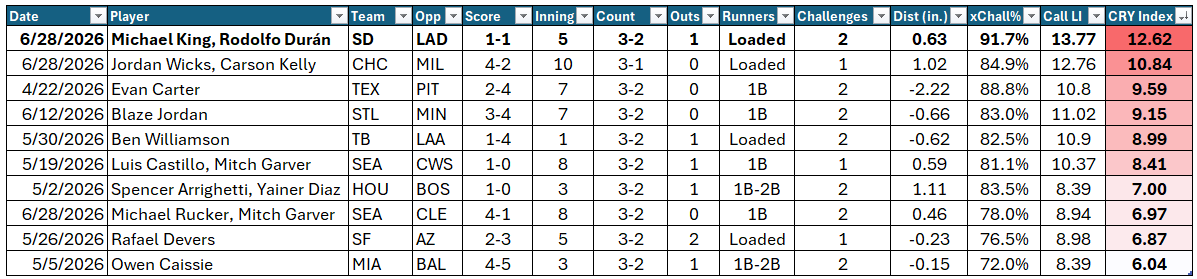
In addition to being highly consequential with the highest leverage index for a missed ABS opportunity, Sunday’s pivotal call also was a fairly easy challenge to justify irrespective of leverage, with an expected challenge rate of 91.7% given its proximity to the strike zone.
For comparison, Mike Yastrzemski challenged a pitch with a very low expected challenge rate of 7.1%:

So had he forgone his challenge, Brave fans may have rightly recognized the strategic mistake, but would have relatively less CRY about.
A pitch with a high expected challenge probability but low leverage may be annoying to miss, but it probably is not costly. A pitch with high leverage but almost no plausible chance of being overturned may not create much regret either. The worst missed opportunities are the pitches that combine both: close enough to challenge and important enough to matter.
Getting It Right
Coincidentally, when Mike Yastryzemski made his doomed-but-correct challenge, Eli White was the runner on second base. In the beginning of May White found himself up to bat in an identical scenario to Freeman, tied game with the bases loaded and one out in the top of the 5th. White faced the King/Duran dilemma when the umpire called a pitch near the top of the zone strike three. White made a half turn to the dugout but then quickly tapped his helmet for review:
The pitch came in 0.58 inches out of the zone and the call was overturned for ball four. Driving in a run. Preserving the bases loaded, 1-out state.
When Manny Machado hit a 4th inning homerun Monday to give the Padres a 1-0 lead, the Padres win probability surged from 59.3% to 72.4%. When Eli White tapped his helmet in Colorado the Braves win probability surged from 59.0% to 75.0%. The identical surge happened to the Dodgers Sunday when King and Duran missed their opportunity to do the same.
There are limitless ways to win games. The best way is to have unlimited resources and pursue them all. There is, in reality, only one team playing that game. Everyone else needs to find no-roster-cost edges. All the small things.
ABS challenge game theory is a true source for teams to differentiate themselves. Because while strike zone acuity is a skill intrinsic to the player, leverage acuity is skill that is likely to reside outside the player. Players need to be trained in proper heuristic understanding of when to switch modes from cautious use of high-confidence challenges, to aggressive use of low-confidence challenges. Teams need to explore in-game signaling when leverage thresholds are crossed. These skills are not going to self organize. A team that can protocolize smart use of low-confidence challenges based on leverage awareness will have a leg up on the league. A first mover advantage anyway.
The Padres cannot fix their rotation with an ABS challenge. They cannot make struggling hitters productive by getting better at challenge math. The correct risk management strategy for ABS challenges adds zero MPH to Lucas Giolito’s fastball. But it can help get him out of trouble. It can incrementally shift the teams odds in the right direction.
That is all this is. And that is not nothing.
we'll learn a lot more about our team from the next 7 than the last 6. great to get a sweep, but the braves were the coldest team in MLB. would gladly take 3-4, at least stay afloat.