
First Impressions
Power Arms, Long Lineups, and Freddy Framin'

The Padres took two out of three games from the Cardinals in the first series after the shock-and-awe trade deadline. The impact of the new additions was felt throughout the series. Some of the new players’ contributions are straightforwardly apparent, but others are more subtle. Here we’ll highlight a few of the early impressions.
Friday Night Lights Out
On Friday Mason Miller immediately matched the fastest recorded pitch from a Padres pitcher with his 102.8 MPH four-seamer, and totaled six pitches 102 MPH or faster. There are pitchers in the league with ERAs better than Miller’s, but this superficial measure belies the dominance of Miller’s arm:
Miller has the premier fastball in the league and has an edge on even the very best hitters. He only pitched on Friday, and his exact role is yet to be made clear. But undoubtedly he will be called on to pitch in the most important innings of the stretch run and beyond.
Longer Lineup
The additions of Ryan O’Hearn and Ramon Laureano lengthened the lineup enormously, and on Sunday the Padres got a pair of home runs from the number 7 and 8 spots in the lineup. Ramon Laureano connected with his first home run late in the game Sunday:
Notably this was a two-strike swing. Laureano does not get cheated. It’s hard to remember when the Padres had a 7th spot in the order that could hit home runs 105 MPH to the opposite field. It was the third home run hit at least that hard to the opposite field for Laureano this season, the other two had exit velocities of 107 and 108.1 MPH.
Jake Cronenworth hit 8th on Saturday and Sunday. Cronenworth is overqualified to be a number 8 hitter, but his presence there is a luxury the Padres can now afford:
Freddy Fermin hit out of the 9th spot on Saturday and Sunday and looked exactly as advertised, taking tough at bats and avoiding strikeouts, collecting three hits and a walk in eight plate appearances. And he did the thing:
Nolan Gorman had a rough series at third base for the Cardinals and was playing a deep 117 feet from home plate to start this at bat in the top of the third:
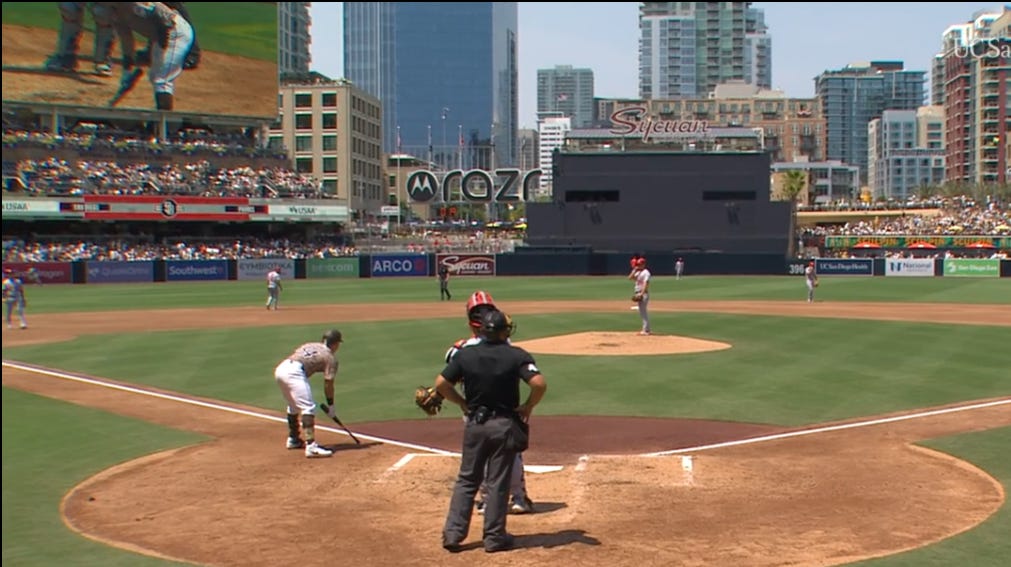
Pitcher Andre Pallante tends to fall hard off the mound to the first base side and you can see this costs him a step as he tries to field the bunt:
Fermin noticed these things, as well as the game context (bases empty, no outs) in which a single to the outfield carries no extra value compared to a bunt single, and the value of hitting for power is diminished. This was good situational hitting.
It was interesting to see that Fernando Tatis Jr came up next and immediately showed bunt as well:
Nolan Gorman was much closer to start this at bat than he had been for Fermin’s bunt single, starting 104 feet away. But showing bunt induced a further change in alignment as Gorman started the next pitch only 94 feet away:
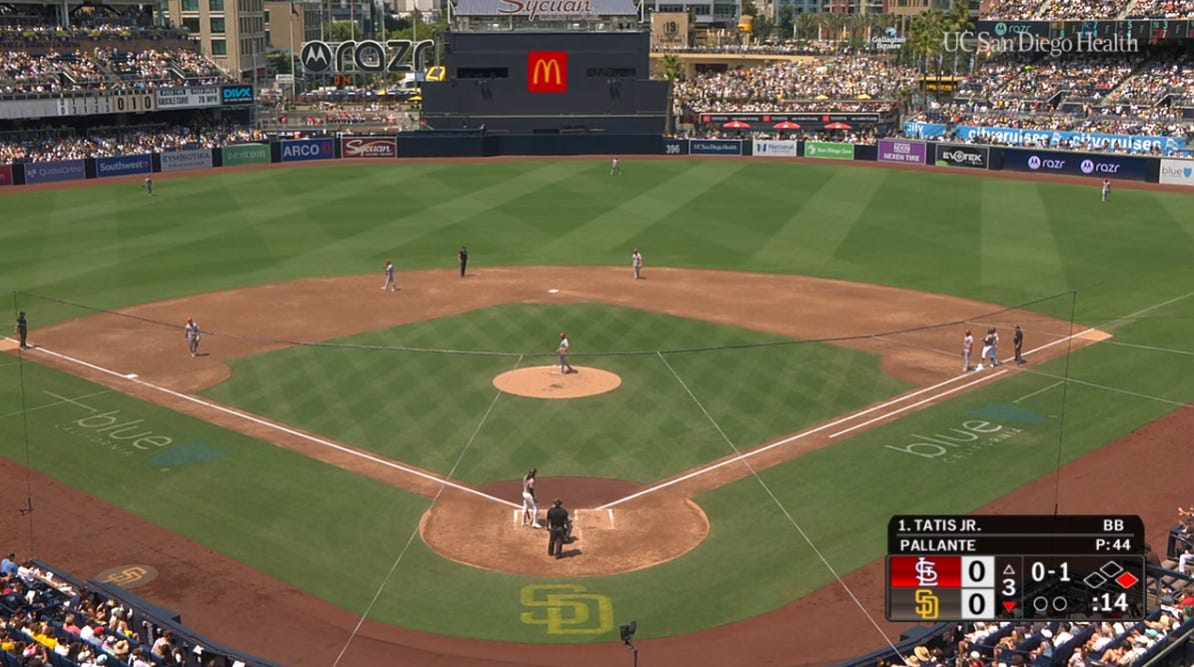
With the third baseman now drawn in, Tatis would proceed to swing away at the next pitch (fouled off), and never squared to bunt again the rest of the at bat, ultimately drawing a walk. Tatis should not be bunting very often. But just having to account for it by showing bunt stressed the defense further out of its preferred alignment. A third baseman playing nearly even with the bag has far less effective range to stop ground balls or line drives from getting through the infield.
In Tatis’ next at bat Gorman started 120 feet back, and on the first pitch of the at bat Tatis tried to do the thing:
This was the identical situation Fermin saw as he led off the 3rd inning, and it’s remarkable how similar the bunt attempt was. Tatis disguised his intent until the pitcher was in his wind up, and tried to place it right down the third base line, the ball just trickling foul by a few feet. You can see Gorman had no play should the ball have remained fair.
Again, Tatis should not be bunting often. But when the moment is chosen carefully, this play carries a much larger expected value than you might think:
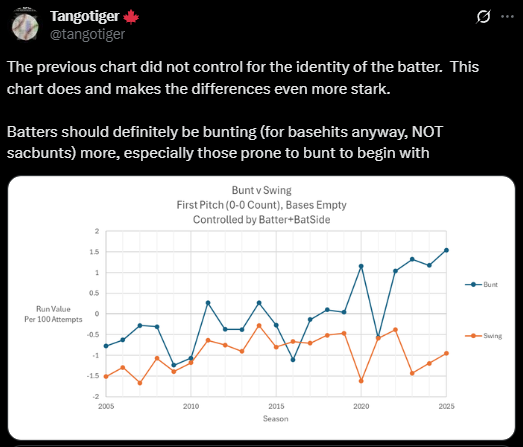
This is one of the biggest inefficiencies in baseball. Teams should absolutely be bunting more. Not indiscriminately, and not for sacrifices (unless specific game context rewards that). But mixing in a bunt-base-hit attempt when the circumstances are right can both lead to very efficient at bats, and force defenses out of alignment in subsequent at bats once a hitter proves he has the ability to make that play.
New Strategies
The Padres appeared to deploy an interesting new strategy when they brought in Jason Adam in the 6th inning Sunday with the Padres holding on to a 2-0 lead. In the current baseball orthodoxy the better the reliever, the later in the game he typically pitches. Indeed, Adam had pitched in the 7th inning or later in 51 of the previous 52 appearances, including 43 appearances in the 8th inning or later, and only one appearance in the 6th inning on June 24th in a game in which Ryan Bergert was hit by a comebacker and had to leave in the 4th forcing the Padres to go to their pen very early. The decision to pitch Adam in the 6th on Sunday was probably not a sign of a demotion. It was more likely due to the game context. The Cardinals had the top of the order coming up in the 6th for the third time through. The Padres may have decided to bring in their most trusted non-closer to get through the Cardinals toughest hitters. Adam pitched a clean sixth, and Jeremiah Estrada was brought in for the 7th with the game still 2-0. The Padres scored four runs in the bottom of the 7th, and with the extra run cushion they went to David Morgan for the 8th instead of Adrian Morejon or Mason Miller. The Padres added a run in the bottom of the 8th and with a 7-0 lead Morejon was brought in in the 9th. Morejon struggled uncharacteristically, giving up a walk and four singles creating a save situation for which Robert Suarez was brought in to close out the game. The Padres ended up winning 7-3, and never had to bring in Mason Miller, though he was available should the inning have spiraled further.
The sequencing of relievers seemed to track very much with the leverage of the game context, including considering the hitters up to bat, rather than a hierarchy based on the inning number alone. It will be interesting to see if this is the beginning of a difference in approach to locking down wins.
Cease, Fire
After the trade deadline it was reported that the Padres’ asking price for Cease was too high, and despite immense interest from other contending teams, no deal could be made.
Given Cease’s well-chronicled first half struggles, it might seem odd that there was both intense interest in acquiring Cease from contending teams, and that the Padres were unwilling to move him unless blown away by a trade offer.
But the interest from contenders, and reluctance from the Padres to part ways is easy to reconcile. Both positions reflect bets on the likelihood that Cease can re-harness the stuff that has made him a top four Cy Young vote getter twice in the past four seasons.
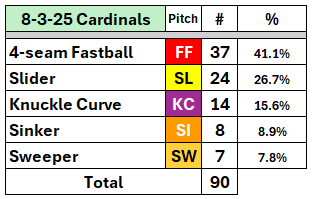
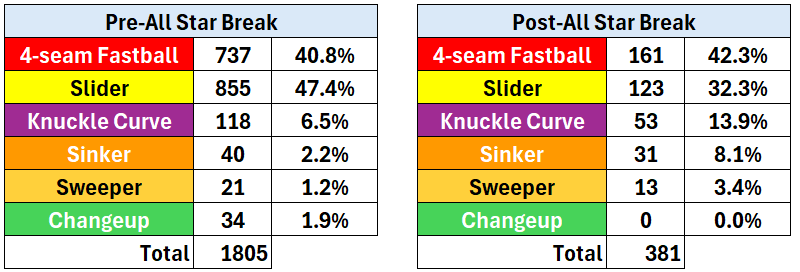
And again on Sunday, for the fourth straight game, Cease deployed a pitch mix very different from his first-half averages:
He was dominant both times through the order, completing five innings, and finished his outing before going to a third time through:
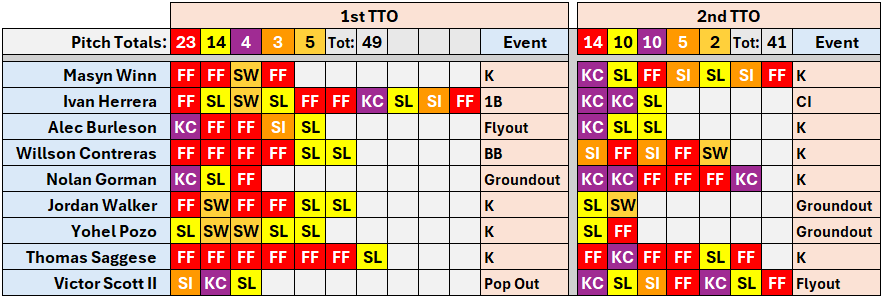
The dominance of the outing is easy to appreciate by looking at the batted ball outcomes:
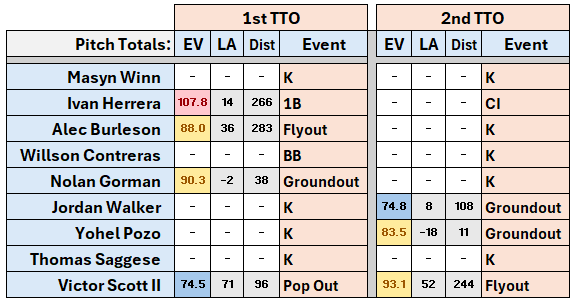
The Cardinals put one hard hit ball in play, made weak contact six other times (all for outs), and struck out another nine times. Cease now has the most strikeouts (99) in innings 1-3 of any pitcher in baseball. On Sunday he was more dominant the second time through the order.
In the first half he crossed a hidden threshold of pitching two pitches over 80% of the time without a secondary pitch reaching 10% usage. He is clearly trying to diversify his arsenal1.
There were some interesting things to see in the sequence to Nolan Gorman the second time through. Cease started with back-to-back knuckle curves, the second for a strike. With the count 1-1 he challenged Gorman with a four-seamer and Gorman was late, swinging through. He then threw two four-seamers out of the zone running the count full. On 3-2 he went back to the knuckle curve and located it impeccably for the strikeout:
The knuckle curve is a pitch Cease has struggled to locate, and this was his undoing three starts ago in Miami when he hung a 3-2 knuckle curve to Jesus Sanchez that proved to be the deciding blow in the game. But you can see that on 3-2 Cease shook off the initial pitch call to get to the knuckle curve:
That Cease elected to go with the knuckle curve on a do-or-die offering suggests he felt he could command it. And command of pitches other than the four-seamer and slider portends well for Cease’s ability to break out of the predictable rut he fell into in the first half.
There’s another reason to expect Cease, as well as other Padres pitchers might find more success down the stretch than in the first half.
Freddy Framin’
In the at bat above, when the count was 1-0 to Gorman, Freddy Fermin stole a strike with outstanding pitch framing:
‘Bad calls’ often have their provenance in a skilled catcher frame job. And Fermin excels in this exact area of the strike zone. This was also an area of weakness for Cease’s previous catcher Martin Maldonado:
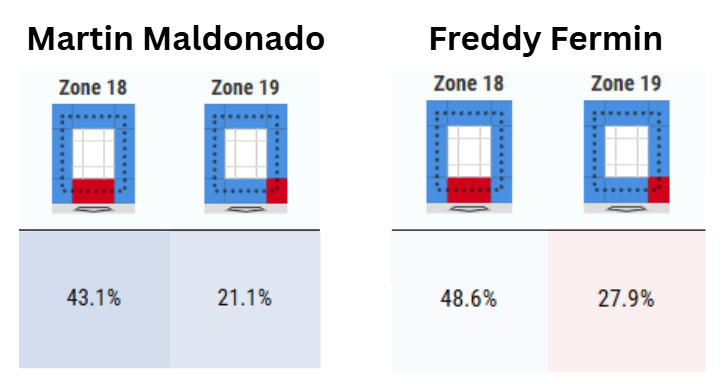
These are stark differences in framing strike rates. And there’s more leverage on a single stolen strike than one might think. The count would have gone to 2-0 if the 1-0 offering was called a ball, and instead the stolen strike made it 1-1. Here is the difference in hitter performance in 2025 in 2-0 counts versus 1-1:
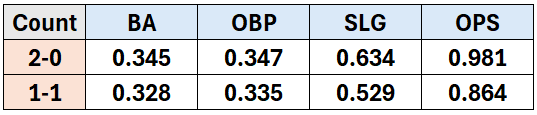
This difference has been remarkably stable year-over-year. Here are the average hitter performance in 2-0 versus 1-1 counts since 2008:
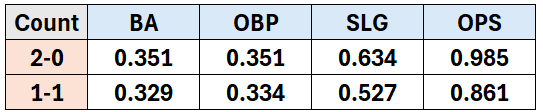
Hitters slug over 100 points worse depending on whether a 1-0 offering is a ball vs a strike.
In the next inning Fermin again showed his ability to tilt the leverage of at bats with his framing:
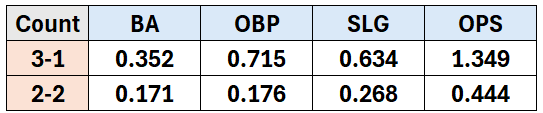
In this instance the count leverage changed dramatically. The stolen strike moved what would have been a 3-1 count to a 2-2 count. Here are the 2025 league averages for hitters in a 3-1 count versus a 2-2 count:
And here are the league averages for hitters in a 3-1 count versus a 2-2 count since 2008:
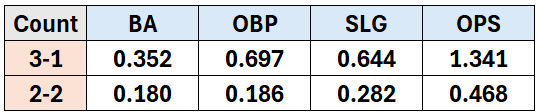
Baseball proceeds like a game of blackjack where the strategy changes with each card (pitch) dealt. The effects of small things like a stolen strike compound more than intuition leads us to believe. In the instance above, Fermin’s stolen strike transformed the hitter at the plate from Barry Bonds to Trenton Brooks.
Levers Not Pulled
Game two of the series was a frustrating loss in which Randy Vasquez struggled badly in the 4th inning and gave up a four run lead. There was an opportunity in the 4th to bring in a high leverage arm to shut down the Cardinals rally, and with the depth of the bullpen it was easy to envision being able to lock down the win with 5+ innings of relief. But the Padres didn’t pull this lever. It’s nearly certain they would have if this were a playoff game. The bullpen has been the team’s greatest strength this season, and prioritizing not overtaxing down the stretch may well prove to be a good strategy.
Lefties Left
The Padres have not yet seen the two lefties they acquired at the deadline. JP Sears is set to make a start in Arizona Monday, and it appears Nestor Cortes will be getting a rotation start in the near future. Sears and Cortes are intriguing arms, both with unique pitch mechanics that seem to be part of their success. Sears is leaving a moribund franchise in a ridiculous hitter’s park. Cortes is a formerly all-star caliber starter recovering from injury. Their mere presence as southpaws able to provide length will provide the team optionality. It will be fascinating to see if either is deployed in an opener role down the stretch.
So Long, and thanks for all the FIP
Randy Vasquez was sent down to El Paso to make room on the roster for Cortes. We never understood Vasquez’ success, and so we expected the clock may eventually strike midnight. Vasquez may not be recalled until rosters expand in September, and even then it’s not a guarantee. If his season on the big league club is over, it was a good one. Regardless of how he did it, he managed to pitch 107.2 innings of 3.93 ERA across 22 starts, and the Padres were 14-8 when he pitched. Much like Matt Waldron in 2024, the Padres would not be where they are —three games out of the division lead— without Randy Vasquez. Among starters with at least 100 innings pitched, Vasquez’ 3.93 ERA is a top 50 mark in MLB. A valuable performance. A mystifying, stressful, tremendously valuable performance. Godspeed Strandy.
He’s abandoned his changeup completely (it was always a bit of a gimmick pitch averaging a preposterous 77.3 MPH and loathed by pitch modeling analytics).
I absorb a fair amount of baseball analysis and find yours the best. Being a Padres fan probably makes it more engaging given the topic, but objectively excellent.
Felt a tingle of informed insight watching Fermin bunt after reading your analysis.
I wrote at length in another comment about Tatis, but he has the most recent ~ 75% of his season as 1 HR per 50 PA hitter. Assuming a healthy 600 PA, that is 12 HR season. I know you have written in depth about him, but something seems up and remain curious. Concerned too except he has transformed his game into a true, effective leadoff.
RIP Strandy. Not saying it wasn’t the right move to send him down, but what a gut punch that must’ve been for him.
He arguably pitched to his ceiling for the entire season to this point, keeping the team in contention (where we ironically won more games with him on the mound than Cease) only for AJ to say “well done, we’ll take it from here” by bringing in Cortez / Sears.
Hope next year he continues to progress and is able to stick with the club the whole way through. I’d take a team record of 14-8 for a 5th starter any day of the week.