
First Looks Part 1
Top Of The Rotation and the Lefty Lineup

The Padres closed the opening series of the season going 1-2 against a Tigers team that looks to be one of the best in the league. Though it was only three games, the answers to burning questions going into opening day are already being revealed. And of course the games revealed new questions that must be answered before the 2026 Padres outlook truly comes into focus.
Game 1
Nick Pivetta faced off against reigning back-to-back Cy Young winner Tarik Skubal. Pivetta started the season off with a strikeout of Kerry Carpenter on three perfectly executed pitches. The first pitch of the season was a 94.3 MPH 4-seam fastball with 21 inches of induced vertical break (iVB) at the top of the zone. This is the key pitch that led Pivetta to 6th in Cy Young voting in 2025. The iVB creates so much ride it’s extremely difficult for hitters to square up in the top of the zone, even when they’re sitting on it as it appeared Carpenter was. Carpenter would foul off two well located 4-seamers up and in before Pivetta buried him with a 2700 RPM curveball that dropped 61 inches on the way to the plate thanks to an absurd -18 inches of iVB.
Here is the curveball halfway to home plate, about the time a hitter needs to decide to swing:
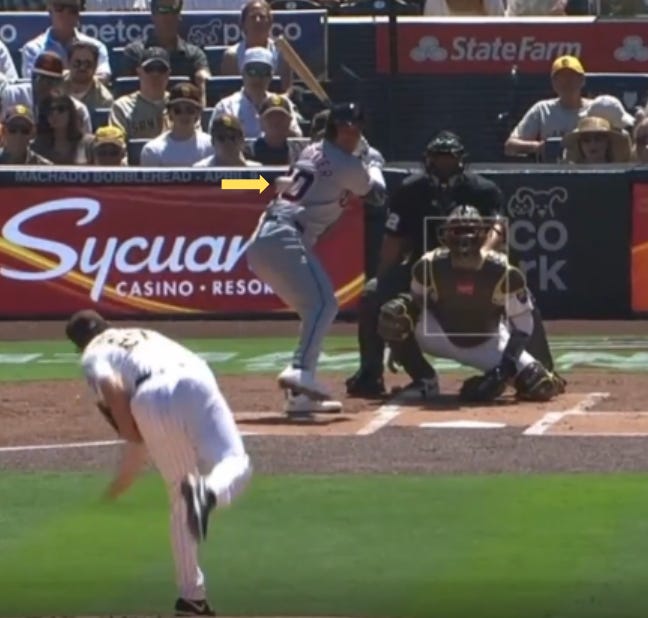
Pivetta’s velocity and pitch shapes were elite, but more importantly, he located the pitches well. This is the game Pivetta plays with hitters: high fastballs at the top edge of the zone for fouls or swing throughs, and curveballs that start near the hitter’s eye level but dive to the bottom of the zone. 71% of his pitches in 2025 were the 4-seamer (48.5%) or curveball (22.4%). When he locates this pitch mix it’s a nightmare for hitters. This would change in the second at bat.
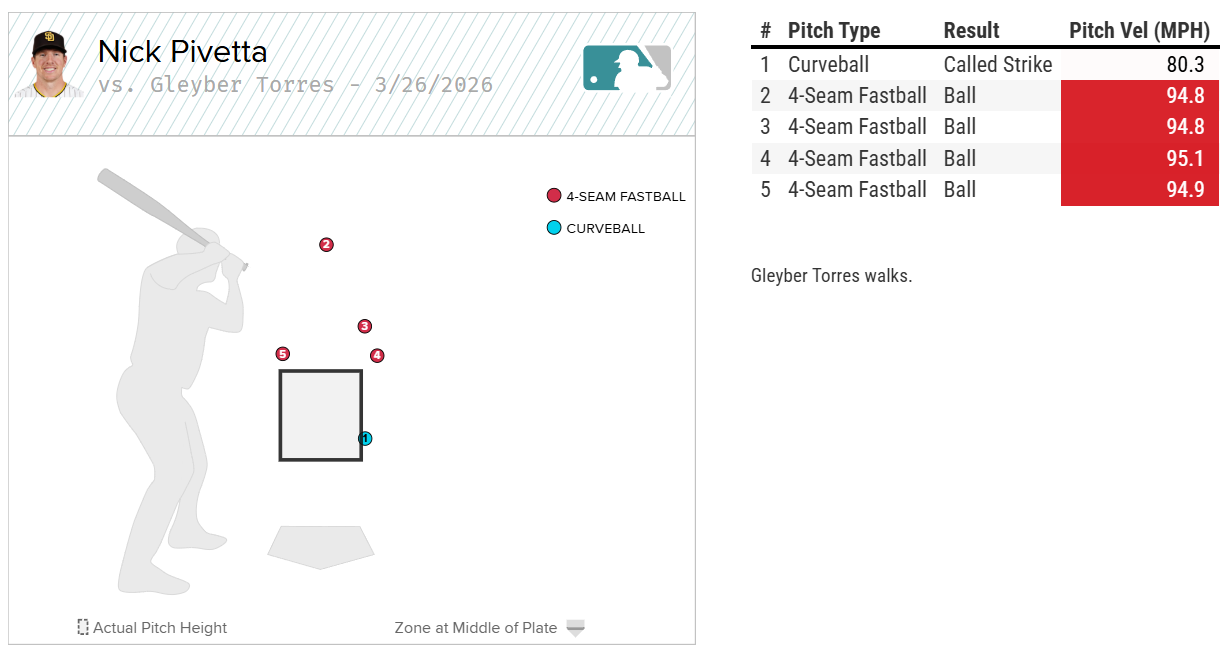
Gleyber Torres saw an inverted pitch mix with a curveball that Pivetta located well to start the at bat, but he missed wildly with his 4-seam on the second pitch. He would fire off three more 4-seamers that each inched closer to the zone, but each missed, and Torres didn’t offer at any drawing the walk:
Pivetta may have been overthrowing here. This was one of the highest velocity sequences of his outing:
Pivetta stuck with the 4-seamer to start Colt Keith and his first offering was again high, but it induced an excuse-me swing from Keith who likely was fooled by the iVB, but his weak flare dropped in for a single.
The Tigers’ most dangerous hitter Riley Greene came up with two on and one-out and Pivetta broke up the string of 4-seamers with two poorly located curves that didn’t tempt Greene. Pivetta fooled Greene with another curve on the 2-0 fastball count.
But on 2-1 Pivetta again missed badly with a 4-seamer a foot up and out of the zone. You can see Freddy Fermin tilt his head a little bit after the pitch, sometimes a sign the catcher wants the pitcher to settle down a little. Greene seemed to have also sensed Pivetta was struggling with command as he stared at a 3-1 cutter that Pivetta essentially threw right down the middle. On 3-2 Greene watched a curveball bounce for ball four, loading the bases, and sending Ruben Niebla to the mound for a visit:
Spencer Torkelson came to bat with the bases loaded, and this is where Pivetta’s outing unraveled. Pivetta’s command issues had been on display and Torkelson appeared to be locking in on one part of the zone, un-tempted by the first two 4-seamers just off the outer edge of the plate. Pivetta’s third 4-seamer sailed above the zone, and on 3-0 he had probably his wildest miss of the game with a 4-seamer nowhere near the zone walking in a run:
It’s interesting to look at the change in pitch velocity and spin during this at bat. To this point in the game Pivetta hadn’t thrown a single 4-seamer in the zone, and the velocity had been 94-95 MPH and ~2450 RPM. He started Torkelson with three straight 4-seamers under 94 MPH with noticeably less spin:
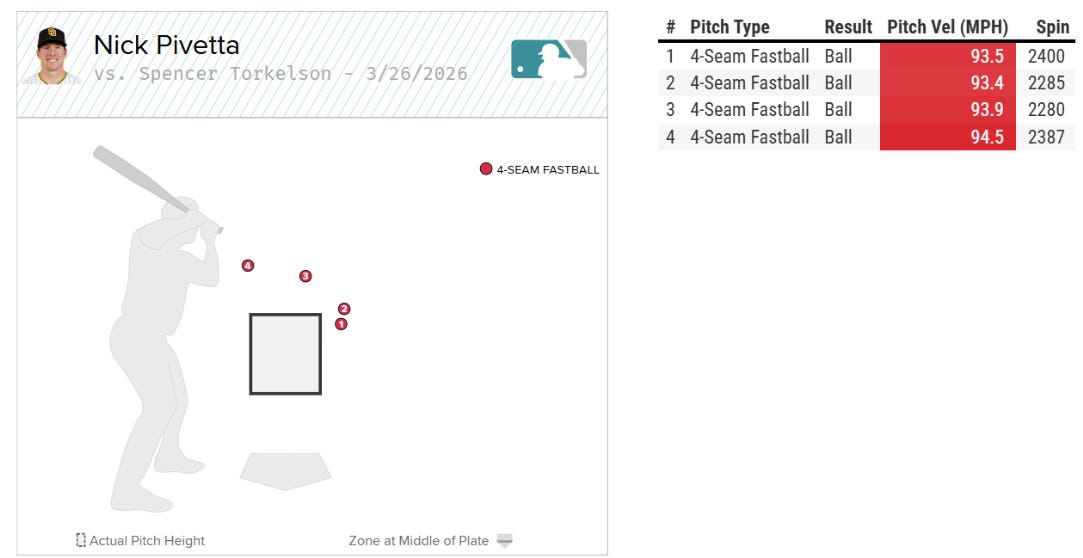
It’s possible he was trying to find his release point, aiming his pitches a little and moving away from max effort in the process. When the count reached 3-0, he went back to a max effort delivery and missed very high, a hallmark of overthrowing and failing to get on top of the ball. Impossible to say for sure.
With the bases still loaded and the Tigers leading 1-0, future rookie of the year Kevin McGonigle came up for his first major league at bat. Pitchers almost invariably follow up a four pitch walk with a concerted effort to throw a strike, and indeed Pivetta threw a cutter on the inner half of the zone that McGonigle ambushed and looped into right field on the first major league pitch he ever saw:
This was the second cutter Pivetta had thrown, the first was a 92.5 MPH, 2470 RPM offering to Riley Greene. The pitch to McGonigle was a 91.2 MPH, 2356 RPM offering. Again, we can’t get inside Pivetta’s head, but it was only the 20th pitch of the game, typically not a significant enough workload for fatigue to be setting in. Small down ticks in velocity and spin can be a result of a pitcher aiming rather than delivering at true max effort. We can’t know, but it’s a more benign possibility than fatigue so early in an outing...
Dillon Dingler would bat with the Tigers up 3-0 and runners on second and third. Pivetta spun a sweeper that was not poorly located but Dingler still hit it off the end of the bat and through the left side of the infield to drive in another run:
Pivetta seemed to settle down a little at this point and located his 4-seamer and curveball well to Parker Meadows, but with velos and spin rates still noticeably lower than the start of the inning:
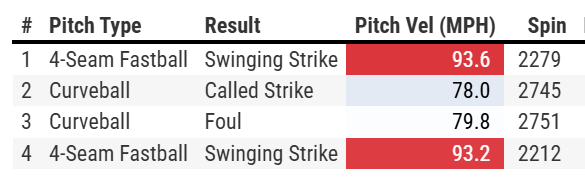
Pivetta’s pitch shapes are so elite that he doesn’t need to blow hitters away with velocity, even at the slower speed and lower spin rates he still achieved over 19 inches of iVB on both 4-seamers and located them perfectly to have the intended effect.
The final batter of the first inning was the notoriously free swinging Javy Baez who had a typical at bat in which he saw only one strike but swung six times including at a sweeper that ended up in the opposite batter’s box:
It’s hard to know if Pivetta was still struggling with control, or purposefully staying out of the strike zone against the league’s most notoriously un-selective hitter. Freddy Fermin saved a run on a very nice block of a sweeper in the dirt mid-at bat which might imply the former. It also looked like the one pitch Pivetta threw in the zone to Baez was actually a location miss:
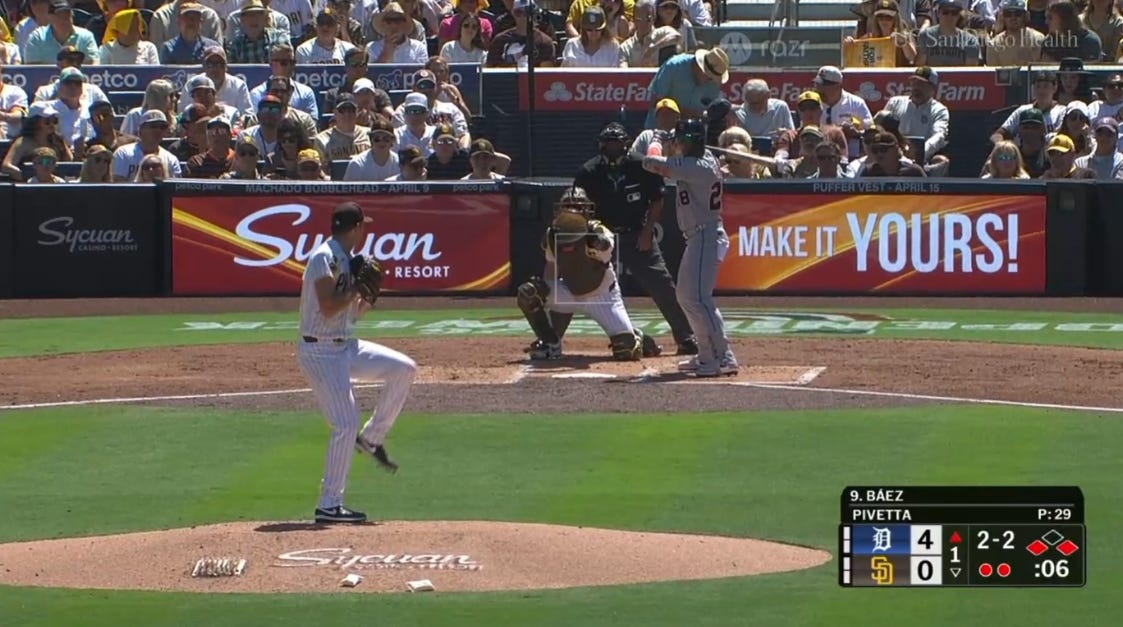
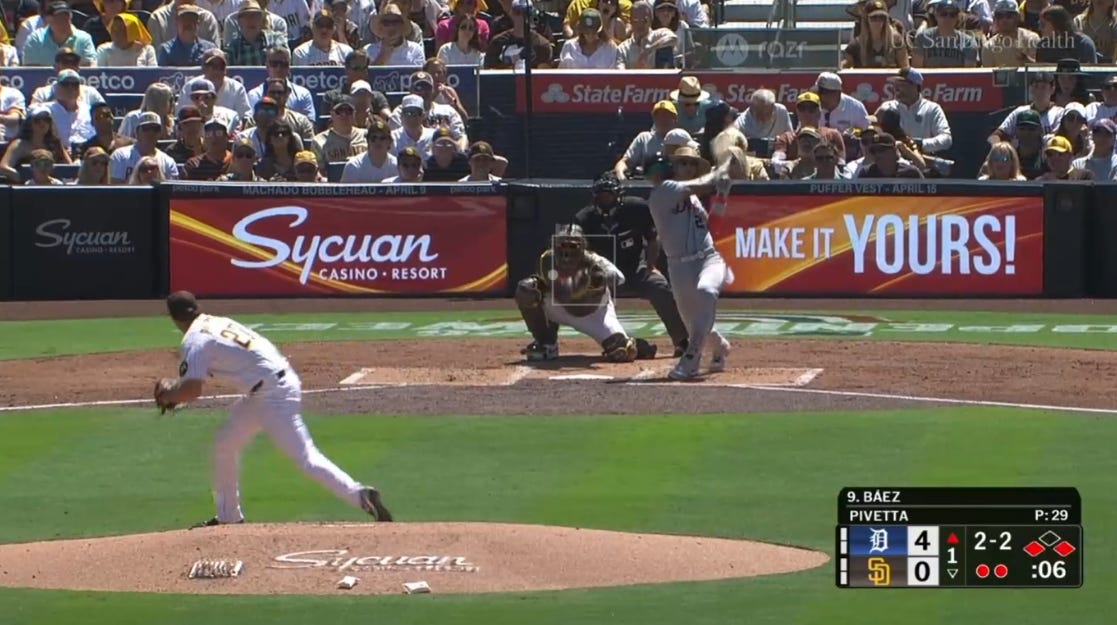
Pivetta would give up a hard hit single in a scoreless 2nd inning, the first truly hard hit ball of the game.
Pivetta would run into some bad luck in the 3rd. Spencer Torkelson led off with a weakly hit single. A 79.6 MPH exit velocity flare to center field:
Future All-star Kevin McGonigle would follow for his second major league at bat and battled back from an 0-2 count to square up a 4-seamer at the top of the zone for a 105.9 MPH double off the right field wall:
Parker Meadows followed with another weak flare to center that found grass despite a 66.5 MPH exit velocity plating two more runs:
Pivetta would finish the 3rd but his day was done after 69 pitches with six earned runs allowed.
Pivetta didn’t give up a ton of hard contact on the day and certainly got unlucky in the sequencing of several weakly hit balls, but the command issues were very real. When he located his pitches he was effective. The Tigers weren’t really squaring him up. Four of the base hits that led to the scoring had weak exit velocities of 66.5 MPH, 70.4 MPH, 79.9 MPH, and 89.9 MPH. The two hard hits that led to scoring had EVs of 97 MPH and 105.9 MPH, the latter being the only truly sublime contact the Tigers made against him. But the walks in the first inning were untenable, and were the product of poor command rather than the hitters’ plate discipline. On the day Pivetta had only a 21.2% strike-zone percentage for his 4-seamer, very uncharacteristic after averaging 55.4% a season ago.
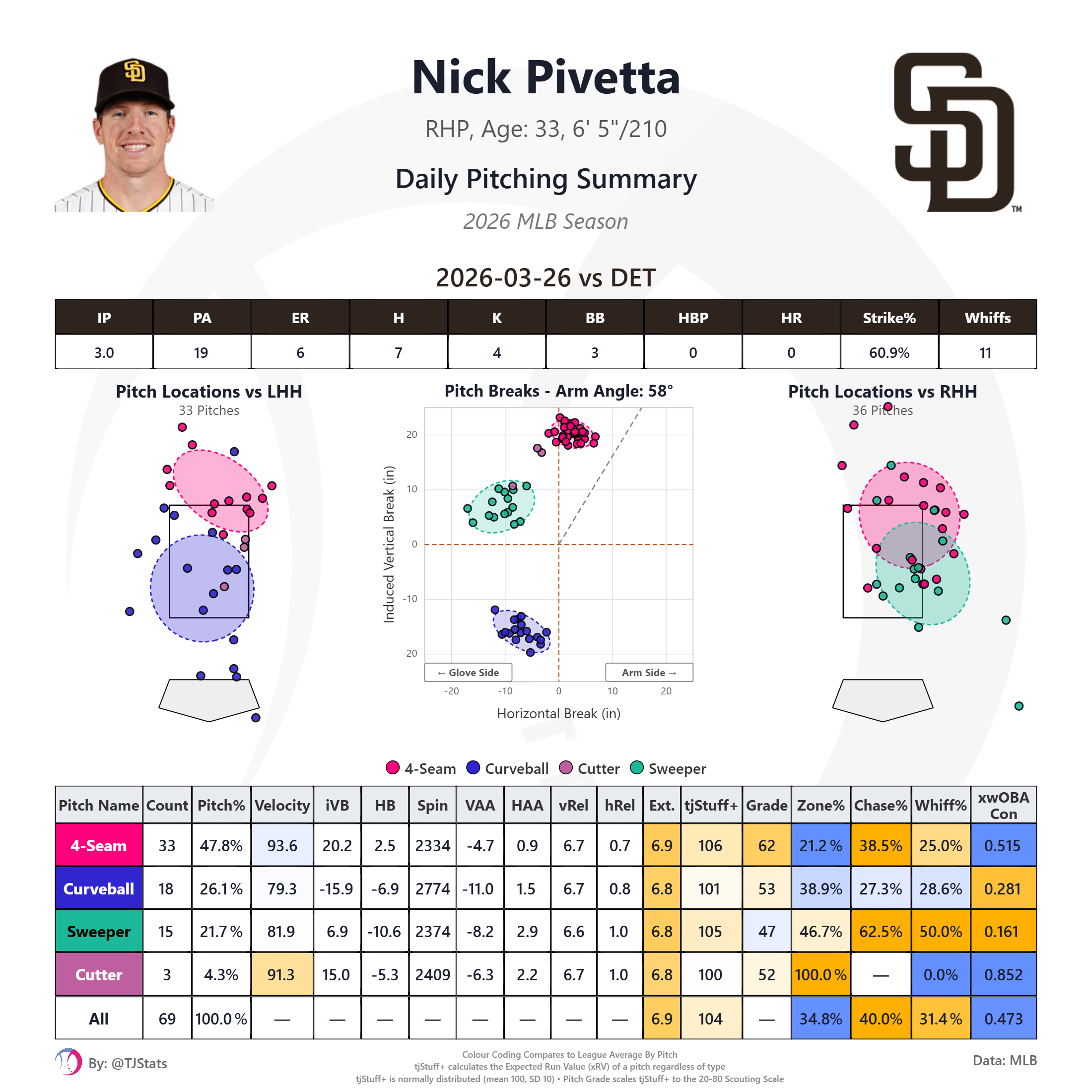
The best case scenario here is if Pivetta was struggling with early season nerves. Too amped up. Overthrowing initially, and not able to locate effectively. Still, the changes in his pitch characteristics as the game went on are something to watch given Pivetta’s delayed start in spring training and the nebulous comments regarding ‘regular arm fatigue’.
The game was essentially out of reach after the 3rd. Tarik Skubal hadn’t given up six runs in a start since 2023 and looked in mid-season form. The Padres hitters weren’t totally overmatched, but managed to scrape across only one run against Skubal. There were some interesting things to see on offense, starting with the lineup:
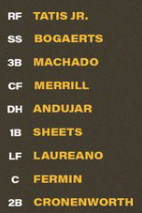
Facing the lefty Skubal it makes sense that Cronenworth was dropped to the bottom of the order and Miguel Andujar was given the start at DH, but it was a bit odd to see Gavin Sheets starting at first base instead of Nick Castellanos whose entire value proposition rests on his ability to hit lefties. It was also interesting to keep Merrill in the 4th spot against possibly the best lefty in the league.
Fernando Tatis Jr led off, after mostly hitting lower in the order in the pre-season. Though he would be retired on a check swing roller, there were some encouraging signs:
His first swing against Skubal didn’t quite connect, but it was the swing characteristics on his first hack that were encouraging:
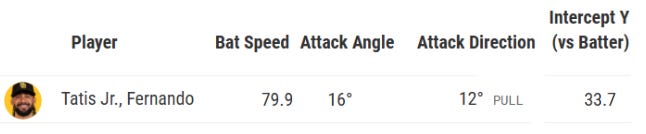
This is the swing that Tatis should be taking nearly every time when there are less than two strikes, and depending on the game situation, often even with two strikes. The bat speed is elite, and the attack angle is a fly ball oriented bat path. The pull-side attack direction and Y intercept of 33.7 inches (how far out in front of the plate the bat intercepts the ball) are optimized for power hitting. Tatis is fresh off the WBC in which he showed he still has light-tower power:
His swing characteristics had been trending away from the pull side/flyball orientation each of the past three seasons:
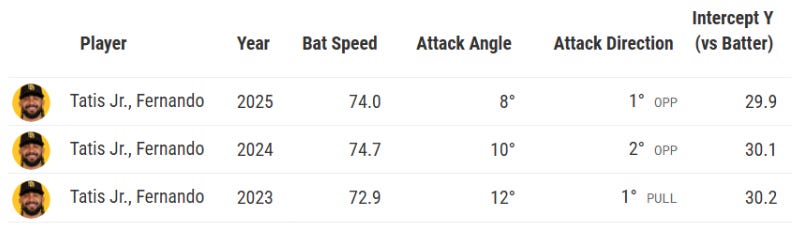
The Padres new hitting coach Steven Souza Jr. has emphasized the importance of improving the Padres ability to hit for power, and the best way to achieve that is for hitters with raw power to orient their swing paths towards pulling the ball in the air. Tatis hasn’t connected yet, but taking swings like this is the right process to maximize his talents. Tatis would hit the ball hard each of his next three at bats, but come away with only one hit on a 107.2 MPH line drive single to center in the 8th:
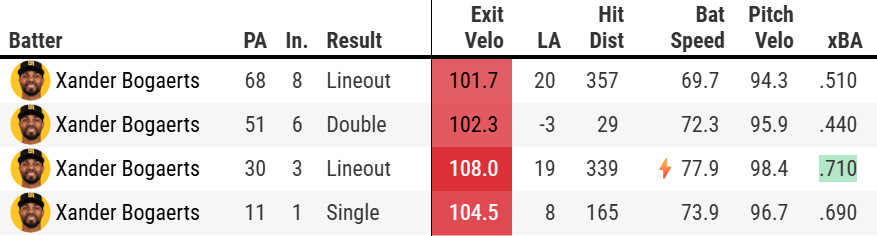
Xander Bogaerts saw the ball very well all day, including hitting the ball hard in all three at bats against Skubal:
His 2-4 final line belies how well he hit all day:
Manny Machado had a relatively quiet day but reached base twice on a walk and single.
Jackson Merrill had a rough first game with three strikeouts, and it’s fair to question the wisdom of hitting Merrill in the crucial 4th spot against the league’s top lefty. But the team clearly feels Merrill will develop into a true every day heart of the order hitter.
The most impressive swings came from Ramon Laureano who looks healthy after a freak hand injury ended his season just before the playoffs in 2025:
Laureano hit 7th. And while having power at the bottom of an order is a great luxury, it is likely only a matter of time before Laureano is hitting nearer the heart of the order.
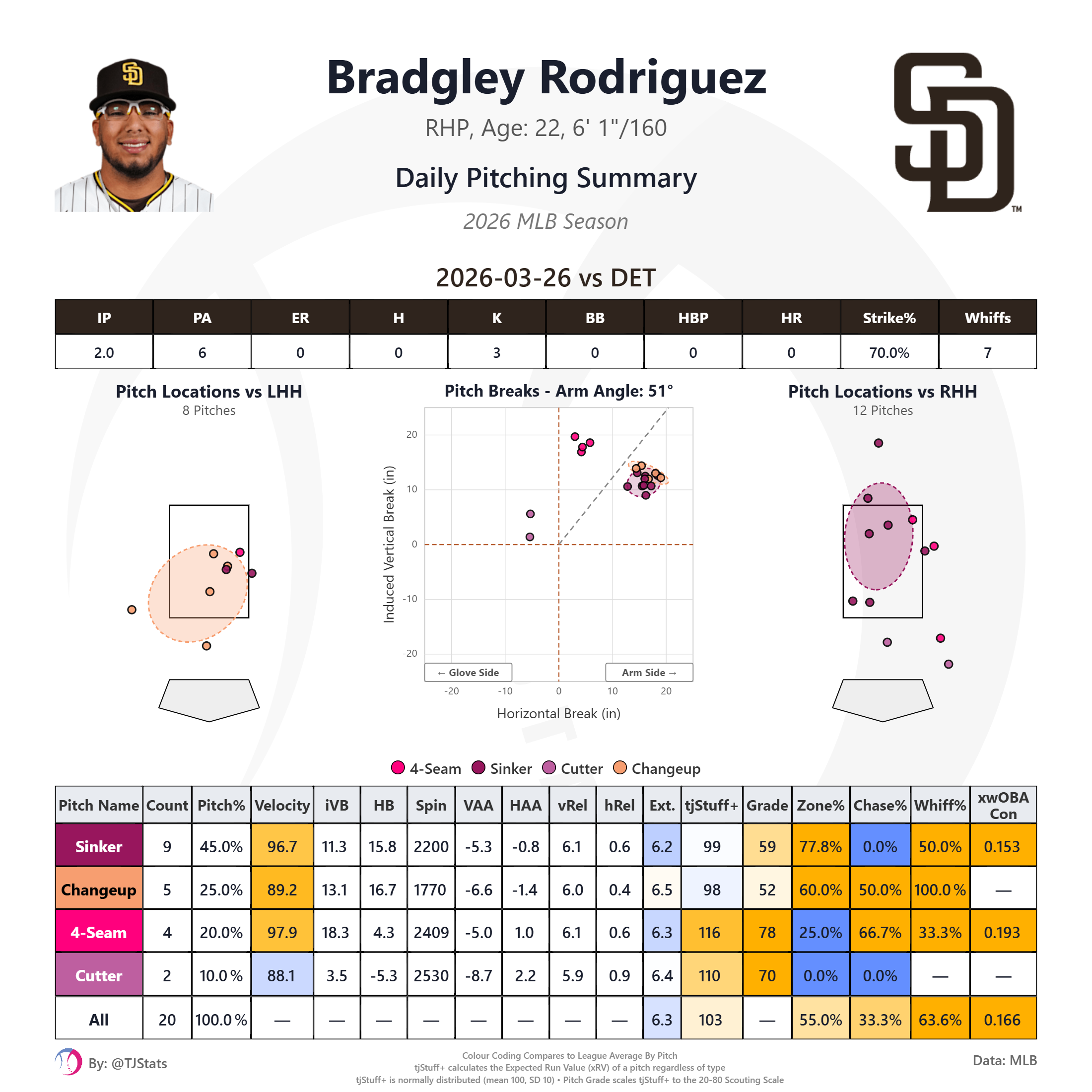
With Pivetta’s early exit and the game out of reach the bullpen was called on to pitch long relief. The most interesting performance came from Bradgley Rodriguez who was electric. Rodriguez attacked right handed hitters with his outstanding 4-seam fastball that reached 98 MPH with 18 inches of iVB, and sinker that sat at 97 MPH with 16 inches of arm-side break. But the most interesting pitch was his changeup which he deployed to the lefties he faced. The most impressive sequence came against the heart of the Tigers order including back-to-back three pitch strikeouts to Colt Keith and Riley Greene, finishing both off with consecutive changeups:
If Rodriguez can command his changeup he may be the rare right handed reliever who can reliably get lefties out, and that is an incredibly valuable player in the modern game. Rodriguez is only 22, and it’s not wise to draw conclusions yet given his limited body of work. But you really couldn’t ask for a more encouraging first showing.
Game 2
Michael King took the mound in game two facing off against another formidable Tigers lefty Framber Valdez. We wrote about King’s pitch shapes in spring training. Although his velocities were right in line with 2025, the movement on his pitches, especially the horizontal break, had been slightly behind his 2025 season averages, including in his final spring start just over a week ago. One possible explanation for the decreased movement could have been the different atmospherics in the desert confines of Peoria, and indeed in King’s first start at Petco the break on his pitches was much closer to what he’d shown in 2025:
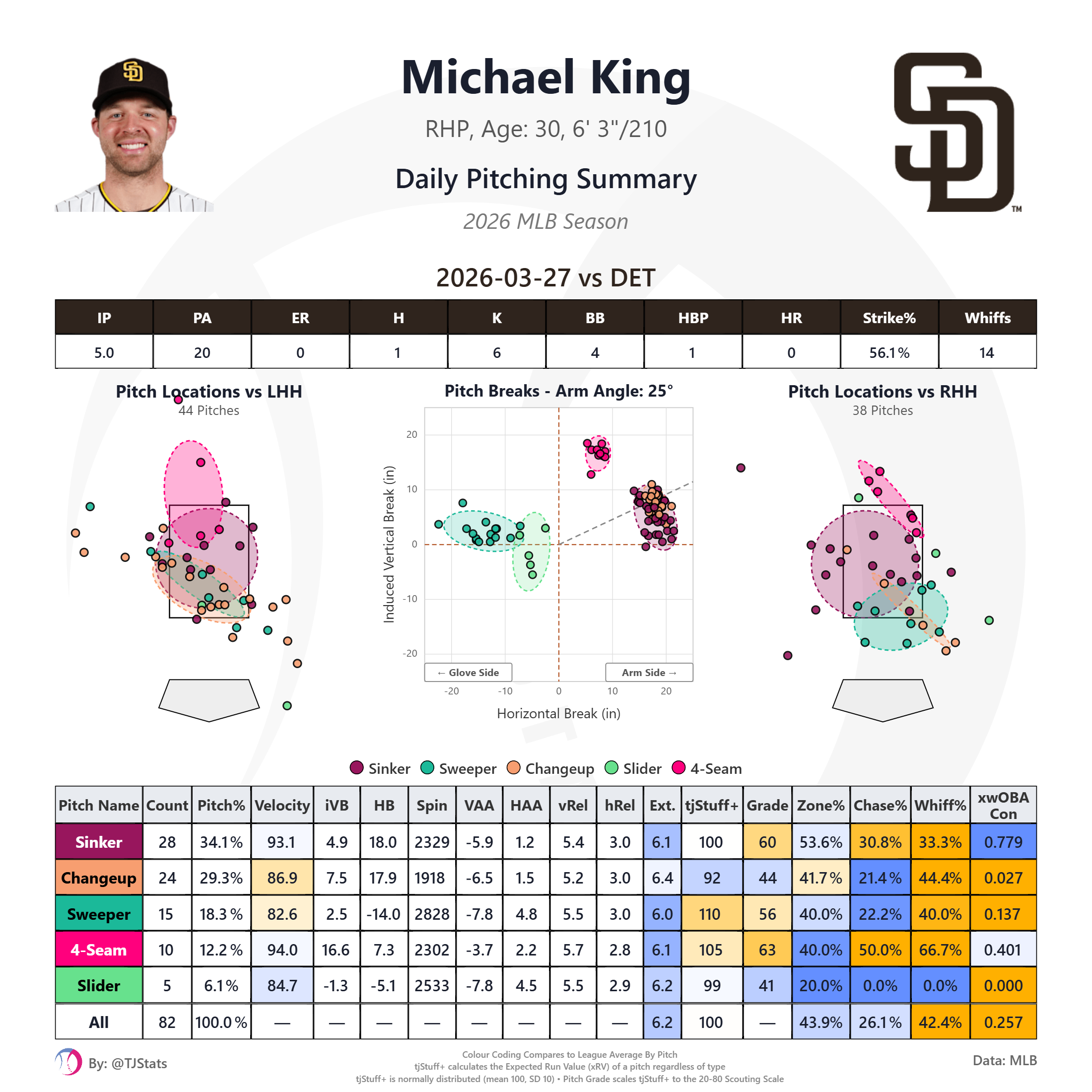
The Sinker and Changeup made up the bulk of his arsenal as expected, and both had about 2 inches more horizontal break than at any point during spring training, right back in line with his 2025 movement profile. King was also effective with his 4-seam fastball, using it sparingly but getting a 66% whiff rate and hitting 95.4 MPH on the gun:
The only hard hit King gave up all night came from future MVP Kevin McGonigle who had finished his first big league game with four hits, and nearly went yard in his first at bat Friday night:
King finished the night with five innings pitched, six strikeouts, three walks, and a HBP giving up one unearned run. If King remains healthy it’s very likely he will pitch like a top of the rotation starter. There’s no indication he’s lost any of his stuff after the long layoff last season.
King would leave with a 1-0 lead after facing the first batter of the 6th inning, Gleyber Torres who drew a walk on a 3-2 pitch after a tough at bat.
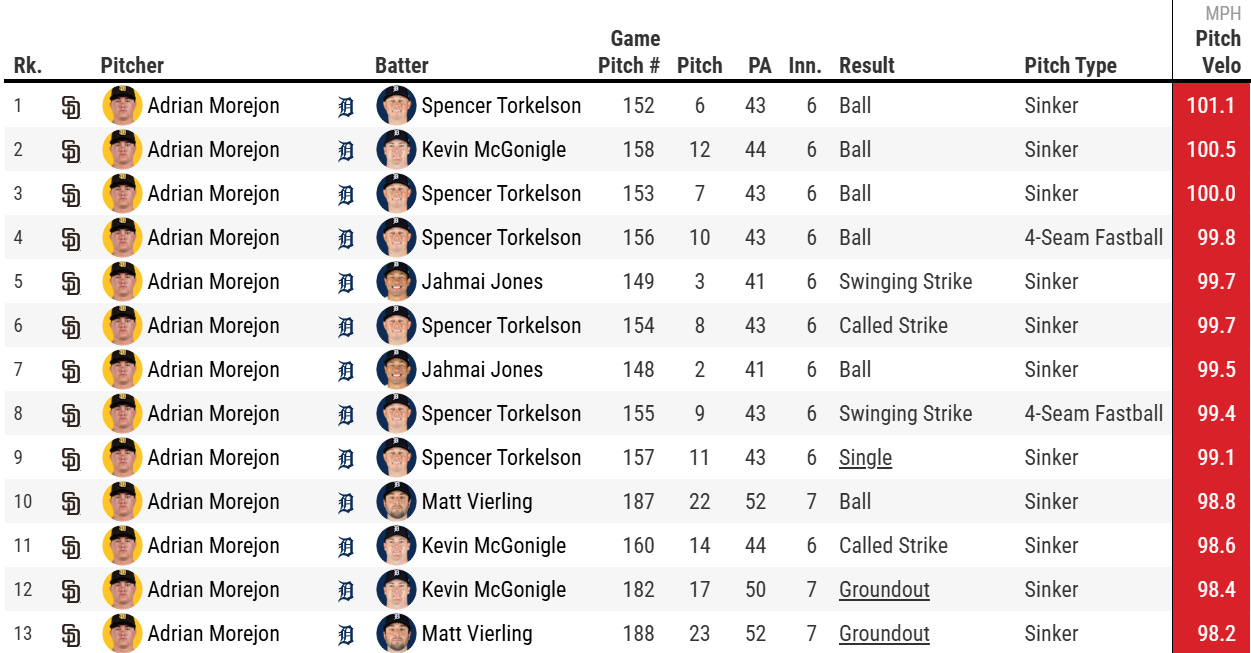
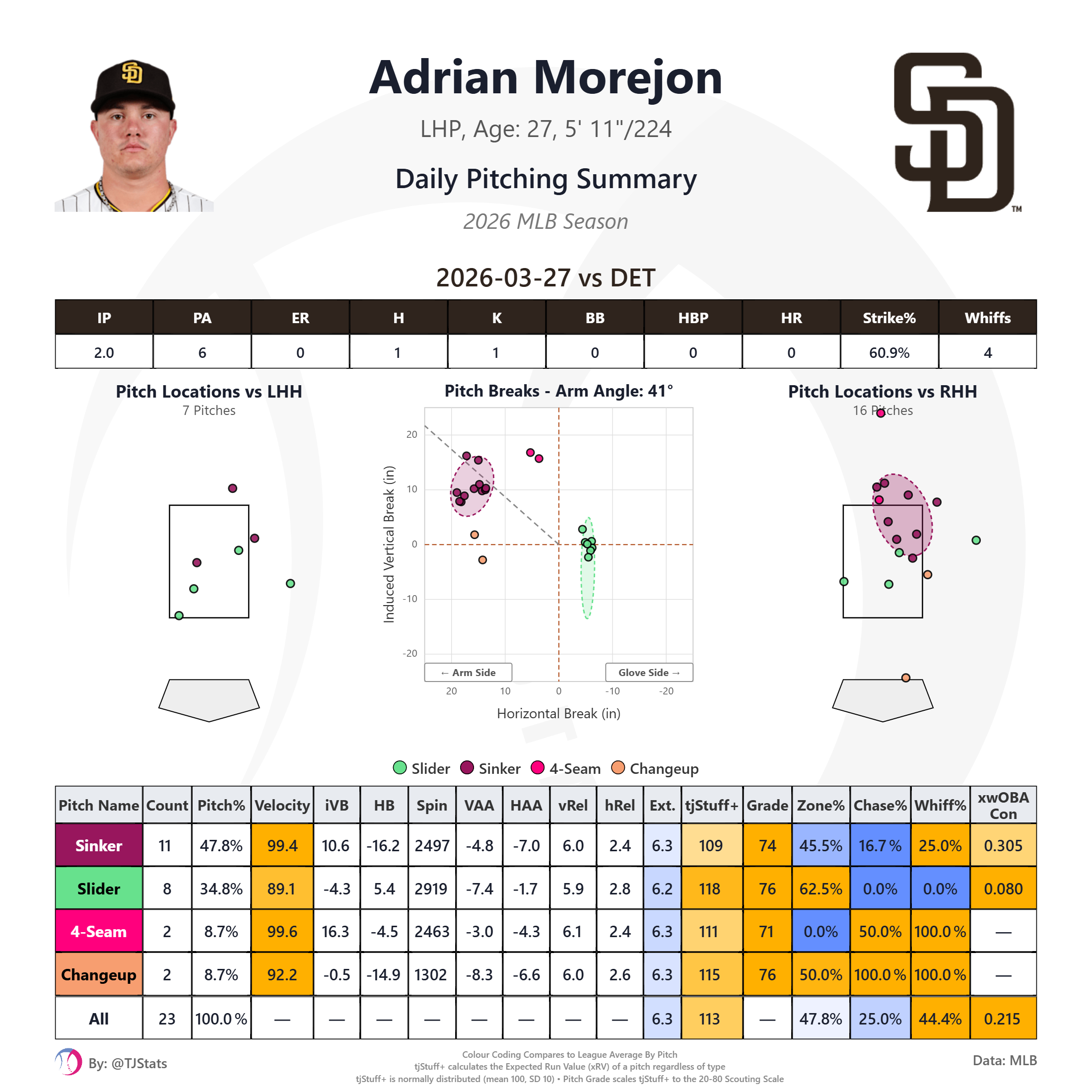
Adrian Morejon came in to relieve King, making his first appearance of the season. And Morejon showed something new. In 2025 Morejon averaged 97.7 MPH on his sinker and 96.5 MPH on his 4-seam fastball. His first sinker of the night to Jahmai Jones was 99.5 MPH. His first 4-seamer was 99.4 MPH. And he would dial up the velocity from there. Morejon ended up throwing the 13 fastest pitches of the night. He reached a max of 101.1 MPH with his sinker and 99.8 MPH with his 4-seamer:
Morejon looked overpowering in his first matchup against Jahmai Jones, freezing him with a slider, getting a whiff on a sinker near the top of the zone, and inducing a flailing swing at a 2-strike slider that bounced right to Manny Machado for what appeared to be a double play ball:
Machado’s error put two on with no outs and the Tigers best hitter Riley Greene at the plate. Morejon’s first pitch was an 89.2 MPH 2902 RPM slider that Greene bounced back to the mound for a 1-6-3 double play:
With a runner on third the 1-0 lead was intact and Spencer Torkelson was up. In a six pitch at bat Morejon threw nothing but heat, with every pitch over 99 MPH, including two over 100 MPH. But the Tigers uncanny good fortune continued. On the final pitch of the at bat Morejon threw an 80 grade sinker with a Michael King-like 18 inches of horizontal break that Torkelson hit weakly off the end of the bat, only an 82.2 MPH exit velocity. But it found grass just in front of Ramon Laureano in left and the game was tied:
The inning would come to a close when Luis Campusano threw out Torkelson trying to steal second. Campusano’s throw was truly excellent, to the first base side of the bag which is the shortest path for the ball to travel allowing for the tag to be applied sooner:
Impeccable.
Morejon would pitch the 7th and retire the side in order. The unearned run marred the outing somewhat, but Morejon’s performance was elite. No hitter looked comfortable.
In the bottom of the sixth with one out Jackson Merrill drew a tough walk off Framber Valdez in a six pitch at bat, and took second after an errant pickoff throw from the Tigers’ catcher Dingler. The Padres hitters were seeing Valdez for the third time and Miguel Andujar got off a good swing on a sinker and nearly hit it out to left field, but it was tracked down for the second out. Ramon Laureano, moved up to sixth in the order Friday, had been taking good swings all night but seemed to be really seeing Valdez well in his third at bat. He nearly doubled on a deep line drive to right field that fell just foul. He pulled the next pitch sharply foul down the third base line. After laying off a sinker up out of the zone, Laureano finally hit paydirt clubbing a double off the wall in right and giving the Padres a 2-1 lead:
Laureano had nearly homered off Valdez in his second at bat, a towering shot just hooking foul left of the Western Metal Supply building:
Laureano made great swing decisions in addition to punishing several balls both fair and foul the first two games of the season. There has been no sign of a fall off after a resurgent 2025.
The Padres would take the 2-1 lead into the 8th and Jeremiah Estrada was brought in to protect the lead. The inning played out eerily similar to the 1st inning of game 1. After striking out the first batter of the inning, Estrada completely lost command. He walked three straight hitters, missing badly both above and below the zone as he struggled to find his release point. The walks loaded the bases. The Tigers’ best non-McGonigle, Riley Greene, came up in a big moment. Estrada managed to jam Greene badly on a 4-seamer up and in, but the 57.3 MPH exit velocity squib trickled towards the empty part of the infield where no one could get to it in time:
The infield single tied the game and left the bases loaded.
To Estrada’s credit he found his poise and cut down Spencer Torkelson on four pitches with the bases still loaded to record the second out of the inning. The fourth pitch of the at bat was special, a 96.2 MPH 4-seam fastball with an unheard of 23 inches of iVB:
That was a laser beam. The pitch only dropped 7 inches on its way to home plate and had almost no horizontal break. An almost pure magnus spin heater that grazed the top of the strike zone. A perfect pitch.
This was Estrada’s worst outing of his Padres tenure, but it was entirely of his own doing. In the end he faced six hitters, struck out two, walked three, and gave up the squibbed infield single to Greene. And while his final pitch of the outing had elite shape, it’s notable that his fastball velocity averaged 96.2 MPH and topped out at 96.9 MPH after averaging 97.9 MPH last season. His slider and splitter velocities were also about 3 MPH below his 2025 averages:
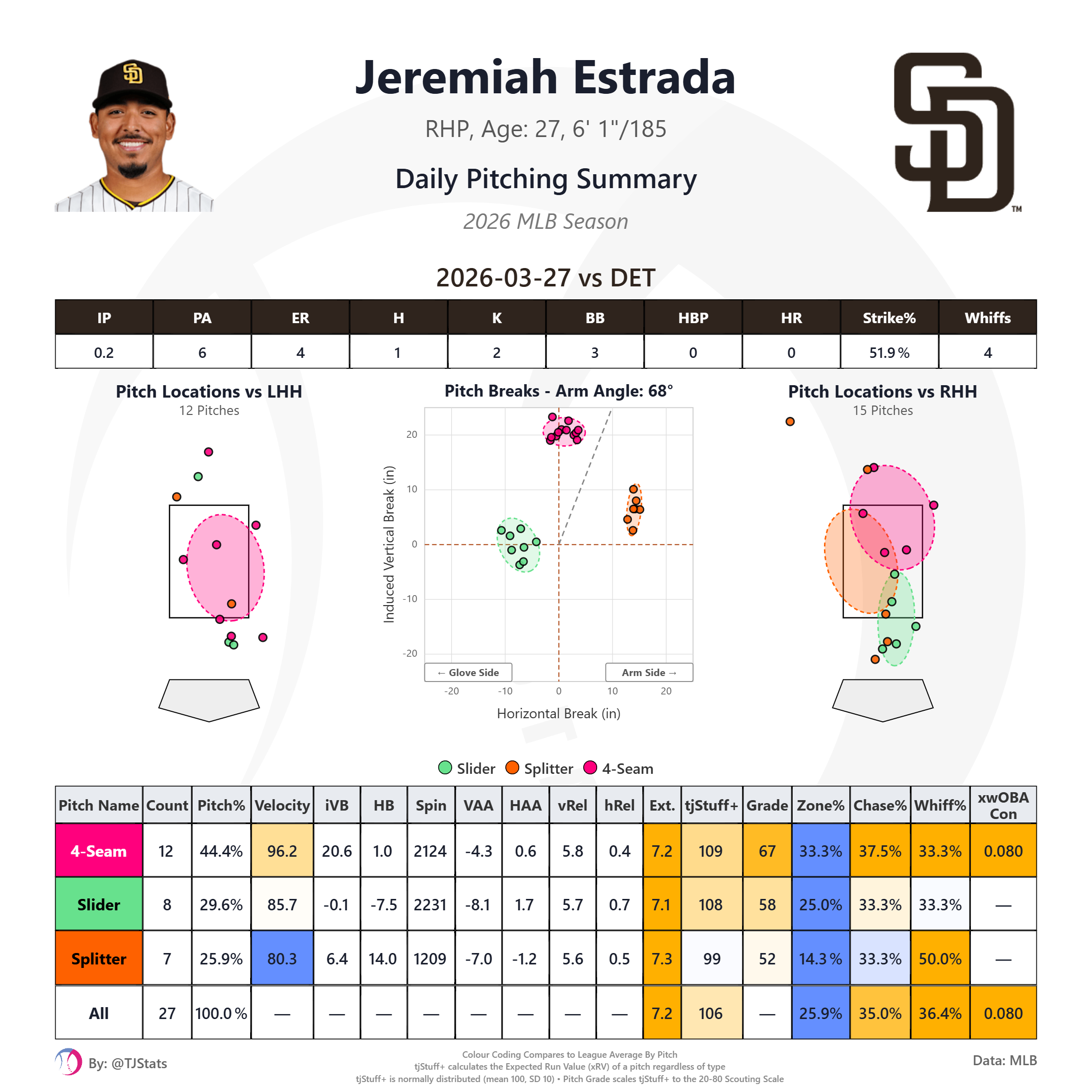
It’s hard to know what to make of those numbers. Estrada struggled badly with control, and perhaps he took a little off his pitches just trying to be in the zone. Perhaps its just early in the season and he’s still building up. Regardless of stuff, though, no pitcher can survive throwing only 25% of their pitches for strikes. Estrada should be better than this going forward, but command and velocity are items to watch in his subsequent outings.
An interesting sequence followed Estrada’s departure with two outs and the bases loaded. Wandy Peralata was brought in to face future first ballot hall of famer Kevin McGonigle. Playing in his second game ever, McGonigle took the at bat like a 10 year veteran, fouling off six pitches and working a full count before finally breaking through:
The Tigers would push the lead to 5-2 and take the second game of the series.
Game Theory
It’s worth lingering on the 8th inning for a little longer, because there was an important game theory consideration. The Padres elected not to use their bullpen unicorn, Mason Miller, at all during a very close game that the Padres were in position to win very late in the game. Craig Stammen would note that “We decided before the game that [multiple innings for Miller] was probably not an option.” This is a perfectly valid constraint to put on Miller’s usage early in the season. But it may have been more efficient to use Miller in the 8th even with the one inning constraint. Because after Jeremiah Estrada struck out the first batter then walked the next two, two things happened simultaneously:
Estrada was eligible to be removed from the game having faced the three batter minimum, and
The leverage index increased above the maximum possible leverage that a closer can face to start the 9th inning
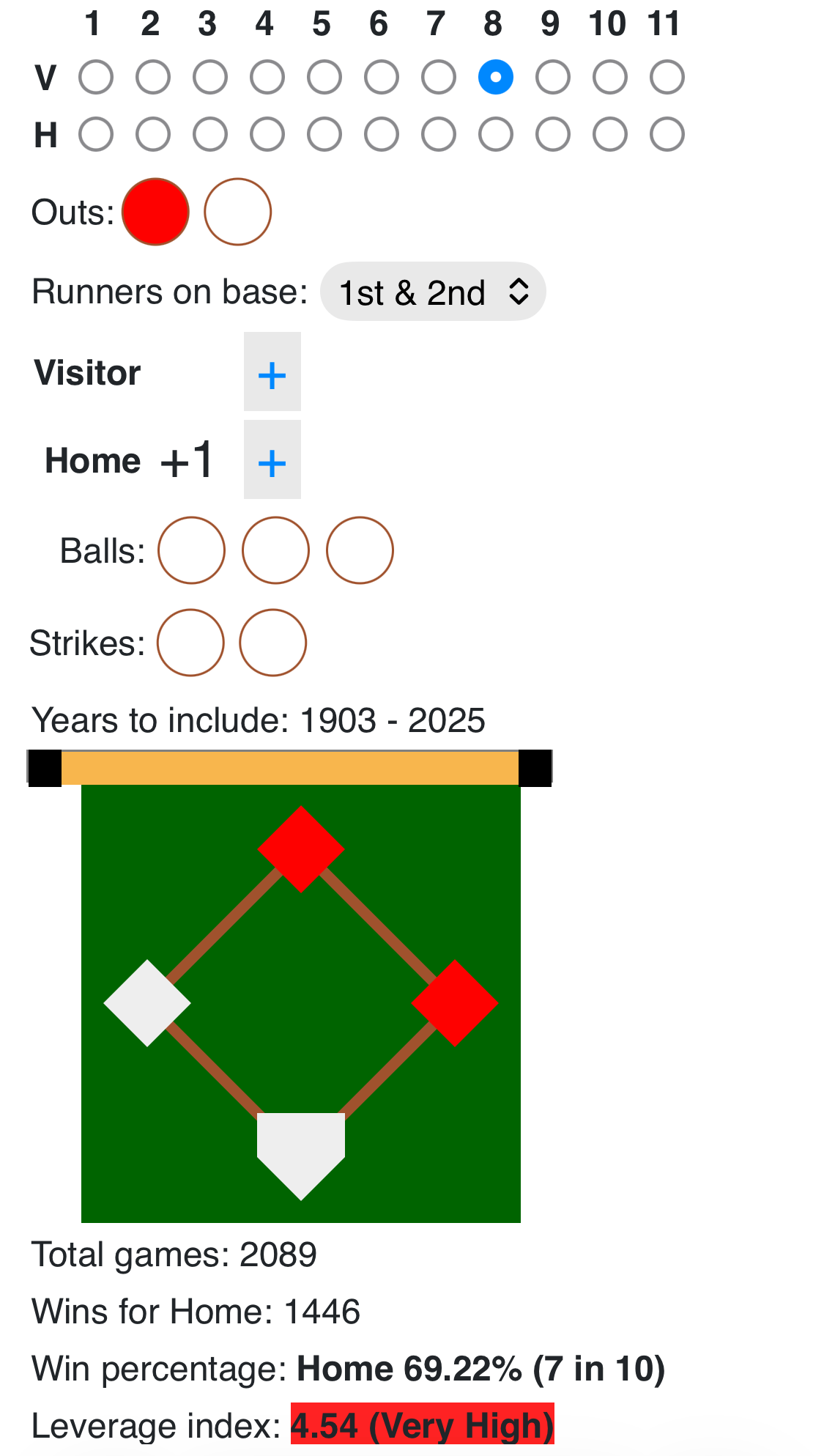
The leverage index quantifies the swing in win probability based on the outcome of the current situation compared to the average swing across all situations. The leverage index with one out in the top of the 8th inning and runners on first and second with the home team leading by one run is 4.54, extremely high:
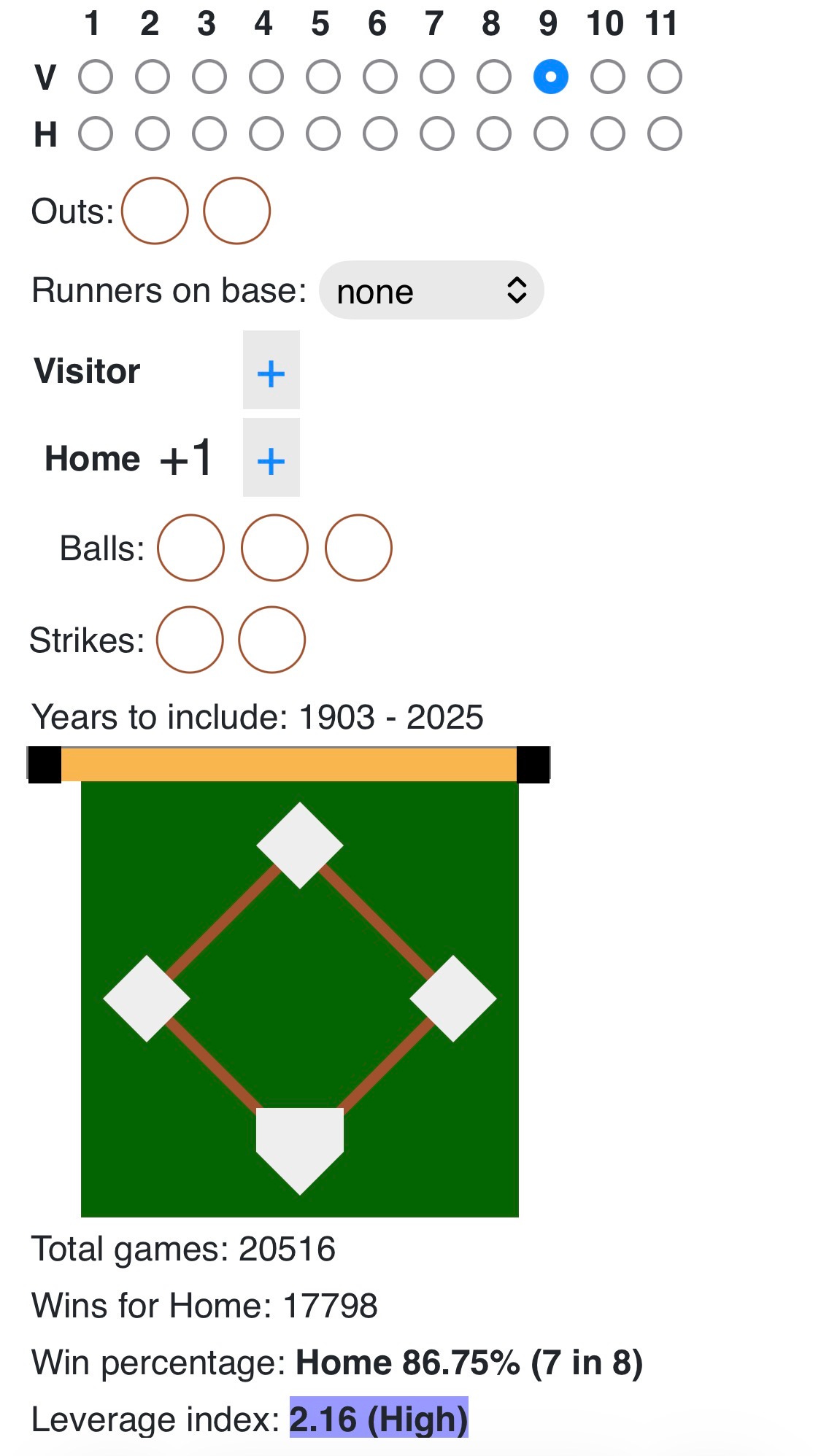
For comparison the highest leverage a closer starting the top of the 9th inning in a save situation can face is 2.16, still high but significantly lower leverage than the 8th inning situation above:
In holding Mason Miller back at that moment, the Padres made a quiet but consequential guarantee: If Miller pitched at all, he would be entering a lower-leverage environment than the one currently unfolding.
From a decision-theoretic perspective, bullpen usage is an allocation problem under uncertainty. Each pitcher represents a different distribution of outcomes, the best arm (closer) having the tightest distribution and highest probability of preserving win expectancy in volatile (high leverage) game states.
If the goal is to maximize the chance of winning, the objective should not be to “save” the best pitcher for a pre-determined inning. The objective should be to allocate the highest-skill resource to the highest-leverage node in the game tree.
At the moment Estrada issued the second walk, that node had arrived.
The Padres instead chose a pre-conceived strategy: reserve Miller for a future state (the 9th) that by definition carries a capped leverage ceiling (2.16). In doing so, they passed on a present state whose leverage had already exceeded that ceiling and hence they passed on an opportunity to harvest more win probability.
It’s also fair to say that the situational leverage was asymmetric:
The downside of the current situation in the 8th (allowing the Tigers to tie or take the lead) is immediate
The upside of waiting to deploy Miller in the 9th inning is contingent and may never materialize (which it didn’t)
Another way to say this is that the Padres were ironically reallocating Miller to a lower expected impact role, while leaving a higher-consequence moment to a lesser reliever.
This is more complicated of course because convention in baseball is extremely powerful, and unconventional decisions risk a manager getting pilloried by fans and press if the move doesn’t work out, since deviations from well established convention intuitively feel like strategic errors. It was also more difficult practically given the pace of the modern game with the pitch clock, limited mound visits, and a reported clamping down on "pitch com malfunctions”. The team may simply not have had the time to warm up Miller unless he started to warm up early in the eighth, and that may not be something the team wants to do. Still, it’s worth considering whether to have an override condition for pregame decisions if the opportunity for a crucial or unexpected win arises and the leverage of the situation implies a change in strategy.
These are certainly considerations on the margin, and that may seem like irrelevant minutiae, decision points that might only nudge the team’s win probability a few percentage points one way or the other. But when you look at the actual margins that separate teams at the end of the season, you see how slim these margins actually are. Here are the number of games, and the difference in winning percentage, that the Padres either made or missed the playoffs by for the past five seasons:

If a team can cobble together enough good decisions to tilt their odds to win by even 1-2%, that’s a potentially very meaningful difference in total wins across the entire 162 game season. If ever they have an opportunity to decide to pursue a strategy that increases their odds to win a game by even 5%, that is enormous across the span of 162 games.
This will inevitably sound like Monday morning quarterbacking, but the point is actually the exact opposite of exercising hindsight: this type of stochastic dynamic game optimization can be made prospectively. The game theory offers a clean mathematical rule that will lead to more wins over the long term:
If choosing between deploying a closer in the 9th inning vs the 8th inning, if the leverage in the 8th inning exceeds the maximum possible leverage of the start of the 9th inning, deploy the closer now.
This holds up even if the closer is on a one inning limit.
There is small likelihood this type of strategy will be pursued by the 2026 Padres. But it’s a decision point they control.
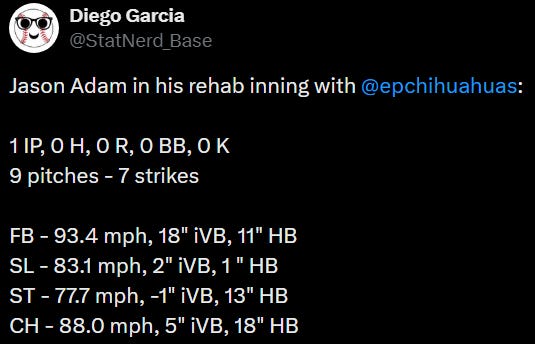
The Padres look to have a very deep bullpen, especially with Jason Adam making a minor league rehab start this week and his pitch shapes and velocity looking healthy:
Perhaps there was no opportunity to truly intervene in the unravelling of the 8th inning in game two Friday night. But there will undoubtedly be similar decision points, similar leverage swings, across many games this season. A deep enough bullpen can afford to have arms warming up, ready to quickly pivot if there are unexpected leverage swings. And pouncing on every opportunity to harvest slivers of win probability through optimized decision making is found money. Something the Padres could really use more of.
The first two games gave a good look at the top of the Padres rotation, and their lineup against lefty starters. Despite the two tough losses, baseball’s back in full swing, and this season looks as fascinating as the last.
We’ll cover the game three revelations, and more ABS game theory in Part 2.
Must-read. Every time. Great as always D
A great part of baseball season is back…Dylan’s Substack game reviews!