
Opening Day
Inspecting The Foundation

Analysis of the Padres opening day roster shows a strange juxtaposition:
The 2026 Padres appear built to perform well across a short playoff series, but
They may be poorly suited to survive the 162 game regular season gauntlet
The Padres lineup, top end starting pitching, and bullpen stack up well with any team in the league. But survival through to the playoffs depends heavily on how they fare across 30+ trips through the starting rotation. And a team without a credible fourth and fifth starter is very unlikely to win enough games to survive no matter how good the best version of itself might be.
Final Roster
As Jeff Sanders reported, the start of the Padres will include a significant amount of talent on the IL.
Right-handers Jason Adam (left quad), Griffin Canning (left Achilles), Bryan Hoeing (elbow), Joe Musgrove (elbow) and Matt Waldron (hemorrhoid surgery) will begin the season on the 15-day injured list, as will left-hander Yuki Matsui (left groin). Infielders Sung-Mun Song and Will Wagner, both nursing right oblique strains, will open the season on the 10-day injured list.
The Padres starting lineup is likely to look something like this:
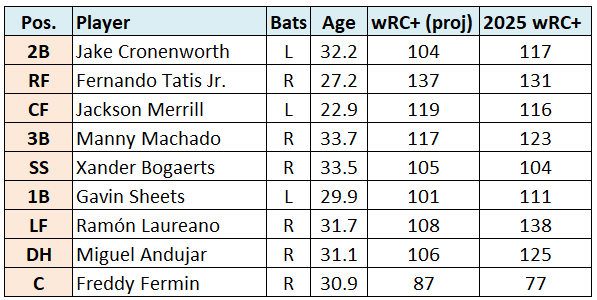
That is a lineup with just enough offensive firepower and defensive chops to be competitive in a playoff race. Fernando Tatis Jr. and Jackson Merrill both have the potential to exceed their projections, and either doing so would meaningfully increase the chances that the Padres offense is good on the whole.
The trio of Gavin Sheets, Ramon Laureano, and Miguel Andujar are all projected by Fangraphs to regress from their 2025 performances, but all project to still be above average offensive contributors even if the regression is realized. Miguel Andujar is a former runner up for rookie of the year in 2018 when he hit 27 home runs with an .855 OPS for the New York Yankees. He’s never replicated his rookie year success, but he’s been a serviceable hitter against favorable platoon matchups his whole career. Ramon Laureano is harder to forecast as his 2025 breakout was a bit unexpected, and his season ended on a bizarre right hand fracture. Gavin Sheets appears to be the most likely of the trio to sustain his breakout performance from 2025 given his age and the lost development time he suffered with the moribund White Sox early in his career.
The bench is unusually high variance as well:
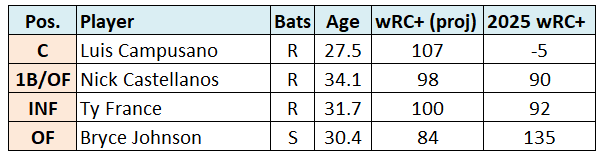
It appears Luis Campusano will be given a real chance to accrue playing time in 2026. He’s done everything a player can do at the AAA level. He’s even had briefs stints of success at the major league level. But he’s no longer a young prospect. It’s time to produce, or move on.
The team appears committed to finding out if Nick Castellanos can be a situationally effective hitter. Castellanos’ falloff in 2025 was multifactorial, but from a purely statistical standpoint, it was his sudden ineffectiveness against left handed pitching that accounts for the drop in production compared to years past:
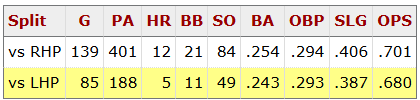
He really didn’t fare much better against RHP in 2024, but maintained outstanding production against LHP boosting his overall productivity:
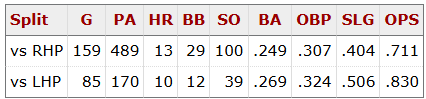
In fact his entire career has been built on feasting on left handed pitching:
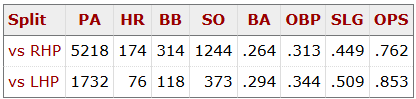
If he can still be effective as a platoon bat, he’ll provide value. If he’s not able to hit LHP his career is over. It would be wise for the Padres to figure this out early in the season, because Castellanos does not provide credible defensive or baserunning value.
Ty France and Bryce Johnson provide legitimate multi-positional defensive depth and can take non-embarrassing major league at bats.
The lineup appears more likely to be good, than not, but with more variance than seasons past. On paper it’s a strength.
The Bullpen
Jason Adam, Griffin Canning, Matt Waldron, and Joe Musgrove will start the year on the IL. And while starting pitching is clearly the area of highest concern for the team, it’s Adam’s absence, and eventual return, that might impact the team’s late season fortunes the most.
Adam threw 19 pitches in spring training across two scoreless innings, but he’s rehabbing from a ruptured quad, and his stuff is not back to what it was in his stellar 2025. But despite his absence the Padres bullpen still looks strong:
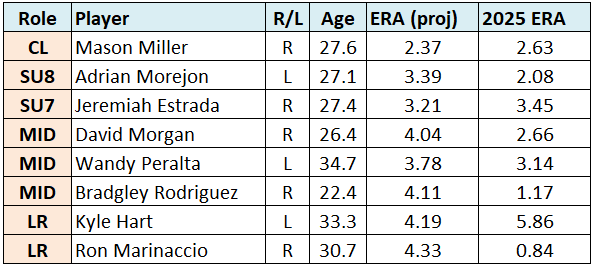
A lot will hinge on whether David Morgan and Bradgley Rodriguez can harness their outstanding arm talent and become true, reliable, setup arms. Both can be overpowering at times. But neither has the pedigree of sustained success at the major league level in high leverage duty.
The 2025 playoffs were yet another data point demonstrating the outsized importance of dominant relief pitching, especially in playing platoon matchups to navigate opposing teams’ best hitters. Adrian Morejon established himself as one of the premier left handed relievers in the league last season, but the Padres have only Kyle Hart and Wandy Peralta behind him. It is here that Adam’s absence will be felt the most as Adam is the rare dominant right handed reliever who is just as effective against left handed hitters (more so, even):

Adam’s absence will create space for the Padres to get extended looks at what they have in Morgan and Rodriguez, and should Adam regain his 2025 form when fully healthy it’s not a stretch to think the 2026 Padres bullpen could be the most dominant they’ve ever had.
It’s also easy to imagine how the bullpen might sputter. If Morgan and Rodriguez cannot thrive in higher leverage roles, and if Adam’s athleticism is impaired longer term, the team will end up struggling to lock down wins. Especially given the starting pitching outlook.
Starting Pitching
The starting pitching is far and away the biggest question mark for the 2026 outlook. Every pitcher in the rotation has various sources of concern.
Nick Pivetta was a revelation in 2025, finishing 6th in Cy Young voting while setting a career high in innings pitched across 31 starts. His 2026 spring training included a delayed start for which he gave this ominous explanation:
I would just say just regular arm fatigue
Still, he pitched five shutout innings in his final outing March 20th and his pitch velocities and shapes were nearly identical to his 2025 campaign.
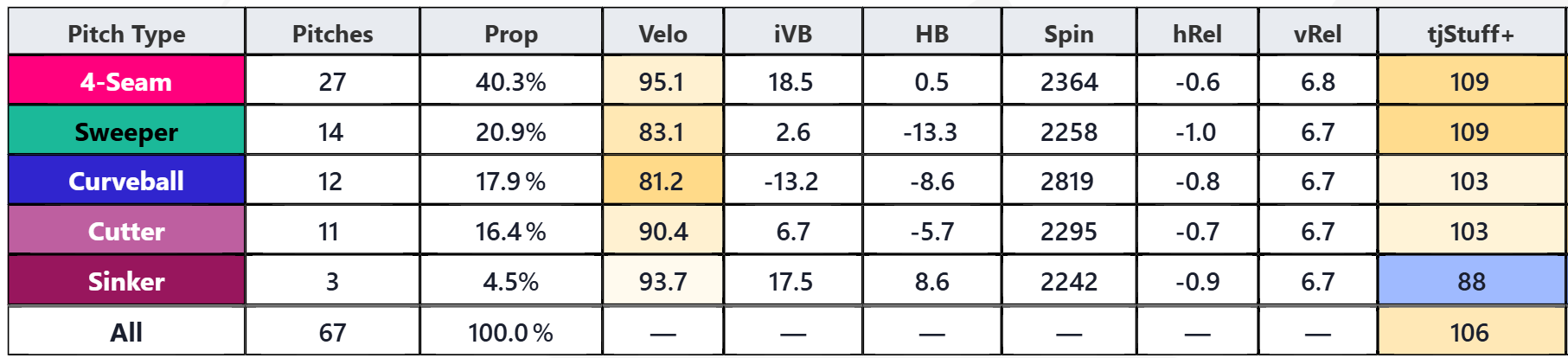
The hope is that Pivetta’s delayed start and nebulous comment were truly just anodyne pre-season workload management. It’s hard to be a Padres fan and not get a jump scare at any mention of ‘arm fatigue’ from a front end starter. But if you’re looking for evidence that Pivetta is ok, you couldn’t hope for much better than that of the underlying pitch metrics from his final preseason start.
Michael King starts the season as the unquestioned number two starter in the rotation. He made five starts this spring, and his pitch velocities are right in line with what he showed when healthy in 2025:
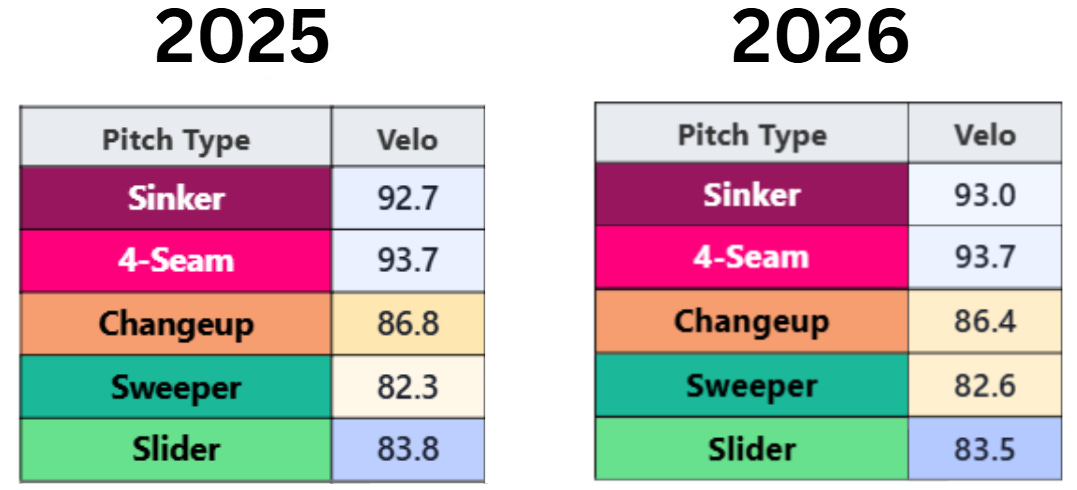
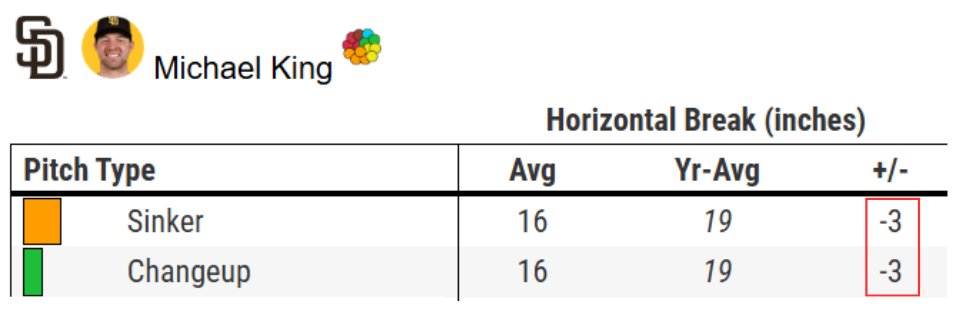
But his pitch shapes, even in his final start on March 19th, remain off from what he demonstrated in 2025. Especially the all important horizontal break on his sinker and changeup:
The front door sinker with its wildly deceptive horizontal break is the pitch that made Michael King famous:
Courtesy: @PitchingNinja
He was still able to be effective in spring training when his location was impeccable:
But he gave up nine home runs in his five starts, six of which came off of the sinker or changeup. It’s very early and perhaps he’s struggling to find command, especially of the notoriously difficult to locate changeup. But it’s hard to watch pitches like these and wonder if perhaps it’s just not moving the way he’s used to:
This last changeup had only 15 inches of horizontal break, and ended up right over the heart of the plate. There’s probably some location miss that factored in, but his 2025 offerings had 4.3 inches of additional arm-side run, and that was undoubtedly a factor.
You can see why just a few inches less arm-side run on the sinker may be a problem as well:
This was a good piece of hitting on a sinker that ran in off the plate to Christian Moore. But you can see on Baseball Savant’s 3D pitch reconstruction that if the sinker had even two more inches to the arm-side, as it did consistently during King’s 2025, Moore would almost certainly not have been able to barrel it up:
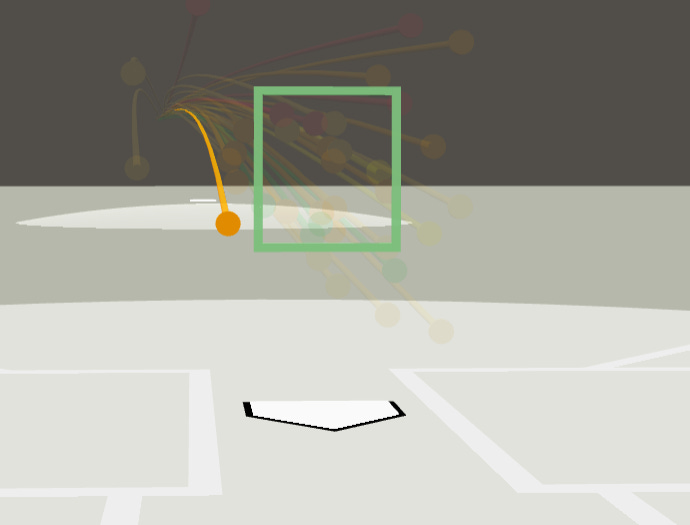
Spring training is held in the arid Sonoran desert, and the atmospherics will have some explanatory power for differences in pitch shapes. But this will be something to watch as King returns to Petco, and seeks to return to form.
The most intriguing member of the starting rotation in 2026 is its de facto number three starter Randy Vasquez. That’s because he sustained a change throughout spring training that he first showed at the end of 2025. Through August of last season Strandy was consistently throwing a low-90’s fastball with his 4-seamer and sinker both averaging 93 MPH, and only using each pitch ~20% of the time:
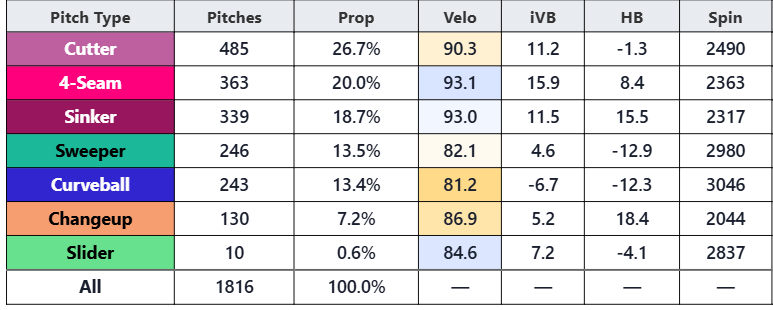
Being unable, or unwilling, to establish a fastball increases the level of difficulty in getting hitters out with off-speed and breaking pitches.
But late last year something started to change. Vasquez was optioned to AAA on August 16th, and when he returned September 6th, he looked like a different pitcher, at least by the pitch metrics. From his return to the Padres September 6th, and through the final five appearances of the season, Vasquez showed legitimate major league fastball velocity with a significant uptick in usage:
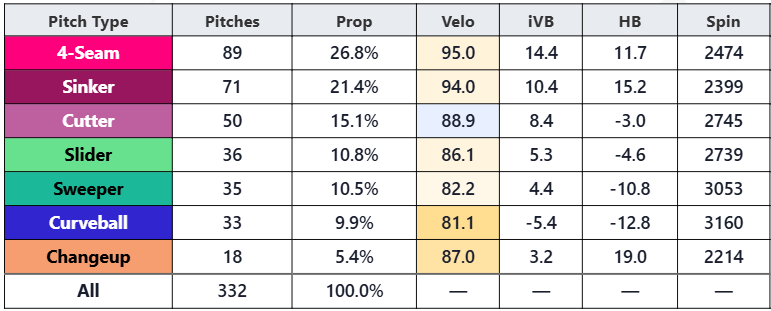
In about three weeks he added two MPH to his heater.
In his final appearance of the season September 28th his average fastball velocity was ~97 MPH, a ~4 MPH bump, and he upped his fastball usage to 68%:
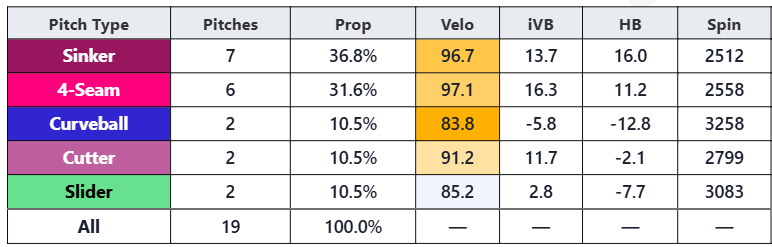
At the time this was just something of a late season oddity. But his performance in spring training showed that the change was durable:
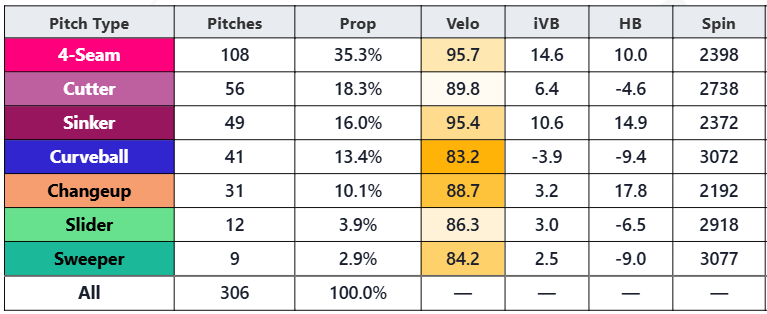
Through five starts in spring training Randy Vasquez maintained an average 4-seam and sinker velocity above 95.4 MPH, more than a 2 MPH increase from his averages before his fateful mid-season tune-up in AAA last year. It’s hard to think of a similar mid-season performance improvement.
Perhaps more than any pitcher we’ve ever analyzed, Vasquez’ success has been difficult to understand. His outcomes have exceeded what models predicted based on his underlying stuff throughout his career. Some of that was attributed to his large pitch mix that keeps hitters guessing. But voices in the organization have always highlighted that he’s a fierce competitor. Not prone to lapses in concentration, always fielding his position aggressively, and never giving in to the pressures of high leverage moments. Finding ways to be successful that just aren’t inputs to quantitative models. These latter points are non-falsifiable statements. Impossible to verify. But there are clues that suggest something like that is part of his makeup. In spring training Vasquez dialed up the average velocity on his 4-seamer to 96 MPH in two-strike counts:

He topped 96.5 MPH nine different times in two strike counts. He wasn’t just using the fastball to set up his offspeed/breaking pitches:
That’s just heat.
Randy Vasquez still isn’t a ‘flame thrower’, but it’s much easier to become a number three starter with major league fastball. And nothing he did this spring suggested his late 2025 velocity improvements were a flash in the pan.
Vasquez is being counted on to pitch as a number three starter for a team with playoff aspirations. A year ago that would’ve seemed laughable. It’s now at least plausible.
Questions Unanswered
It’s fair to say that we’ve left the very biggest question marks on the team unexplored: who will take hold of the fourth and fifth spots in the rotation? This is undoubtedly the team’s most glaring weakness as the season starts. But the thing is, that will hardly matter if the Padres top three starters aren’t up to the task that’s been handed to them. The Padres will pitch all three of Pivetta, King, and Vasquez in the opening series that starts today.
The long winter is over.
Who is this Dylan guy? Bring back Archi!
One other variable to the season- maybe the biggest- who buys the team and what, if any impact that will have on the in-season budget.