
The Upper Bound
How Good Is the Best Version of the Padres?

The baseball season is the longest of any sport. Across 162 games impressions form of what a team is, and inevitably those impressions bleed into single-game forecasts. But that impression is illusory. In reality a team is never the same night-to-night. The starting rotation cycles, injuries mount, game scripts shift, and managers conserve fuel to survive the trek to October.
That changes in the postseason. Suddenly, the rationing is over. And though 162 games seems like enough to have tested every permutation, a bizarre truth stands out about the 2025 Padres: not once did they field their best possible version. Until now.
The Offense
A shocking amount of the 2025 season was spent with the offense out of sync. Jackson Merrill suffered three separate IL stints, Xander Bogaerts missed a month with a fracture, Jake Cronenworth missed nearly 30 games. Fernando Tatis Jr, Luis Arraez, and Manny Machado all suffered through the worst slumps of their careers. Gavin Sheets emerged as the season went on, but entered as an unproven entity, only earning trust as an everyday player in the waning months. The best version of the Padres undoubtedly includes the presence of each member of this cohort. But they only took the field together a total of 72 games. Far less than half the season. The team fared a decent 40-32 when they all played:
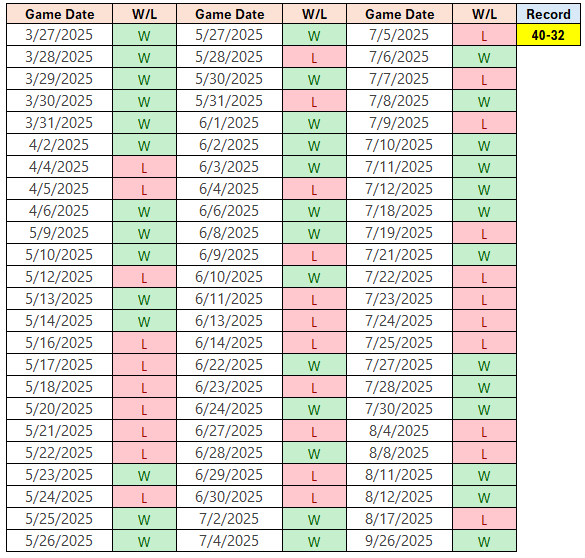
But in many of these games the lineup included Martin Maldonado, Yuli Gurriel, Oscar Gonzalez, Trenton Brooks, Tyler Wade, Jayson Heyward and other wayward players who will be spectators in October.
Ryan O’Hearn and Freddy Fermin were late additions and will assume a spot in the best version of the lineup in the playoffs. But there were only four games all season in which all nine of the best hitters took the field together:
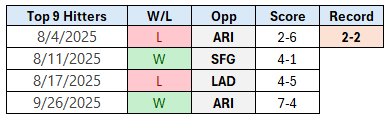
This is not much to go by. But you don’t need a large sample to understand that O’Hearn and Fermin are superior hitters to those that they replaced. And across the final weeks of the season Jackson Merrill, Fernando Tatis Jr, and Xander Bogaerts showed no signs of any lingering effects of the injuries that marred earlier parts of their seasons.
Bogaerts’ final home run of the regular season Saturday was not a typical home run.
This ball had a 110.1 MPH exit velocity and a 31 degree launch angle. This was the first time he’s hit a flyball >110 mph with >30 LA since 2022. Not many hitters ever hit a ball that well. Fresh off the IL there were questions about how his swing might be affected mechanically by lingering pain from the fracture in his front/plant foot. It’s impossible to hit a ball that well with impaired mechanics. He’ll be wearing a guard over his left foot, but he put any questions about his mechanics to rest with one swing.
Jackson Merrill had a torrid start to the season with a 1.046 OPS in March/April before a hamstring injury caused him to miss a full month of games, followed by the cascading IL stints for a concussion and ankle injury which kept the offense from ever firing on all cylinders.
John Gennaro published a fascinating look at Merrill’s injury-plagued season on Section 1904 (available to subscribers only, but worth every penny) in which he noted that in games when Merrill was not either playing with an injury that would soon land him on the IL, or essentially playing rehab games at the major league level when coming off the IL, he looked very much like his 2024 self:
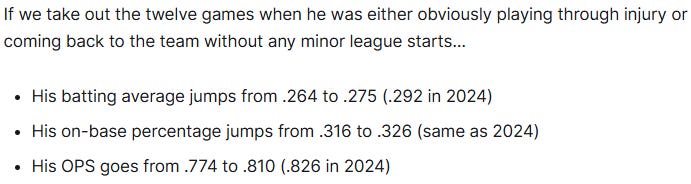
Merrill has finally found a prolonged stretch of good health. And it’s probably not coincidence that across the final month of the season he put up a .946 OPS with a slash line of .275/.320/.626, and a return of the all-fields power he showed during his precocious rookie campaign:
Gennaro published an equally interesting look at the season of Fernando Tatis Jr., asking Is 2025 the best season of Tatis’ career? (no subscription required). Despite the offensive struggles Tatis has weathered, Gennaro notes Tatis has had a marvelous season in several ways:
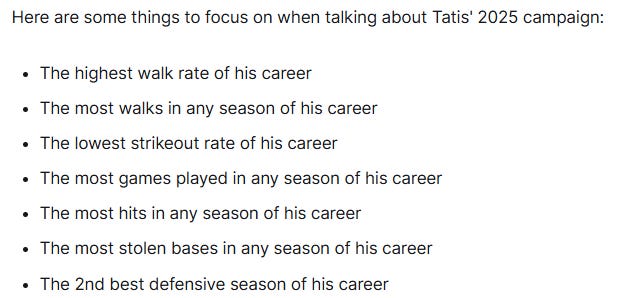
The article was published September 15th, but the final two weeks of the season offered an interesting coda to Gennaro’s query. The only thing keeping 2025 from clearly being Tatis’ best season was the decreased power production that marked much of the season. In late August Eno Sarris and Dennis Lin had traced some of Tatis’ power outage to his swing path, specifically that he had spent the season allowing pitches to travel further before making contact than in years past. Statcast tracks this tendency with the stat Y-Intercept.
The Y-intercept is how far out in front of the plate the point of contact with a pitch is. This is important for power hitting because bat speed increases as the bat head travels through the swing path, and becomes more oriented for pull and loft the further out front the point of contact is. Making contact out in front of the plate is unquestionably the best approach for hitting home runs, with the ideal Y-intercept being close to 36 inches. Here is the average swing path Tatis had from opening day until Gennaro’s article was published:

Tatis had been letting the ball travel further than the average hitter all season, and had a lower attack angle and opposite field attack direction as a result. And it’s fascinating to look at the changes in his swing path after the article making the case he was having the best season of his career even without the power from previous seasons:

The dramatic changes in swing path across the final two weeks were accompanied by a vintage Tatis slash line of .324/.378/.588 with three home runs.
An at-bat from the final series of the season, on the last night for the Padres City Connect jerseys, is worth highlighting. Because the swings Tatis took were a clear departure from those that were the focus of Sarris and Lin’s examination. Facing Zac Gallen with the bases loaded Tatis took four swings in one at-bat that were clearly pull oriented and an attempt to meet the ball out in front of the plate. And Tatis stuck with this approach even when the count reached two strikes:
You can see how far out in front of the plate the the point of contact is:
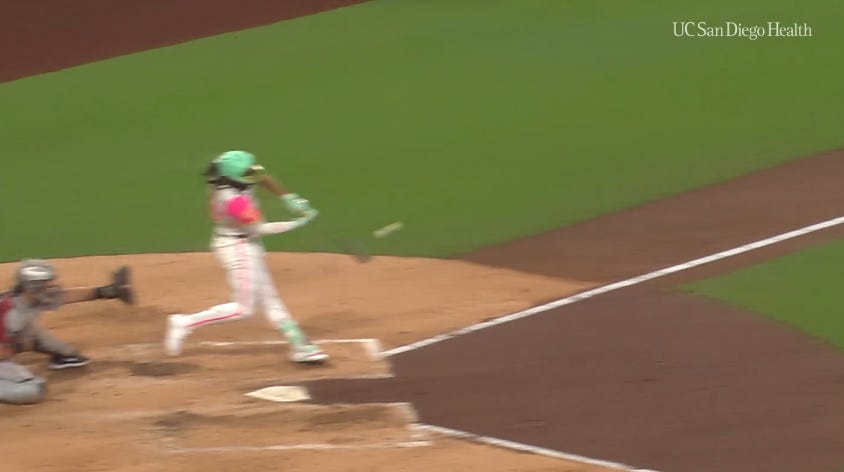
Tatis would take this swing the very next night:
This ball was not only pulled, but hit 109.6 MPH with a 37 degree launch angle. This will be a home run no matter the park, no matter the altitude, no matter the weather conditions.
Tatis’s swing path and point of contact across the last week of the season is simply remarkable:

This is a transformation. This is a swing path nearly perfect to maximize power.
Tatis’ season at the plate has been the focus of much concern, and was likely affected early on by playing through injury. His early season swing path showed that in fact, for much of the season, he was a different hitter than years past. But the final weeks showed something different. Something familiar.
Tatis’ season has a bit of symmetry with Merrill’s: an incandescent start with a 1.011 OPS in March/April followed by months marked by diminished power production and slumps. But he finished strong with a .900 OPS and a slash line of .293/.352/.549 in September.
Despite the aggregate season statistics suggesting the 2025 Padres offense is a weak point, a closer look at the team it is likely to field this week suggests that one should keep an open mind. Still, it’s fair to say the team was able to achieve 90 wins and a playoff berth despite the tentpole stars being out of sync much of the way. And the other side of the ball is where the Padres have shown consistent strength all season long.
The Pitching
The Padres starting pitching in the playoffs will revolve around Nick Pivetta, Dylan Cease, and Michael King, with Yu Darvish likely to be the late man in the rotation. And while during the regular season starters are asked to provide length to spare the bullpen too much mileage, the rules are inverted in the playoffs. The Padres bullpen will be taking more innings across the sudden death short series.
The Padres first half was buoyed by incredible production from the four horsemen: Jason Adam, Jeremiah Estrada, Adrian Morejon, and Robert Suarez.
Jason Adam will not be playing in the postseason due to a season-ending quad rupture September 1st. But as transcendent as his season was (65 appearances, 1.93 ERA), the Padres were uniquely suited to endure such a loss, the reins of the vacated mount passing seamlessly into Mason Miller’s hand. A one-of-one:
Video Courtesy: @PitchingNinja
Adam’s loss was enormous, but it’s reasonable to think that with Miller the team still has four horsemen. The pacing of the 162 game season demands a smart rationing of resources, and as such there were very few instances in which the Padres asked for appearances from four of their horsemen in the same game. Only nine times all season. But the results are interesting:
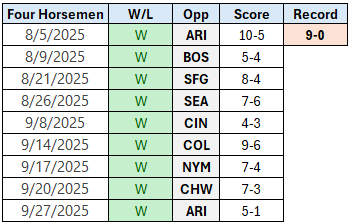
It’s not a surprise that all nine games in which the Padres pressed the full weight of their bullpen advantage came after the trade deadline when they briefly expanded their ranks to five. But it’s notable that the final month of the season, after the terrible loss of Adam, is when the team pressed its advantage the most.
There’s always noise within a small sample. But it’s a mistake to think there is no signal here. The Padres bullpen is a point of differentiation. The small sample was a necessary byproduct of the incredibly long season, but the season isn’t long anymore. It’s terrifyingly short. There won’t be any rationing. They’ll be playing as though there is no tomorrow. Because there isn’t.
The Padres will be pitching only their best starters, primarily Pivetta, King, and Cease. But they will be managed differently. Dylan Cease’s struggles successive times through the order have been the biggest contributor to what looks like a down season. Michael King is still playing back into form after missing most of the season with injury and threw only 49 pitches in his final outing of the season. But neither will have to go 6+ innings or three times through the order. The bullpen will be called on, and it’s interesting to look at how the team fared this season when one of Pivetta, Cease, and King started a game in which at least three of the four horsemen pitched in relief:
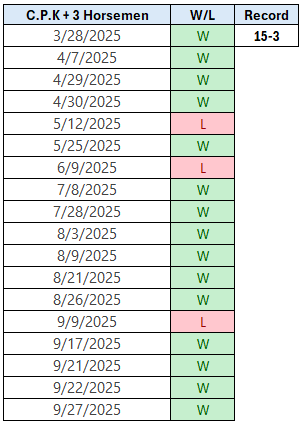
If the Padres can win 13 more games they will be world champions.
The Best Version
There were only six games all season in which one of the Padres three top starting pitchers, three or more of the four horsemen, and all of Tatis, Machado, Merrill, Bogaerts, Cronenworth, Arraez, and Sheets all took the field together:
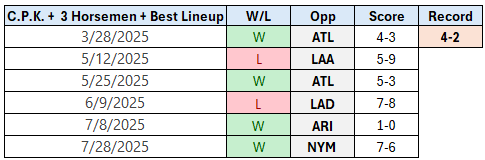
The two losses were at home against the Angels on May 12th when the Padres led 5-3 entering the 9th, but Robert Suarez had a rare bad outing blowing the save followed by Alek Jacob letting the Angels run up the score. In the June 9th loss the Padres battled the Dodgers to a standstill through nine innings but with Jason Adam unavailable having pitched the two prior games, they had only Wandy Peralta still available and he gave up two runs in the top of the 10th letting the Dodgers pull ahead. The chain broke at the weakest link.
The six games in which the Padres put out the best version of the lineup with one of their best starting pitchers, and used three or more of their best bullpen arms included four wins, and two losses in which the Padres were favored to win entering the 9th inning.
Yet To Come
While the six games above likely represent the strongest combination of players the Padres put on the field during the regular season, all six games came before the trade deadline. Ryan O’Hearn and Freddy Fermin will be taking the at-bats that were occupied by the wayward AAAA cohort in those games. Jason Adam’s role has been filled by Mason Miller, and it’s not a knock on Adam to say that Miller is likely the superior player. And this implies that, despite the longest regular season in all of professional sports, at no point in 2025 have the Padres played a game in which the very best version of the team was on the field. These are the players likely to see action in game 1 of the Wild Card series Tuesday against the Cubs in Chicago:
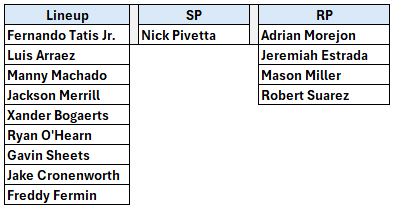
If they all play, it will be the first time the Padres have used all of their best available players in a single game in 2025. And that is reason to hope that for the 2025 Padres, the best is yet to come.
Wild Card
The playoffs are structurally different than the regular season, and teams will structure themselves differently as a result. And this limits the regular season’s predictive power of the upper bound of the very best version of a team. Indeed, the very best version of a team may not have even seen the field until the postseason is underway. But baseball is a stochastic sport. And no matter how good the best version of a team is, victory can never be guaranteed. In this way baseball shares common ancestry with poker or blackjack. To some degree, no matter the skill of the players, their fate depends on fortune. In the playoffs every team is a wild card. They have to believe they can win a game they can’t fully control. They have to keep the faith.
Keep the faith.
Just praying Cease can see a hypnotist before his start tomorrow. And that if he does manage to survive the first trip through the order that Shildt doesn’t think that means he should pitch the second. Go Pads.
Wanted to post a picture, but not sure how to do that. I calculated wOBA vs xwOBA for the series for the teams, weighted by balls in play. Seemed to confirm what I was seeing:
CHN: wOBA: .315 xwOBA: .298
SDN: wOBA: .245 xwOBA: .324
Some of that is probably better defense, but seemed like the Padres kept putting balls in locations where a great defender could snag them without any offsetting balls by Chicago.
Frustrating series. Also, Tatis seemed almost spaced out in Game 3 in addition to surprisingly weak PA's.