
Trust
Redemption Arc

Thursday night saw a stomach churning barn burner against the Rockies. One of the longest games at Petco in recent memory ended in spectacular fashion. This game will undoubtedly, and deservedly, be remembered as the game Xander Bogaerts etched his name in Slam Diego lore with a dramatic walk-off grand slam to end the latest battle of attrition between the Padres and the dread pirate Rockies in the bottom of the 12th inning. But this was a watershed game for another reason. One long overdue. It was a game that showed a sea change in the way the organization views Luis Campusano: Not as a project, but as a major league contributor.
Lost Season
Campusano spent time on the major league roster in 2025, but it’s not accurate to say he was given a chance to make an impact. His longest stint with the club was from May 24th to June 16th, but in that time his role was severely limited. The Padres played with three catchers on the roster the entire stretch, and Campusano’s role on the team was break glass in case of emergency only. At one point Campusano got only a single at bat across a 13 day stretch from June 1st to June 13th, with the lone appearance coming in garbage time in a victory against the Dodgers who had Kike Hernandez clowning around on the mound during an 11-1 blowout. Campusano spent most of the season breaking offensive records in AAA, but without a clear role in the club’s future.
To start the 2026 season Campusano was given a vote of confidence as the team’s backup catcher, his role having been to spell starter Freddie Fermin every few days in the early part of the season. But Thursday night was different.
Trust
The Rockies had battled the Padres to a stand-still Thursday night with the score tied 1-1 entering the bottom of the 9th. With two outs, Ty France reached first base on a walk. Starting catcher Freddy Fermin was due up to bat, but the Padres opted to lift Fermin for pinch hitter Miguel Andujar in a situation where an extra base hit might win the game. While Andujar undoubtedly provided an incremental increase in the likelihood of a game winning extra-base hit, the most likely outcome was still that the game would enter extra innings, and lifting Fermin meant Luis Campusano would be trusted with finishing the game, doing so in ultra high leverage situations should the game move to extras. Indeed Andujar, although he hit the ball well, would fly out to right field sending the game into extras. And Campusano started the 10th inning behind the plate with the Rockies getting to start each inning with a runner in scoring position.
This was a move that would’ve been unthinkable in 2025 when Campusano barely saw the field in any capacity. Since the advent of the Manfred Man in extra innings, every mistake and imperfection is magnified because of the increased leverage on the game. This is usually the time when teams deploy defensive replacements, thereby reducing the chances of a defensive deficiency being fatal. The Padres electing to take a small incremental advantage on offense in exchange for Campusano replacing Fermin in extras implies a shifting attitude towards Campusano’s role with the team.
With baseball being baseball, a big moment found Campusano almost immediately in the top of the 10th. Jeremiah Estrada had been brought in to hold the line for the Padres. The first hitter for the Rockies was Jake McCarthy who elected to sacrifice bunt the Manfred man to third base. This is when catcher defense becomes magnified, because a wild pitch or passed ball leads to a run. And Campusano availed himself well when Estrada spiked a splitter on a 1-1 pitch to Brenton Doyle:
Campusano athletically smothered the errant splitter. This doesn’t really show up in the box score. This was one of those small, but significant moments.
Despite the solid defense, the Rockies would eventually score in the inning, and take a 2-1 lead into the bottom of the 10th.
With Campusano now in the game, he was the Manfred Man to start the bottom of the 10th. This is where Craig Stammen would have loved to have another catcher so he could pinch run for Campusano, one of the slower runners on the team. Jake Cronenworth led off the inning with a clear assignment… move the runner.
His attempted sacrifice bunt wasn’t executed well, a little too hard and towards the pitcher on the third base side of the infield. Campusano, running hard on contact, was thrown out easily at third base. The fault was not with Campusano. Even a faster runner like Bryce Johnson would have struggled to reach third base safely with the ball put in play as it was.
Fortunately, the Padres mounted a mini rally with Fernando Tatis Jr. hitting a single in the next at bat, and after a walk to Jackson Merrill, Manny Machado would hit a sac fly that tied the game 2-2.
The game would move into the 11th inning, when Campusano’s next small-big moment came on the second pitch of the inning. With the count 1-0 on former Padres catcher Brett Sullivan, Campusano challenged a call on a pitch on the inside corner that the umpire called a ball, which would have sent the count swinging heavily in the Rockies’ favor with the game very much in the balance:
Campusano judged correctly, the pitch just nicked the lower inside corner of the strike zone. Now the count was 1-1, instead of 2-0… This seems insignificant, but the change in count leverage from 2-0 to 1-1 meant a swing in win probability of 2% in the Padres favor. It’s counterintuitive, but this is very impactful. A 2% increase in win probability across a 162 game season is a difference of about 3 wins. Of course, a former Padre was at the plate, and Brett Sullivan put up one of the finest at bats of his career, fouling off multiple well located pitches from Estrada before finally catching up to a high 4-seam fastball and lining a double down the right field line to once again give the Rockies the lead.
Estrada would walk the next hitter putting runners on first and second. With the count 0-1 to TJ Rumfield, Estrada would throw another splitter in the dirt that Campusano expertly smothered once again:
Estrada would find the zone with his next two pitches and managed to strike out Rumfield on a splitter low in the zone. David Morgan was brought on in relief and faced Willi Castro. Morgan fell behind 2-1. On the fourth pitch of the at bat Morgan missed just inside with a sinker and Campusano again challenged the pitch:
In this case the challenge was unsuccessful, the pitch was found to be 1.4 inches off the inner half of the plate. But this was an excellent challenge nonetheless. The human brain is not capable of total precision on close pitches, and as we’ve written about there are certain instances where a challenge should be nearly automatic if it’s close, even if there is low confidence in an overturn. This was one of those instances. There is enormous leverage on a swing in the count from 2-1 to 3-1 vs 2-1 to 2-2. Here are the differences in batter’s outcomes on the two different counts in 2025:
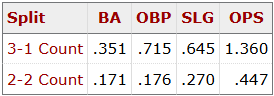
Campusano’s challenge on a close pitch had the potential to swing the outcome of the at bat enormously. Additionally, the Padres were nearing the end of the game, and had three challenges. You can hear at the end of the clip above that it’s announced the Padres had two remaining challenges after the unsuccessful attempt. The umpire actually had to call time because the Rockies bench was questioning this after the ABS call:
But, in fact, the Padres did have three challenges because each team is awarded an additional challenge in extra innings even if they are not out of challenges when the ninth inning ends. A team should have a much lower confidence threshold to challenge calls if there is high leverage and they have multiple challenges remaining in extra innings. Thus far MLB catchers have had a challenge success rate of ~60%:
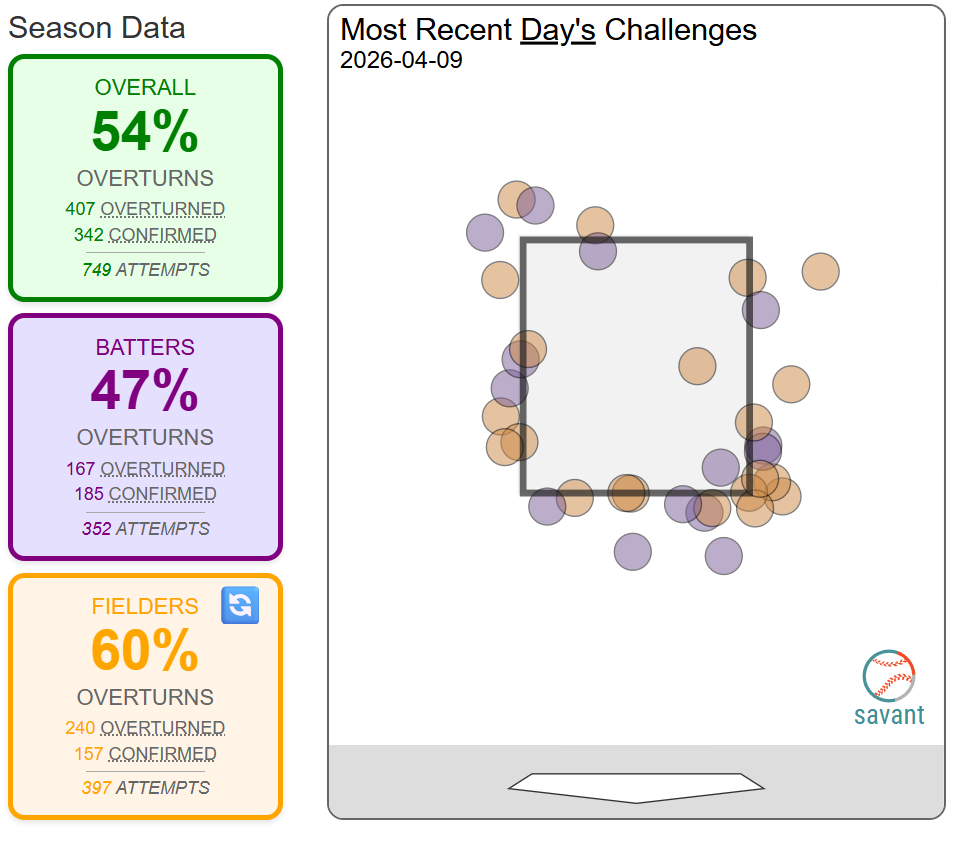
When faced with extra innings and a surplus of challenges remaining, catchers should be challenging high leverage pitch calls that are close even if their confidence is less than 60%. This was good process irrespective of the outcome.
David Morgan would dig very deep on 3-1 with an outstanding curveball that caught the zone for strike two. He would follow up with his best pitch of the night, another curveball that broke sharply under the swing of Castro for strike three, ending the Rockies threat:
In the bottom of the 11th with the Rockies clinging to a 3-2 lead, Gavin Sheets led off with a single to shallow left:
Xander Bogaerts, now in the role of the Manfred Man, was being waved in to score by third base coach Bob Henley, but he pulled up as he rounded third base. On replay, it was probably a wise move by Xander to hold at third base. Still, it meant the Padres were going to need another hitter to step up and get the run home.
Nick Castellanos was up next and continued to show that he retains the ability to turn on a pitch pulling a sharp line drive, but it was snared by Rockies third baseman Kyle Karros. Craig Stammen then made another aggressive move, bringing Ramon Laureano, who had been given an off day, in to pinch hit for Bryce Johnson. With runners at the corners and one out, Laureano took aggressive swings, but ultimately fell victim to an outstanding 1-2 changeup from Brennan Bernardino that vanished on the way to the plate:
Suddenly the Padres were down to their last out. Luis Campusano came up to bat as the Padres final hope. Campusano had not batted early in the game. But he came to the plate ready to hit in do or die time. Bernardino had started every at bat in the inning with a fastball. And indeed, Bernardino tried to get ahead of Campusano with a first pitch cutter. But Campusano ambushed it:
Campusano tied the game with a line drive double to left field. The Padres had their reprieve.
The Rockies would escape thanks to a fine defensive play from Karros in foul territory to the send the game to the fateful 12th inning.
The Rockies would start the 12th inning with yet another sacrifice bunt, once again from Jake McCarthy:
The Rockies now had the go ahead run on third, and Brenton Doyle was once again at the plate. The Padres elected to pitch to Doyle, and brought the entire infield in for perhaps the most fateful play of the game. Doyle sent a groundball up the middle against a drawn in Padres infield. With the runner on third breaking for home on contact, Jake Cronenworth fielded the ball cleanly and made the necessary perfect throw to Luis Campusano. Despite the stellar effort of Cronenworth, there was still plenty for Campusano to do. With the runner gunning in from third base, Campusano had one chance to get the tag down and prevent the run from scoring. He couldn’t have done it better:
This was absolutely perfect defense. Campusano positioned himself to receive the throw from Cronenworth with his glove already moving towards the runner, and executed an immaculate swipe tag to catch Castro on the hand:
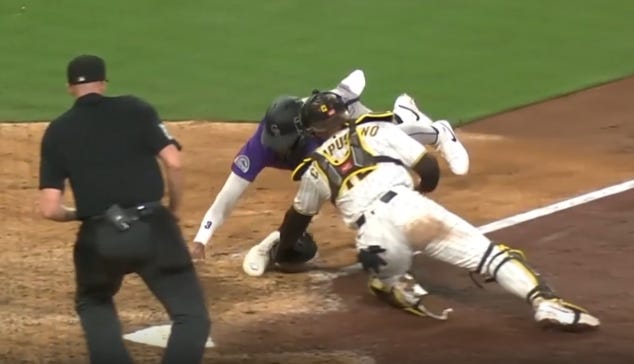
As his glove made contact with the runner he brought his throwing hand down to secure the ball in the glove:
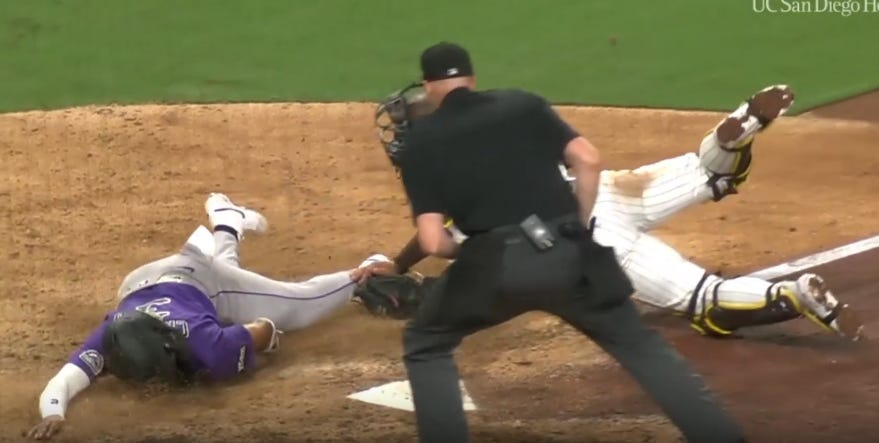
He popped up immediately to show the umpire the ball and stare down the runner at first preventing any attempt at a base advancement. Impeccable.
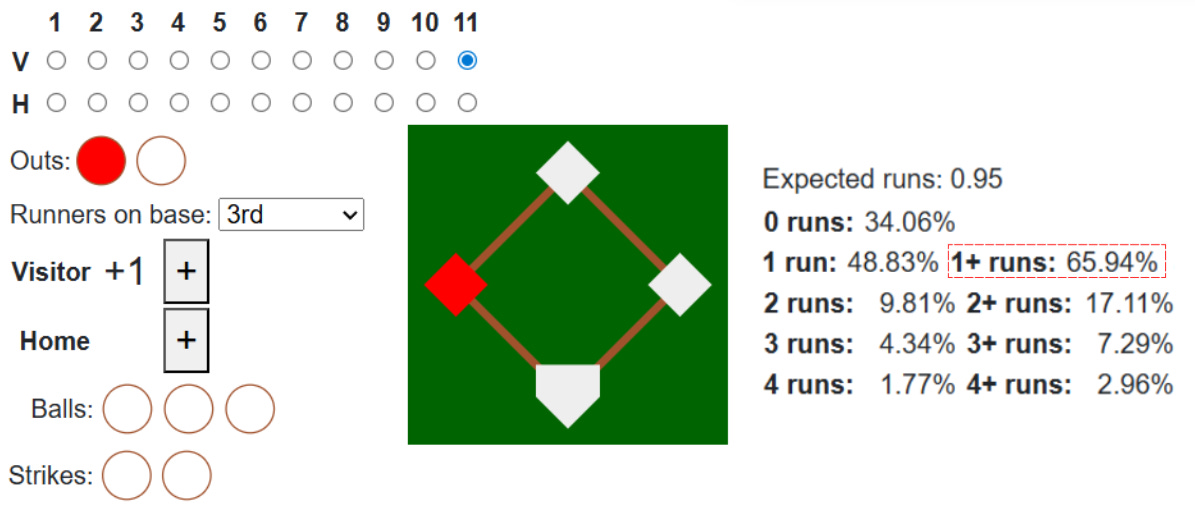
This was an incredible swing in win probability in the Padres favor. Before the play the Rockies had a 65.94% chance of plating at least one run in the inning:
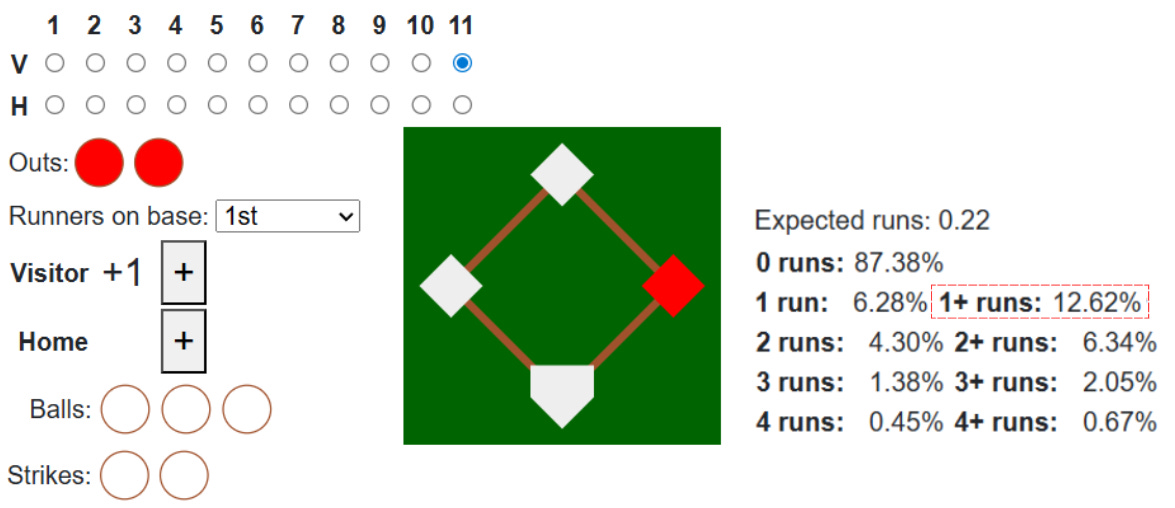
After Cronenworth and Campusano’s defensive clinic the Rockies’ chance of plating a run in the inning dropped to 12.62%:
The Padres would finish the inning with the tie intact, and enter the bottom of the 12th with a chance to walk it off.
In the bottom of the 12th with Cronenworth occupying second base as the Manfred Man, Fernando Tatis Jr. Would execute the fourth sacrifice bunt of extra innings moving the winning run to third:
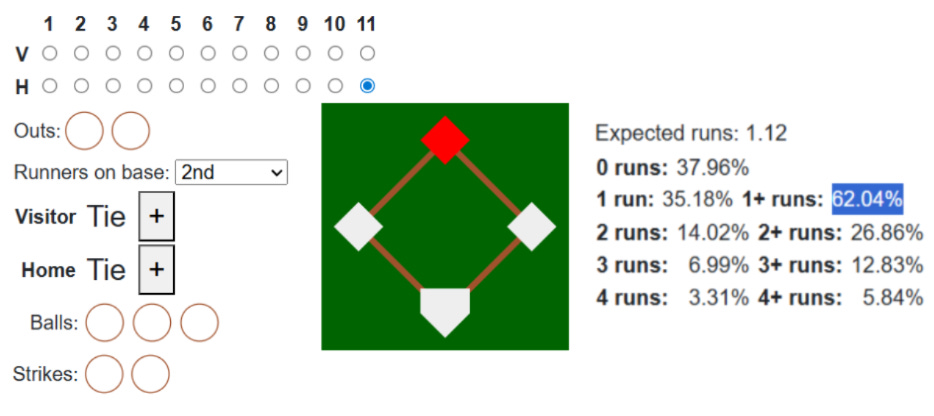
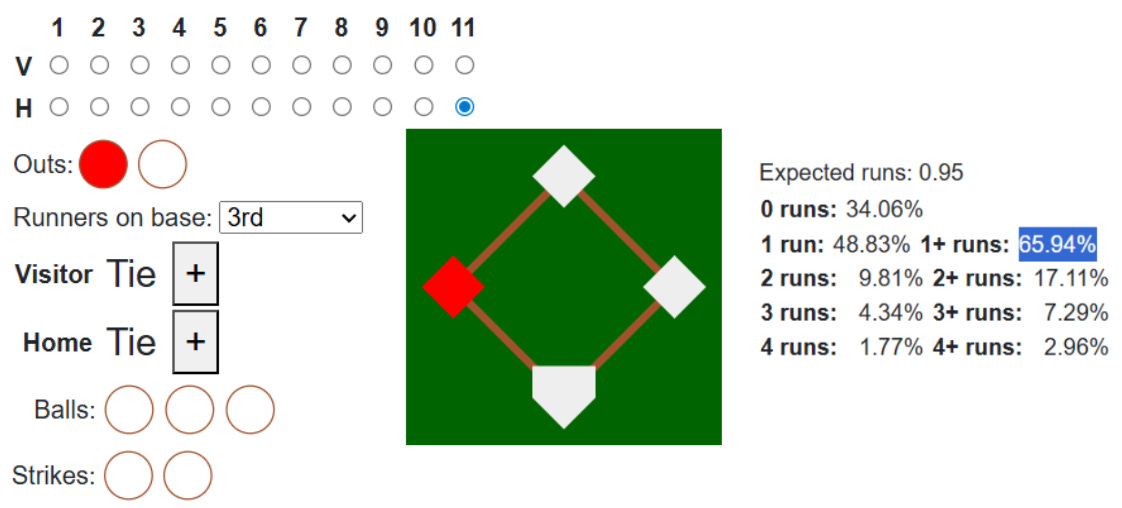
If you’re wondering why both the Rockies and the Padres kept sacrifice bunting, it’s because the play actually incrementally increases the chances of winning the game. Sacrifice bunting leads to less offense over the long run, but specifically sacrificing a runner from 2nd to 3rd base with no outs increases the chances of at least one run scoring from 62.04% by swinging away, to 65.94% by executing the sacrifice:
This isn’t to say Tatis’ move was the strategically correct one. The rest of the context really matters. When Jake McCarthy sacrificed the Manfred Man to third in the 10th and 12th innings, the context was a speedy but weak hitter prioritizing base advancement against a decent reliever. Tatis’ sacrifice represented one of the Padres best hitters giving up an out against one of the Rockies’ weakest relievers, Valente Bellozo who was the seventh Rockies pitcher in what had already been a bullpen game.
But what came next was remarkable, because while the Padres had happily taken the out after McCarthy’s 10th and 12th inning identical sacrifices and tried to pitch their way out of the rest of the inning, the Rockies reacted to Tatis’ sacrifice with the incredible decision to intentionally walk both Jackson Merrill and Manny Machado to load the bases:
Xander Bogaerts stood in against the sinkerballer Bellozo who was hoping to induce an inning ending double play to survive into further extra innings. But Bogaerts was ready. He spit on the first sinker down and out of the zone. On the second pitch of the at bat, he turned on another sinker that caught too much of the zone and hit an absolute no doubter, 108.3 MPH exit velocity rocket to the left field stands that he knew was gone right off the bat:
Don Orsillo was ready too, working in just about every catch phrase in his call of the epic walk off grand slam. Just after the ball landed in the stands the camera cut fittingly to a triumphant Campusano who had truly saved the game for the Padres:
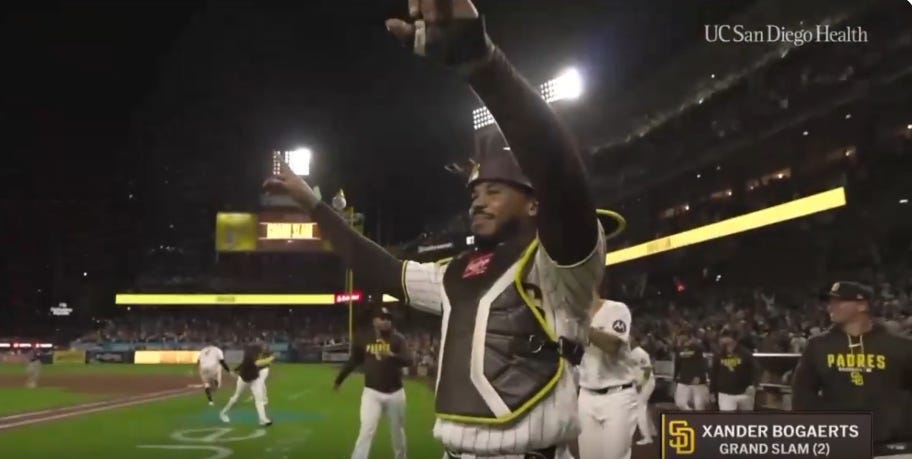
This will rightly be remembered as a transcendent moment for Xander Bogaerts, and a tremendous win against the vexing Rockies who are much improved in 2026. But this was a very important game for what it signaled about Campusano’s development. It didn’t go unnoticed by the players either. Bogaerts mentioned Campusano twice during his immediate postgame interview:
The trust Craig Stammen placed on the shoulders of Luis Campusano, and how Campusano answered his manager’s call was a watershed moment. And Stammen commented after the game that Campusano’s impeccable defensive play was something he’d specifically been working on daily in fielding practice:
And there’s a sense that Campusano’s tantalizing offensive prowess may still materialize at the major league level:
While a player can’t firmly establish himself as a true major league catcher in a single game, a team can firmly establish that they’ve placed trust in a player with a single decision such as the Padres showed Campusano Thursday night. And trust is a prerequisite to a player reaching their potential.
Great stuff as always, this was a phenomenal game with a ton of crucial strategic moments and I was hoping I would see you break it down. Regarding the challenges though, my understanding of the extra innings challenge rules is that you only get an extra challenge in an extra inning if you're out of them entering that inning: https://www.mlb.com/news/abs-challenge-system-mlb-2026. I was surprised when the ump pretty clearly said the Padres had 3 and it only reinforced my perception that he was all over the place, but maybe I'm missing something.
Love the recap.
First of all…”Castro still hasn’t touched home plate.”
Secondly, Jake and Tatis sacrifice bunting is concerning, especially Jake. He had a canyon on the left side of the infield through which he could have gotten a single. Plus, with Campy running, it would take a perfect bunt to get him over. And even if Jake got him over, Campy running takes away the contact play on a grounder and requires a deeper fly ball to score him.
Bad strategy that didn’t optimize win probability given the specific context.