

Obama chuckled. ‘You mean the Chaos Emeralds?’
—Anonymous
Friday’s game was remarkable in that, if it were the only game you’d watched all season, you would likely come away with an understanding of the team as coherent as one brought about by season-long analysis. Not just because it’s the most recent data point, but because the strengths and weaknesses that have emerged across a chaotic season were on full display. And we think the way the team has weathered the tempest implies the strategy AJ Preller should be pursuing across the pivotal next three days. One way or the other, the fate of the team will turn Monday.
Chaos
The Padres starting rotation has been in disarray since the ace of the staff left his fourth start of the season with a right forearm flexor strain. When their Plan B failed after Lucas Giolito proved incapable of providing major-league innings, and Griffin Canning struggled to pitch to even replacement level, we wrote:
The Padres are on to Plan C, hoping to soak up innings any way they can
It turns out the C stands for chaos as the Padres have indeed looked to creative solutions to cover missing innings, with two of the final five games before the trade deadline not having a named starter:
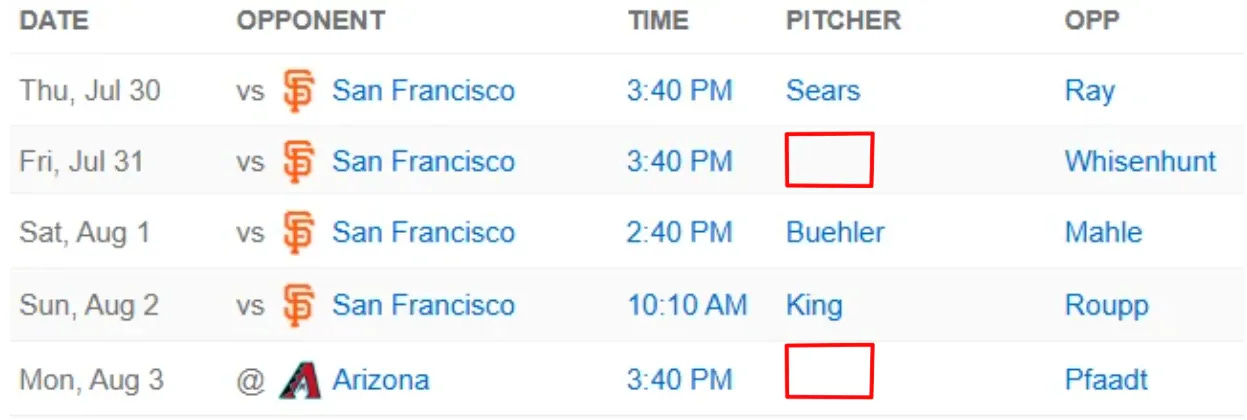
Dennis Lin wrote about the Padres decision to emulate the famous ‘Pitching Chaos’ strategy to fill starts given the depleted starting rotation. The 2024 Tigers famously made an unlikely postseason run when they were down to two starting pitchers by using a combination of openers and bulk relievers to fill starts, deciding who would pitch based on whichever arms emerged rested across the chaos of the previous games.
The Padres were featured on Apple TV’s Friday Night Baseball. The game fell on one of the vacated spots for the starting rotation, and the Padres asked Bradgley Rodriguez, Yuki Matsui, and German Marquez to emulate a Padres starter.
Rodriguez was tagged as opener and faced Luis Arraez to lead off the game. Arraez is healthy and back to performing at pre-Padres level. He hit the fourth pitch of the game well, but fell victim to one of the Padres’ major strengths:
The Padres have elite defense in the outfield with plus athletes at all three positions, and Petco’s penchant of keeping deep balls in the power alleys from leaving the park means the Padres regularly turn would-be home runs and extra base hits into outs which provide box-score invisible leverage swings that are part of the secret to how a team with the worst offense, and one of the worst starting rotations in baseball in the first half of the season managed to remain .500 at the break.
Bradgley Rodriguez’ contribution to the bullpen is also a major reason why enough wins were banked in the first half that the Padres are still in playoff pursuit two weeks into the second half.
Rodriguez showcased exactly how he can be an impact arm for years to come with his pitch sequencing and changeup command to the next two hitters of the night.
His first pitch to Heliot Ramos was a painted 100 MPH four-seam on the outer half that Ramos watched and timed up. He followed with a 99 MPH sinker up and in, and a changeup that again ran in on Ramos:
After buzzing Ramos’ tower in back to back pitches Rodriguez threw the pitch that’s made him effective against both right and left handed hitters.
Home plate is 17 inches wide. This changeup started well off the plate, but had 16 inches of arm-side break and ended up on the outer half of the plate. Ramos froze his swing decision as the pitch was sailing to the plate outside:
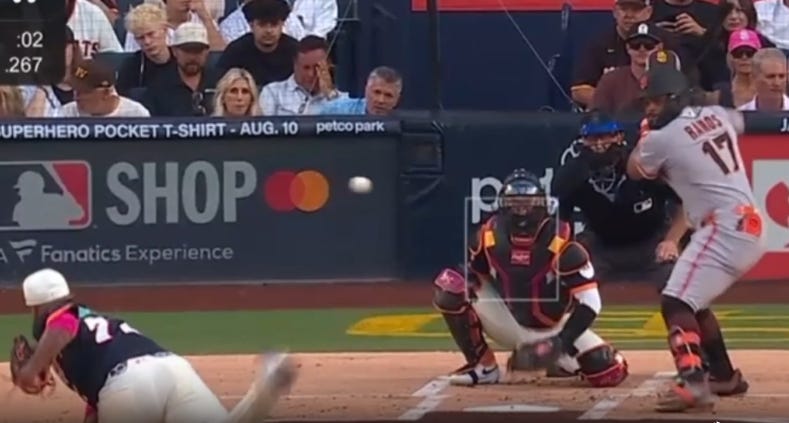
By the time it reached home plate Ramos was staring at a perfect strike:
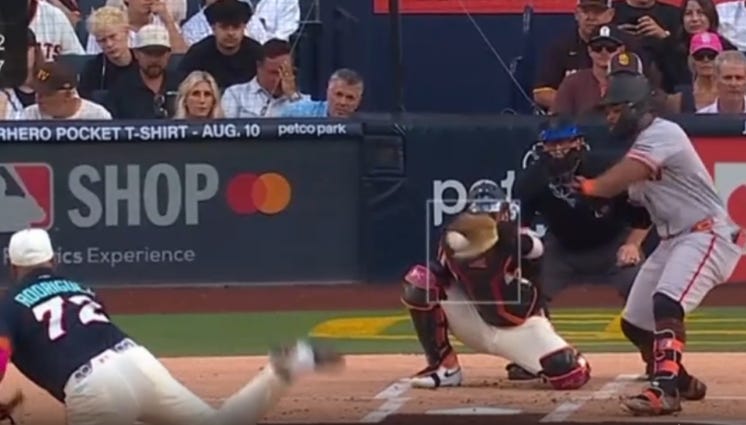
The ability to throw the changeup for strikes against RHH will be one of the differentiators for Rodriguez. When RHH don’t pick up the changeup well, he can then attack multiple parts of the zone with velocity. On Friday Ramos wasn’t seeing Rodriguez well, and he reacted late on the next pitch, a 99.3 MPH four-seamer, for strike three.
The body language from Ramos suggests he was expecting another changeup to dive down and out of the strike zone:
Left handed hitters generally have an even tougher time picking up Bradgley’s changeup, and he uses it differently against lefties to induce bad swings.
Bradgley throws almost exclusively changeups, sinkers, and four-seamers to LHH, mixing his slider and cutter in to RHH ~14% of the time:
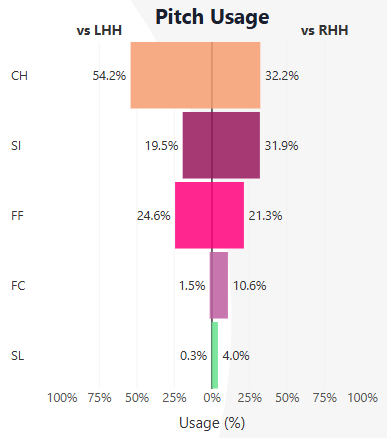
Bryce Eldridge was up next, and got dismantled by the inability to discern the changeup from the fastball:
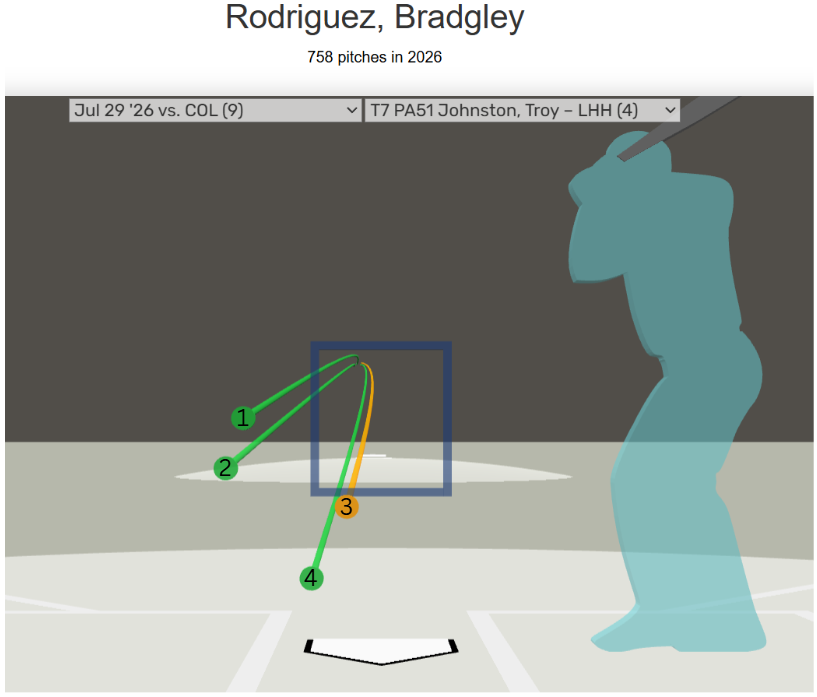
The sequence to Eldridge was typical, and in fact was the identical CH-CH-SI-CH sequence he used to strike out Troy Johnston to help the Padres get out of a jam in his last outing on Tuesday:
You can see how early Johnston is on the first changeup, and after timing up the second changeup out of the zone, Johnston was late on the 98 MPH third pitch sinker. Bradgley then threw another changeup to the exact same spot with identical tunneling to the sinker and Johnston’s timing was out front for an uncompetitive swing-and-miss strike three:
You can see the identical tunneling of the 3rd and 4th pitch, and why this creates such a challenge for LHH who have a harder time detecting the changeup than RHH:
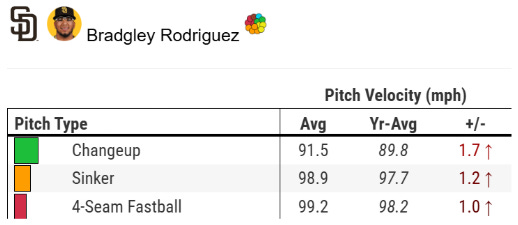
Bradgley Rodriguez is a developmental success story, and his ERA of 2.28 isn’t just smoke and mirrors. His WHIP is 1.14 and he’s struck out more than a batter per inning. When he’s pitched in the 7th-9th innings he’s held opponents to a .185/.254/.294 slash line good for a .548 OPS. On Friday he was advised he would only pitch one inning and he let it rip with all pitches he threw seeing an uptick in velocity compared to his season average:
The Padres have been forced to use him in long relief and as an opener to navigate the pitching chaos, but so long as he’s able to maintain command of his pitch shapes and locate his changeup, he has the stuff to be a knockout middle reliever. He’s best deployed as part of the bridge to the nastiest back end of the bullpen in the league.
The use of openers and bulk relievers to fill the missing starting rotation innings sounds like a worst case scenario, but the one advantage that comes from pitching chaos is eliminating the third-time-through the order penalty. And this is one of the areas in which Padres starting pitchers have been among the worst in the league.
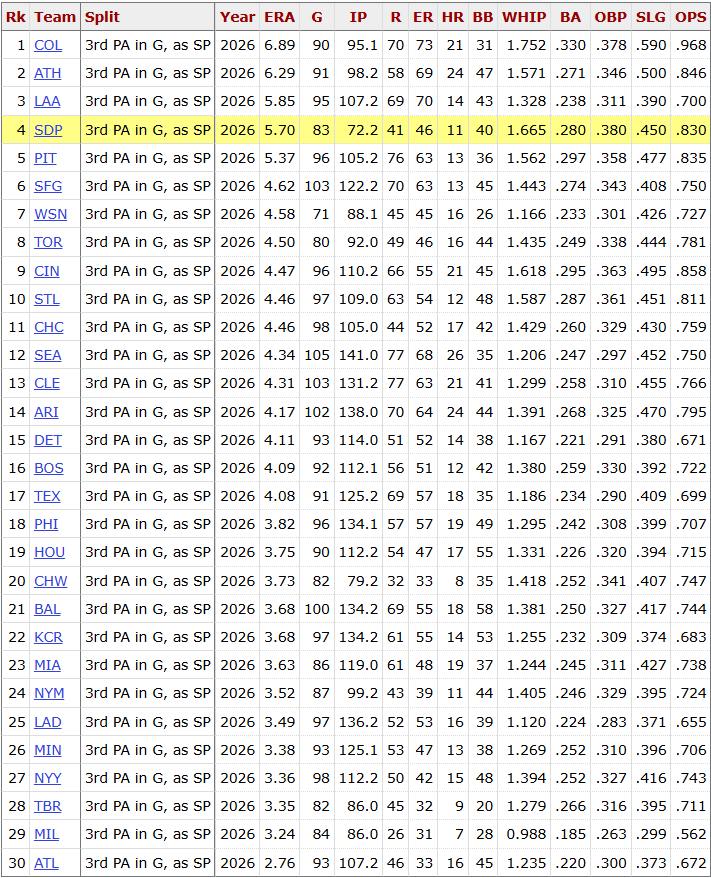
Pitching chaos is absolutely a Plan C, but as Plan C’s go it’s one with at least some precedent for success. Still, addressing the starting pitching situation is unquestionably a focal point of the trade deadline strategy.
Emergent Properties
The Padres half of the 1st started with Fernando Tatis Jr. continuing to hit:
Since the start of the second half, and emerging long before that, Tatis has continued to find his form. Since the All-Star Break Tatis has logged the longest home run in MLB in 2026, and his first career five hit game:
It took Tatis 207 at bats to hit his first home run of 2026. In the 237 at bats he’s had since he’s slashed .305/.371/.488 and hit seven more home runs. You can never definitively say a player is ‘back’, but this is what you’d expect to see if he were.
Tatis would advance to third, and score on a hard hit line drive sac fly by Manny Machado:
Machado has been finding a return to form as well. It took until the last game of the first half to raise his batting average back to the Mendoza line. But he’s been crushing the ball in the second half:
He’s raised his season total to 23 home runs, and on Friday raised his OPS+ above 100. He also discussed the mechanical changes he’s been working through the the Apple TV crew which was shared later in the broadcast.
With the 1-0 lead the Padres would add on thanks to Luis Campusano who continues to rake since returning from the IL in early July:
Notably Campusano started at DH for the first time this season. In April we wrote about the trust the Padres had shown in Campusano’s defense behind the plate. Friday signaled that trust extends to Campusano’s ability at the plate as well.
It simply can’t be overstated how much a healthy Campusano, realizing the offensive potential that made him a prized prospect, would impact the Padres lineup. He looks healthy, and he’s corrected the mechanical changes that derailed his offensive development in 2024. His slash line sits at .306/.409/.510 with a .919 OPS after a productive night Friday.
The Padres would take the 2-0 lead into the 3rd when Jackson Merrill continued to contribute even though the ball wasn’t bouncing his way:
This ball was hit hard, and newly anointed defensive wizard Luis Arraez made a nimble turn that would’ve started an easy double play for the majority of hitters in the league. Jackson Merrill combines elite athleticism with a relentless hustle that let him beat out what seemed like a sure double play.
Campusano followed with his second hit of the game, Merrill’s speed allowed him to advance to third:
Xander Bogaerts followed. This is notable as Bogaerts was hitting 7th, the sixth straight game he’s batted 7th or lower. Xander Bogaerts has struggled at the plate, but much of the consternation around his play is misplaced contract anxiety. He’s been a league average shortstop this season. That may sound like ‘damning with faint praise’, but league average players are very good, a tier below all stars, and two tiers below the player Bogaerts was in Boston. And he’s been worth his contract this year. The problem has been that his struggles at the plate compound the team’s offensive woes when he’s inserted in the heart of the order. There he becomes a liability. At the bottom of the order his .629 OPS fits in with league averages. If he can return to the .720 OPS he put up in 2025, he becomes a plus bat at the bottom of the order. Dropping him in the order is something the Padres can afford with the emergence of Campusano and Ty France. And until Bogaerts gives indication of being in good form at the plate, the team is optimized with him hitting 7th or lower.
Bogaerts would ground to first base, and Rafael Devers caught the ball on the bag which created the opportunity for Jackson Merrill to impact the offense for a second time without getting a hit:
Willy Adames recognized that Devers’ catching the ball while tagging first meant the out at second was no longer a force play, and rushed to tag Campusano running down the basepath. But Merrill sprinted to home in time to score before the tag on Campusano completed the double play.
Merrill struggled at the plate worse than at any point in his career in the first half of the season, but he never stopped contributing to winning. He has elite makeup, and that was no small part of the Padres drafting him in the first round when many felt it was too high.
Merrill didn’t get a hit in this game, but he’s been in far better form since the second half started.
We wrote in the first half that swing path analysis from Baseball Savant suggested he’d made an approach change towards a pull oriented swing, and was clearly struggling with barrel control, fouling off a career high number of good pitches to hit and constantly facing worse count leverage as a result.
Early in the second half Merrill had an at bat that wouldn’t usually be noteworthy because it was off a position player. But the fact that he was able to perfect-perfect a 47 MPH eephus pitch and keep it fair suggested that barrel control hadn’t abandoned him completely:
This was the type of anodyne result a good hitter would be expected to achieve. But Merrill was not a good hitter in the first half precisely because he wasn’t doing the expected damage on good pitches to hit. Regardless of whether this home run was an indicator, he’s been squaring the ball up regularly in the second half:
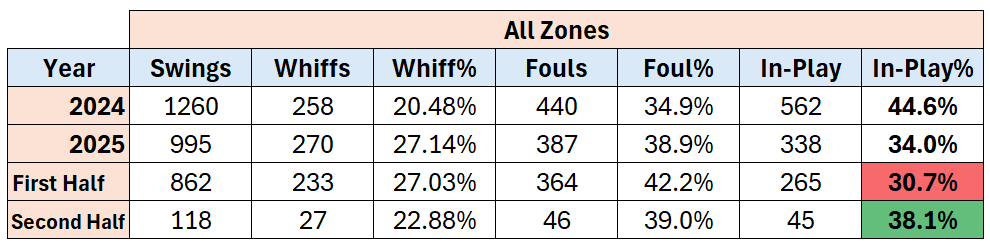
There’s a lot of evidence that he’s found the mechanics to resurface the elite barrel control he showed through the minors and early in his major-league career. He’s cut his whiff rate and foul rate down in the second half and is putting the ball in play much more often:
Importantly, he’s converted the best pitches he’s seen into balls in play as well:

His numbers on pitches in the heart of the zone in the second half reflect that:
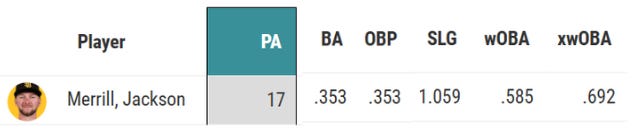
His expected wOBA is higher than his actual wOBA, he probably deserves to have numbers slightly higher than what he’s produced:
Since the start of the second half all three of the team’s most important hitters have looked more like themselves:
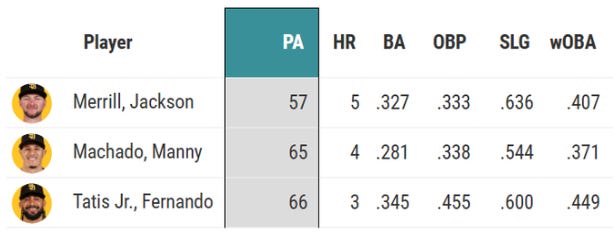
At various points through the season we wrote about the specific struggles Tatis, Machado, and Merrill seemed to be facing. A throughline in all of their struggles was identifiable mechanical or timing issues, none of which implied a permanent loss of form. There was never any reason to think the diminished versions were the new normal. But until you see a return to form, it’s hard to rule it out. There’s now convincing evidence of return to form for all three. No amount of evidence can provide certainty that they’ll be their usual selves going forward, but with three days before the deadline there is reason to think the Padres offense can be good enough to buoy a playoff run. Especially because the offseason addition of Ty France has added another major-league bat.
France came up in the 4th with two outs and runners on first and second. A double steal on a timing play from Tatis put runners on second and third:
France would work the count to 3-1, and when he got a pitch to hit, he lined a 108.7 MPH single to centerfield to plate two more runs. And the rout was on:
Ty France has had a very interesting career. He was the type of hitting prospect that had some GMs thinking he would eventually win a batting title. He never found that form, but he became a major league hitter by adding enough power to hold down a corner-infield position, and even made an all-star game in 2022. But he never developed the consistent 30+ home run power to be a perennial all star either, and in the absence of other another plus skill his career as a corner infielder started to wobble. Before 2025, Statcast named France the worst defensive first baseman in baseball and he took it to heart, vigorously working to improve his defense all season. Remarkably it paid off with winning the Gold Glove for the 2025 season. In 2026, despite playing a part time role early on, France leads MLB in Outs Above Average among first baseman. France is a relentless worker, and he’s transformed himself on the defensive side of the ball. It’s not unreasonable to think that a player capable of transforming himself on defense could also rehabilitate his career on offense. Maybe not to the level of a Silver Slugger, but he’s always had a credible major league bat with stretches of his career where he was plus offensively. A return to just that level of production, an above average bat, would be spectacular for the Padres fortunes. He’s played two thirds of a season in 2026 and is having the most consistent season of his career. He’ll likely surpass his career high in home runs this year. He played most of his career in Seattle in one of the few parks with a claim to be a tougher park to hit in than Petco. The evidence thus far is that his reemergence as a hitter is real. Even if he regressed to his ~.780-.800 OPS peak Seattle years that would help credibly hold down the heart of the order. France is a big reason the Padres are near the top of the league defensively. His signing has been a home run.
France has also honed an unusual hidden skill to help him reach base more frequently. For most of baseball history, getting hit by a pitch was mostly thought of as a pitching statistic. A function of wildness or command. That is part of it. But watching Ty France over the last several years raises an obvious oversight. You can see in his play that getting hit by a pitch is at least partially a hitter skill as well.
Ty France entered the season with 134 career hit by pitches in 3,587 plate appearances, a hit-by-pitch rate of 3.74%. On Thursday night he got hit by a pitch for the 10th time in 2026:
It turns out this was a milestone HBP. Looking at every player in major league history with at least 100 career hit by pitches, France moved past Tommy Tucker into sixth all-time in HBP%:
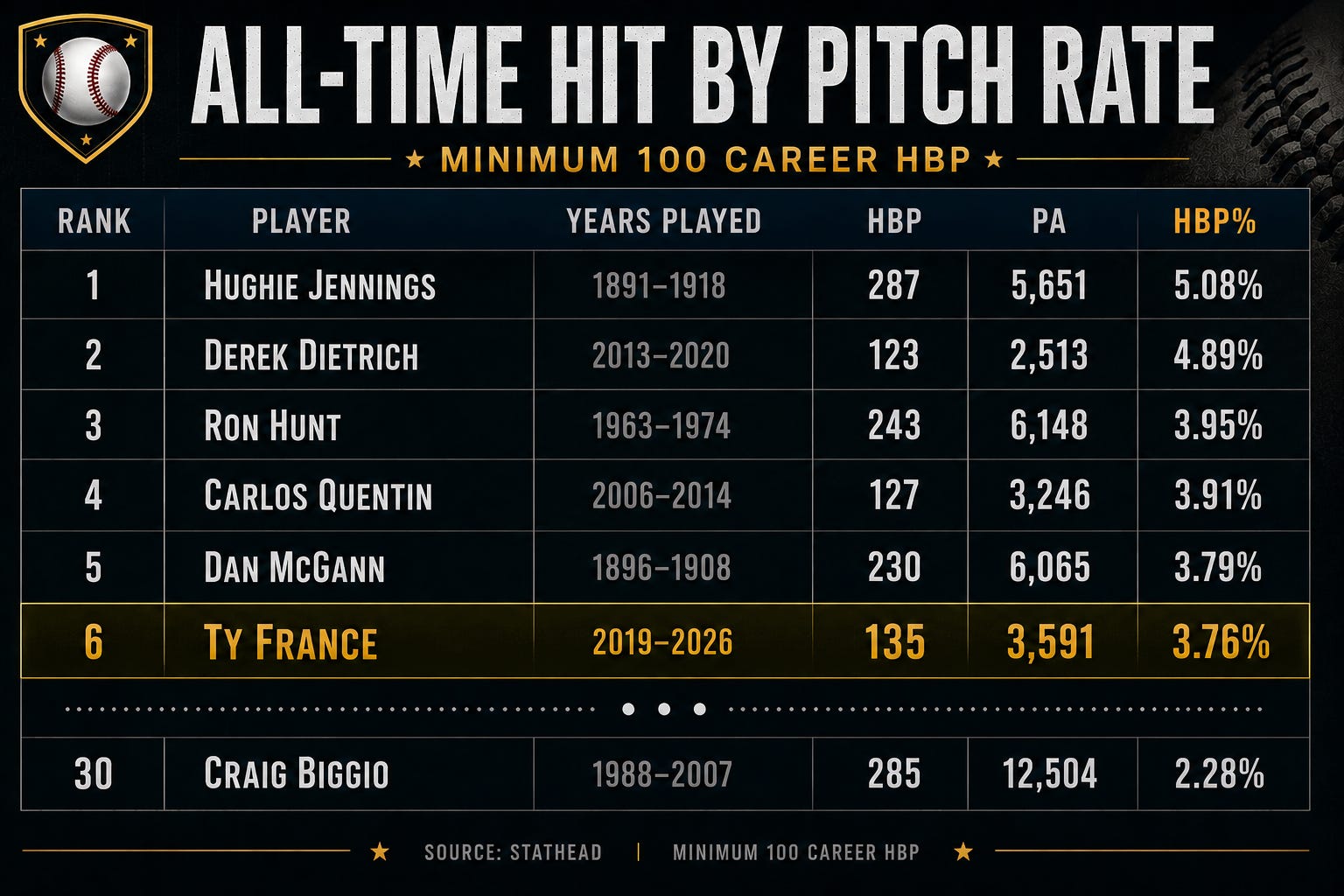
Craig Biggio’s modern record of 285 career hit by pitches came over 12,504 plate appearances, good for a 2.28% hit-by-pitch rate. France has been hit 64% more often when he steps into the batter’s box.
When you watch how France does it, you see that there is indeed a skill involved. Most hitters instinctively jump out of the way of pitches coming towards them, and in the process trade a base advancement for a ball. France does something totally different:
France flinches defensively as hitters do, but he’s very good at getting his critical hit boxes out of the way while moving an armored (by gear or by girth) part of his body into the path of the ball and taking the HBP. How a hitter reacts to a potential HBP is a trainable skill. Some hitters dodge, Ty France parries.
This is an artist at work:
A relentless effort to improve on all aspects of the game is an important part of remaining a major leaguer, and Friday provided another redemption arc of sorts. Jase Bowen was promoted from El Paso in June, and had an inauspicious debut. In his first major league plate appearance he had the misfortune of facing Aaron Nola, owner of one of the best knuckle curves in the league, and the book was out on Bowen after his first at bat:
Bowen would bat again in the 9th inning representing the Padres last hope in a one run game. He faced Jhoan Duran, the imposing closer known for his 98 MPH splitter and 100 MPH four-seamer. Instead Duran threw three straight sweepers. A pitch he throws 9% of the time:
A rookie made to look that bad can be sure that all over the league pitchers start practicing their shuuto’s.
Bowen has been on the field primarily because of his defensive contributions in left, but his long term place in the league will hinge upon his ability to pick up major league spin. That’s part of why his first home run Friday was so special:
This slider wasn’t in a great location to hit, but Bowen picked up the spin, tracked it as it dove out of the zone, and met it perfect-perfect.
Late in the broadcast Manny Machado’s ongoing swing mechanic optimization was discussed by the Apple TV crew. They were mid-discussion of some candid comments offered by Machado when he barreled a double off the right field wall:
Easy power to the opposite field has been one of the aspects that made Machado a special hitter. His performance since the latter half of June, paired with his disclosure that he did indeed make mechanical alterations with a private hitting coach in the offseason, paired with swing path analysis and his comments early in the season that he was working to return to his usual mechanics, capped off with his comments to the broadcast team about finding success, is as much evidence as you could hope for to generate a positive prospectus. The usual rules of uncertainty apply, but it appears far more likely that number 13 is still Manny Machado not Manny Washado.
Fingerprints
Though Jake Cronenworth didn’t play on Friday, his return to the lineup has lengthened it further. He’s put up a wOBA of .329 since coming off the IL, plenty good when combined with the contributions of the heart of the order. More importantly his addition to the infield depth has allowed the defense to optimize, with the Padres two-time platinum glove winner returning to right field. Though Cronenworth didn’t see action, his fingerprints were on the final play of the game when Fernando Tatis Jr. made an extremely hard catch look casual to secure the win:
The final pitch of the game notched German Marquez his first career save, a rare five inning save, and ensured an entire day of rest for the back of the bullpen. This is the best possible outcome a team can find when pursuing a pitching chaos strategy with a depleted rotation.
Balancing Act
The trade deadline is only three days away, and a coherent understanding of the Padres is finally emerging. The revelation is both comforting and sobering. Comforting because the offense has finally begun to resemble the one everyone imagined in March. Sobering because, at the same time, the rotation has revealed itself as the roster’s defining weakness with an uncertain outlook for improvement. The bullpen, and especially the defense, appear to be real strengths. But the bullpen is being taxed by pitching chaos, and while a structure with three points of contact can stay upright, if one of those points fails it will bring the structure down. Offense and Defense can always use upgrades, but the rickety structure most in need of relief is, ironically, the bullpen. The starting pitching has already collapsed, but Dennis Lin reported that Pivetta may not be far from a return and Musgrove may be back in August or early September. The Padres don’t want to bank on their return, but they may have no choice. Acquiring starting pitching at the trade deadline is likely to incur a prohibitive cost.
The Padres are balancing competing priorities. Any trade they make depletes an already modest prospect capital fund. And there are very few additions to be made without mortgaging the future. Bolstering one part of the team likely comes at the opportunity cost of bolstering another. The best balance of these tradeoffs is a strategy that provides maximum resilience against uncertainty, and raises the ceiling of performance in a short playoff series if they can survive through the regular season gauntlet.
The goal is not just to make the playoffs, but to have a chance to win playoff series. Adding reliable but unspectacular starting pitching by trade gives the team the best odds of surviving the remaining turns through the rotation to make the playoffs, but does almost nothing to raise the ceiling of the team once the non-contenders are culled and every playoff opponent will be high quality. Adding a potent bat to the left field platoon adds resilience to loss of form or injury to another spot in the lineup, and raises the odds of success in the playoffs incrementally, but likely forecloses on the possibility of impactful assets on the pitching side given the diminutive war chest. The bullpen is the one part of the team that has lived up to expectations, and it’s tempting to think the team could draw from a strength to address a weakness. Trade a Mason Miller or Adrian Morejon to fill the hole in the starting rotation and maybe even bring back some prospect capital to bolster the future. But the chaos strategy demonstrated that the team is already drawing from that strength to put together competitive games and keep the postseason hopes alive. The bullpen is a strength, but the chaos strategy is taxing it. The biggest unknown is whether Joe Musgrove and Nick Pivetta will return to provide major league quality innings this month. There’s at least some reason to think they will. If they do, it will lessen the impact of any middling starting arms added. If they do not, the bullpen will still be drawn on to cover games.
Solve For The Equilibrium
There’s only one trade strategy that provides the opportunity to both address the team’s biggest weakness, add resilience if that weakness isn’t bolstered by the return of Pivetta and Musgrove, and raises the ceiling in both the final 62 game gauntlet and the postseason. High end bullpen arms are an asset that provide enormous value through the combination of a raised playoff ceiling, resilience against direct bullpen use fatigue, resilience in the event Pivetta and Musgrove can’t return by offering more arms to absorb the chaos strategy, and typically does not cost generational prospect hauls, with Mason Miller being the exception. But Mason Miller is an exception. There is no position player in baseball who can guarantee his team is the best just because he’s on the field. When Mason Miller plays, the team that has him is the best team that inning. If the Toronto Blue Jays had matched the Padres’ offer for Miller they would be world champions12.
Final Countdown
Trying to predict AJ Preller’s next move is a fool’s errand, but we’ve done our best. We’d be shocked if the strategy at the deadline wasn’t some version of ‘Buy’. There’s enough indicators of emerging quality on the Padres to make that a reasonable direction to go. But this team has faced an immense amount of chaos in 2026, and is meeting it in kind. We feel there’s a single strategy that best balances the risks at present, the future value, and the specific weak points of this Padres team. But we won’t be mad if a different course is charted. And we won’t be surprised. A tireless, quixotic GM is endlessly interesting. And baseball is fun. Whatever the next three days hold our position will remain the same as it always has:
Keep the faith.
And go Padres.
Bob Nightengale reported the Blue Jays could have matched the Padres offer for Mason Miller at last year’s deadline, but Blue Jays GM Timothy Horton insists they’re happy with the decision to pass on Miller and hold onto their top prospect Slapdick McGee. Horton told Nightengale: “While Mason Miller is Mason Miller, Slapdick McGee could be anything. He could even be the next Mason Miller.”
For the lawyers, this is a bit.
Turns out he went straight at their most glaring weakness fetching a very good Mize and solid, back end pitcher in Ray. While still unlikely, feels as though if Pivetta or Musgrove are effective (vs. needing both), we have a pretty solid SP rotation to make the playoffs plausible.
Get Weaver, Raley, and Holmes from the Mets to make a superpen. Go full pitching chaos in the postseason. 13 pitchers, no traditional starters. Just openers, starters as bulk guys, and high leverage arms.
Miller, Morejon, Bradgley, Weaver, Raley, Adam, Estrada, Yuki, Hart
King, Holmes, (Pivetta/Randy), (Joe/Buehler)
NLDS vs the Dodgers, do bullpen games every game. Go all out to win game 1 and flip the pressure to them for the rest of the series. Hope their bats come in cold after a week off, get a lead, hold a lead, get the win.